Publisher: Raw Fury
Developer: Dogubomb
Year: 2025
Platform: Windows, PS5, Xbox Series, Switch 2
Rating: 8
While I’m certainly not an adventure game purist, I have never particularly cared for roguelikes. I already have a difficult time with any randomness in my games; the thief in Zork drove me bananas and the random monsters in King’s Quest still anger me. So an entire map that is procedurally generated? Just saying it makes me anxious, so it’s no wonder I was hesitant to give Blue Prince–by first time developer Dogubomb– a chance despite its endless accolades. I needn’t have worried. Dare I say I even found the game’s randomness exciting at times, with no small thanks to the mostly ingenious surrounding puzzles and compelling backstory.
You are a teenage boy named Simon Jones and your eccentric uncle has just died. His will states his mansion is yours…if you can figure out how to enter Room 46, a room that is not only difficult to open, its location is not even given.
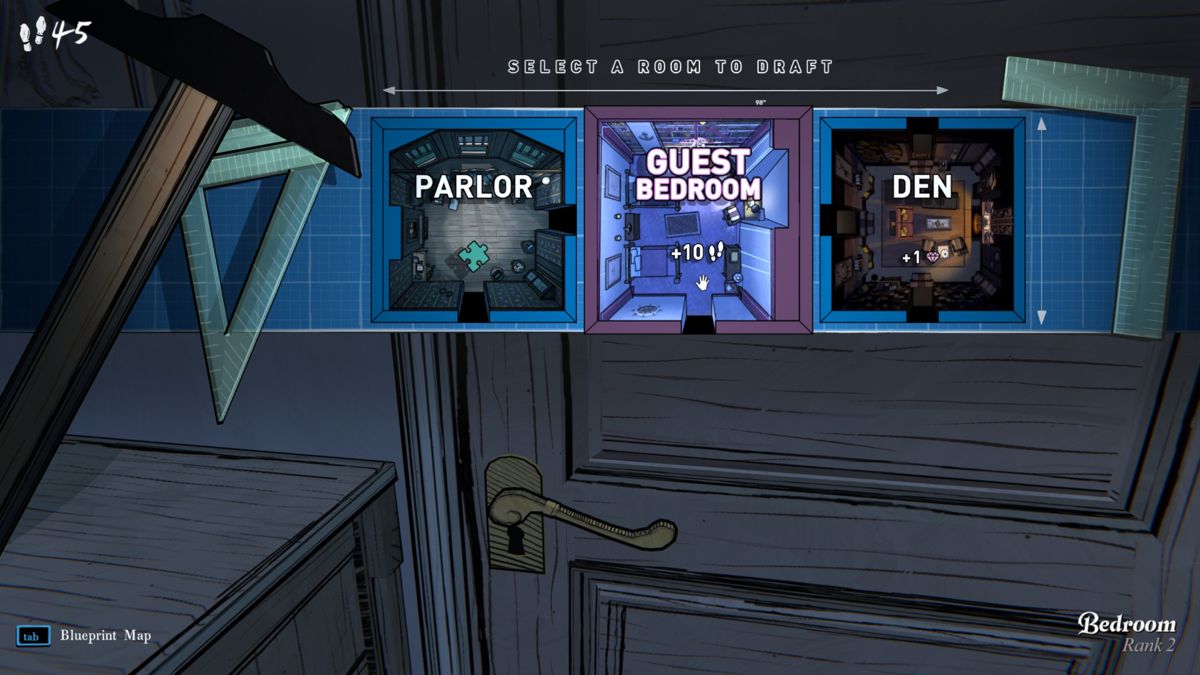
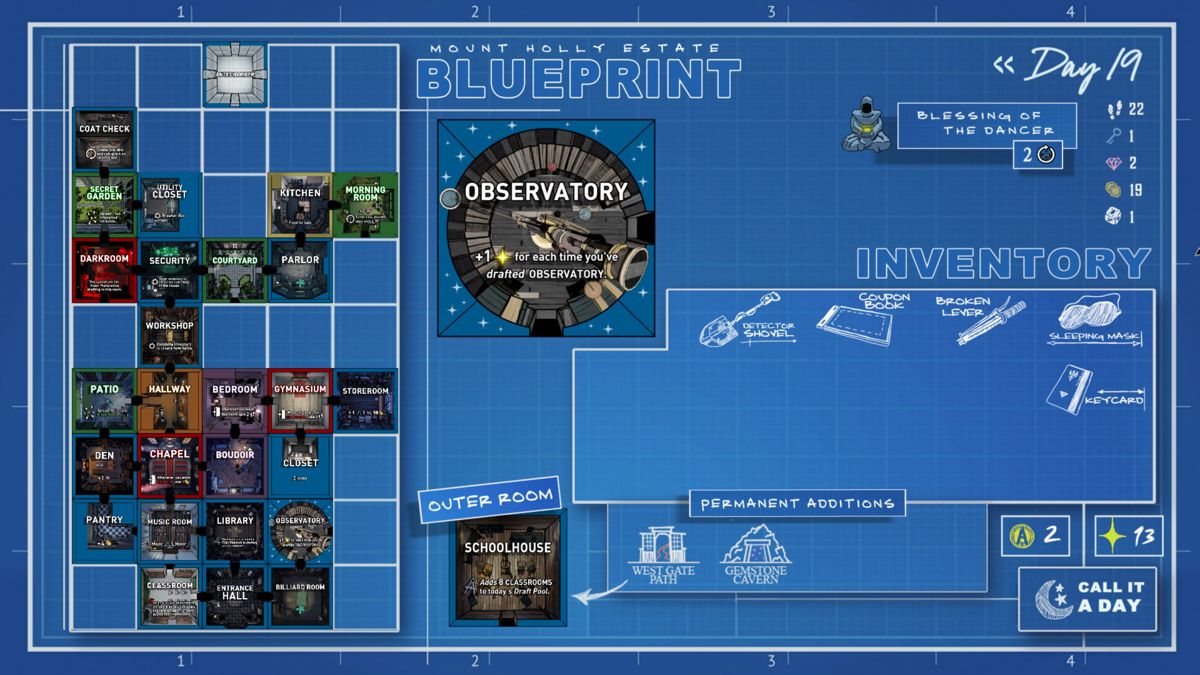
Controlling Simon from a three dimensional, first-person perspective, you begin the day in the entryway. Your uncle’s mansion is a 5×9 grid (i.e. 45 rooms). There are two rooms on the grid that are always the same, the entryway at the front of the house, and the antechamber at the back. Every other room must be drafted from a pool of blueprints, of which there are over 100. The entryway has doors on the west, north, and east sides. Once you decide to open a door, you are randomly presented with three blueprints from the pool and must select one of them. For example, you may have to decide between a Bedroom, a Closet, and a Den. The game notes that the Den contains one gem and two exits, the closet contains two random items and is a dead end, and the bedroom contains two steps and one exit. Once you select a room, it is permanently placed on the grid for that day.
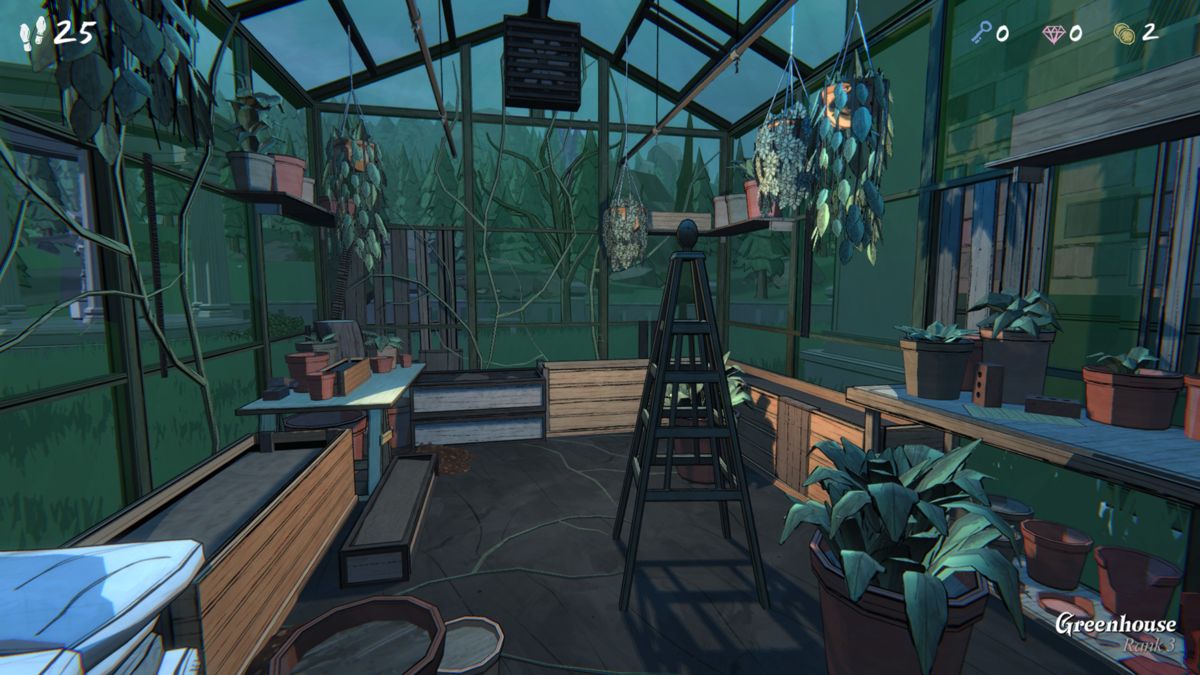
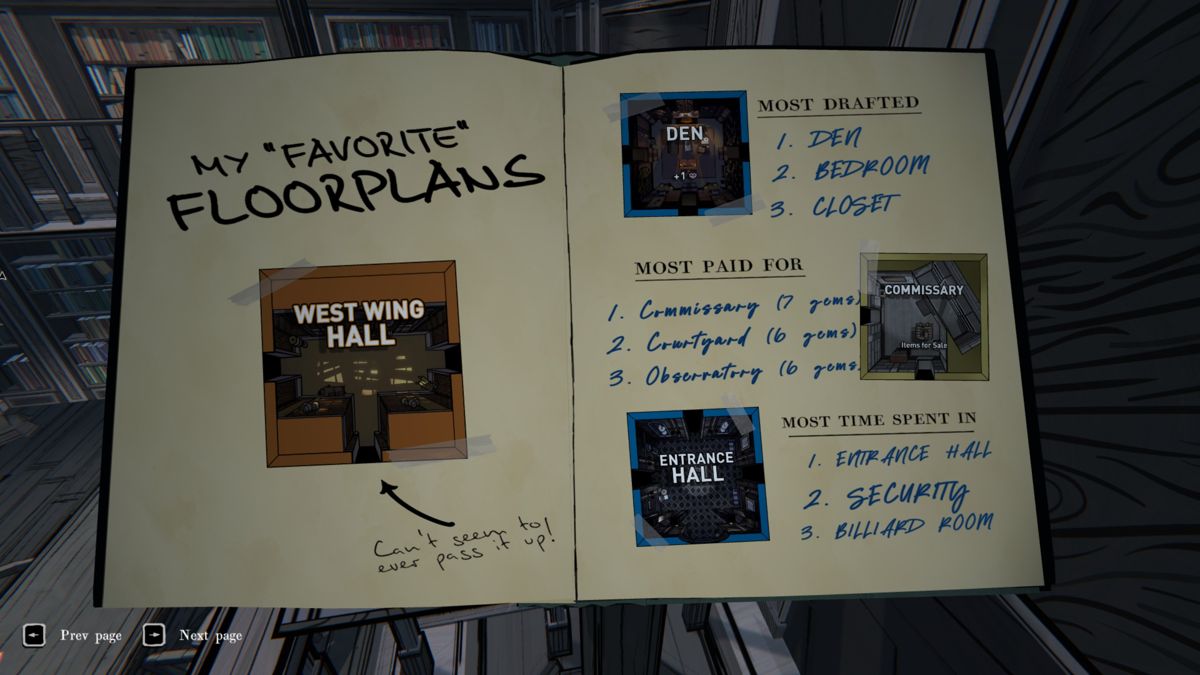
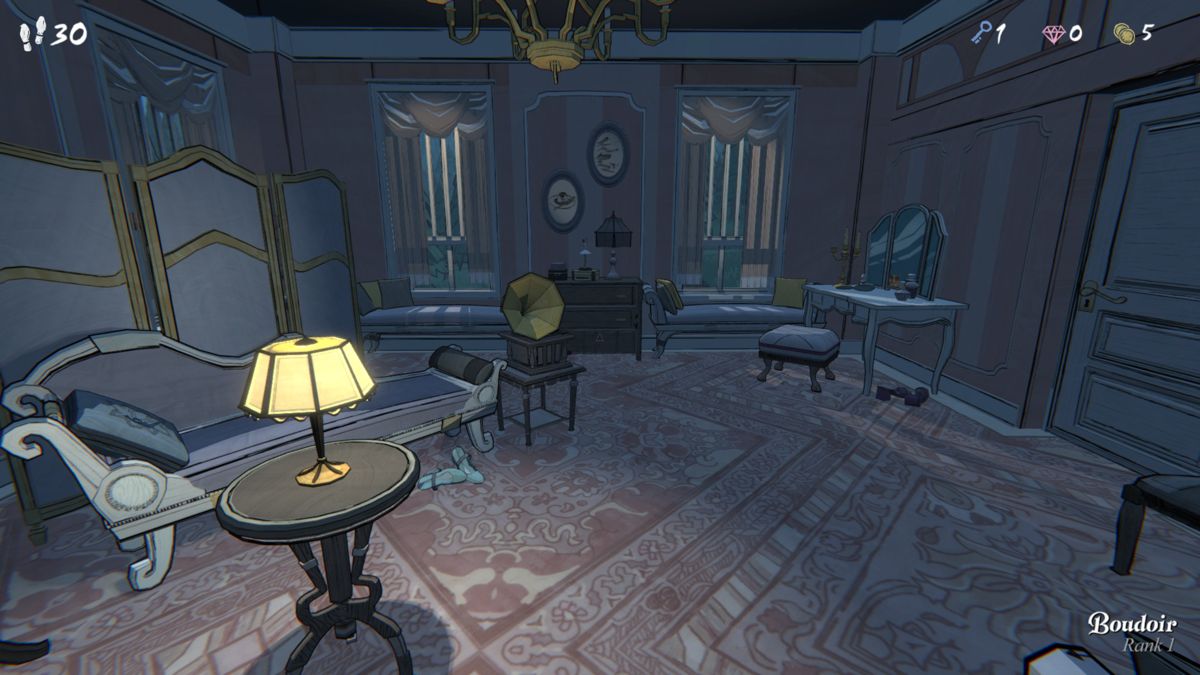
There are different types of rooms. Green rooms (such as the Veranda or the Green House) tend to have more items and gems. Hallways tend to have more exits. Bedrooms (such as the Boudoir or the Nursery) tend to have fewer exits (if any) but often grant you more steps. And red rooms tend to have more exits but punish you in some other way (such as losing steps, or making one of your draft choices a blind guess). However, every room has at least some benefit or vital secret, even if it isn’t obvious or accessible right away. One of my favorite rooms is the library, which in addition to being a place where you can check out books with hints, there also are a couple of books that detail your progress and keep track of your favorite and least favorite rooms based on your choices.
Steps, gems, gold, and keys are the game’s currency. Simon begins each day with 50 steps, and every time he enters a room, he loses one step. While this doesn’t seem like a significant punishment with only 46 possible rooms, backtracking is often required given the number of dead ends you will invariably create as you fill out the grid. Once your 50 steps have been used, Simon calls it a day and goes back outside to sleep in his tent. The next day, all the rooms in the mansion reset, you lose all of your resources, and you can start again.
While a good portion of the mansion’s room are free to draft, some cost gems. Each set of the three rooms to draft from will contain at least one free room (in case you’re out of gems), but the rooms that cost gems, in general, tend to either have more exits or other perks, such as gems, keys, or other helpful items. Gold (which is often found randomly in rooms) is used to purchase items in shops you can draft, and keys are also self explanatory. While rooms in the first few ranks are not locked, the deeper you go into the mansion, the more likely you will need a key to continue. On my first day, I drafted myself into dead ends (or locked rooms without keys) very quickly, which will likely happen to anyone on their first go. However, as you learn the available blue prints (including their rarity in the pool) and available resources, you will learn how to ration your resources and draft rooms more to your benefit.
Other items available (sometimes to purchase in the commissary, or randomly found in various rooms) include things like a metal detector to more easily find hidden keys, gold, and gems or a lock pick to help you unlock some doors without wasting a key. There’s a magnifying glass to read fine print on documents, and ivory dice that allow you to “re-roll” for three more blue prints before making a selection. There are many more items, some with less obvious benefits (at least at first).
Now, if the game was simply managing resources until you reached a room at the end of the map, I would have been bored rather quickly. But the development team managed to create an incredibly deep lore with meticulously devilish puzzles every step of the way. While all the rooms are detailed, many of them seem rather devoid of anything important outside of any resources you find. But the farther you progress in the game, the more you will realize that nearly every room has multiple secrets hidden in plain sight, impossible to grasp until you’ve uncovered information elsewhere. The game strongly encourages you to take notes and it is an absolute must in order to piece things together. No detail is too benign to discount, and I filled up a couple dozen pages of a notebook with everything from notes, pictures, and random background items that seemed to stand out.
The mansion is not the only place to explore. You can leave the mansion to walk around the grounds, each section costing you one step. At the beginning there is little to find outside that isn’t locked or otherwise blocked off, but the grounds are where a significant amount of the game’s mysteries lie.
The graphics are clean, with the room themselves inspired from blueprints with everything fitting neatly into a perfect square. The art style relies on cel shading to give each room a more two-dimensional look. and while few rooms are visually arresting, the attention to detail is impressive, especially the original artwork (e.g. paintings, sketches) inside rooms. There is little music in the background, but what exists perfectly matches the mood, and the game’s big moments are met with orchestral crescendos that feel like a reward of their own.
It took me almost 50 days to find Room 46, which required making several really fun deductions along the way, and the moment I stepped into it was an incredible rush of accomplishment. And while I had heard before I began playing that finding Room 46 is not the game’s end, I had no idea how much more there is to discover even after the mansion becomes yours. I wish I could say that I had as much fun at the after party. At first I was eager to uncover more secrets, solving some fun puzzles and finding additional unexplored areas on the grounds. But at some point around day 150 I hit a wall.
To be honest, at that point the puzzles (which, to be clear, are just about uncovering more lore) exceeded my brain’s ability and patience. Some puzzles I knew I could have solved but they would have taken me many hours to suss out given the random roguelike structure that can slow progress. In the first fifty or so days of play, it is rare to have a run-through where you don’t learn at least one thing you didn’t know before or find a floor plan you haven’t seen yet. But near the endgame, many days you might spend a half hour on a day and learn nothing, either because it’s harder to stumble upon even more obscure clues or because the random gods dealt you a bad hand. It doesn’t help that some of the end game puzzles feel patently unfair, bordering on moon logic. I stopped playing around day 200, and every time I resorted to a walkthrough I felt no guilt, never once going “Ah, duh!” when I saw the answer.
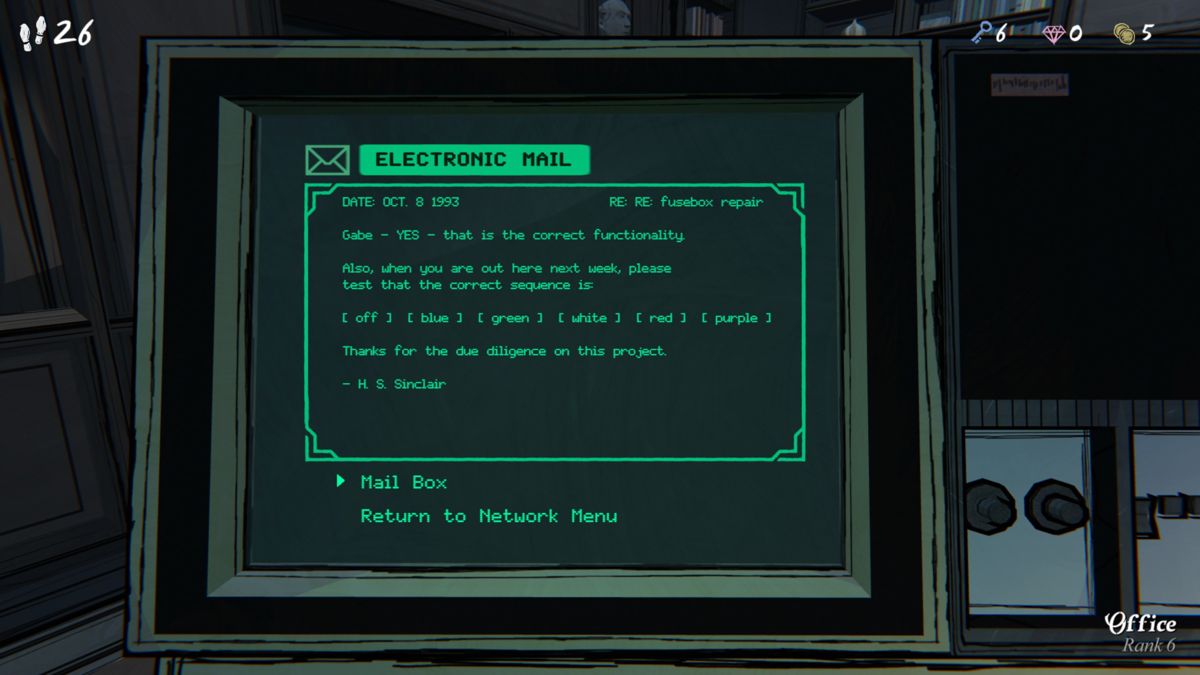
I suppose it goes without saying that one’s enjoyment of the game, even for those who enjoy roguelikes, will come down to whether or not the puzzles are in your wheelhouse. Given that I found Room 46 with only one minor hint on how to approach a mechanical puzzle (my least favorite kind of puzzle), I still felt quite satisfied with my experience, even though my success rate dropped precipitously after that. And it was still fun uncovering the lore myself, even with a walkthrough at hand. The story of Simon’s uncle, the extended family, and the politics of the region are generally fascinating. I wouldn’t say it’s as awe-inspiring or emotionally resonant as the story you uncover in Outer Wilds, but there’s still quite a bit I won’t forget.
I do have to mention one unfortunate bug that still hasn’t been fixed by the developers. There is one area on the grounds that is very easy to get stuck in if you’re not careful. While most of the ways you can get stuck only force you to restart the day (which is a bummer, but not a permanent problem), I somehow figured out a way to softlock my progress towards Room 46, requiring me to restart the game from scratch. Thankfully, once you know a lot of the game’s secrets (with some good note taking), getting back to where you were doesn’t take nearly as long. But the bug is a shame all the same.
Blue Prince has received universal acclaim and is one of the highest-rated games of all-time, all genres included. While it’s certainly not for anybody, it almost perfectly caters to its audience. If you think you’re going to like it, you’re probably going to love it. The amount of content crammed into this relatively small world is unbelievable, like opening a Russian doll, constantly surprised that there’s yet one more doll to open. While it took me about ten days to get the hang of Blue Prince, I soon became addicted and spent every free moment just to tackle one more run through the mansion. While the aforementioned flaws keeps this from being one of my all-time favorites, it was a blast to experience a game this difficult to put down.