Tag Archives: LucasArts

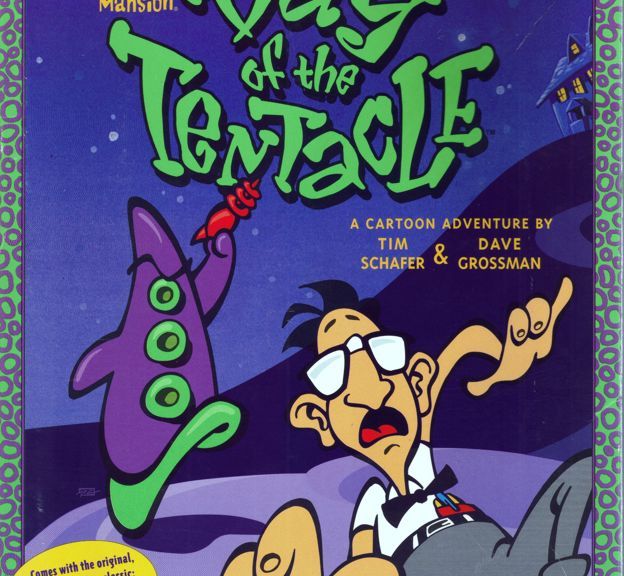
Maniac Mansion: Day of the Tentacle

Publisher: LucasArts
Developer: LucasArts
Year: 1993
Platform: DOS, Amiga, Atari ST, Apple II, Macintosh

ReviewMovie sequels often don’t do as well as the original. The ideas generally aren’t as fresh and those involved can afford to rest on their laurels, their audience almost guaranteed. This is not true with computer games.  In fact, the opposite is almost true. From Leisure Suit Larry to Police Quest to Half-Life, designers and programmers often work even harder on the sequels, using updated technology while listening to user concerns about the first game in building a better product. The greatest example of this is the sequel to Maniac Mansion.  It didn’t hurt that they brought Tim Schafer in on the project.

All the primary characters return for this installment, including Dr. Fred Edison, his wife Edna, Weird Ed, and Dead Cousin Ted. However, the plot is driven by Purple Tentacle, who drinks some sludge from the river, transforming himself into an evil, power-hungry dictator. The good doctor, realizing that he is unstoppable in the present, attempts to send Bernard and his two friends back in time to turn off the sludge machine before Purple Tentacle drinks from it.  Naturally, the time machine fails, sending Hoagie to the past, Laverne to the future, and Bernard right back in the present.  From here you must try to do things in all three time periods to stop purple tentacle and his tentacle minions, all while getting your friends back to the present day. 

While there really is no room for plot development, there are cut scenes that show how Purple Tentacle takes over the world in the future, and they are pretty comical. However, the gist of the game is puzzles, and there is a whole truckload. While many of them are wacky, they generally makes sense and only requires leaps of logic in a few minor cases. What makes them more interesting than your everyday adventure is that you control all three characters, and must help each other with solving puzzles. Despite the fact you are across three time zones, there is a mechanism which allows you to exchange items with one another. Some puzzles are solved by playing with temporal mechanics, thus requiring multiple-step solutions as you witness a task in one time period affecting another. Additionally, some items are used more than once, providing more challenge than normal. 

My only real complaint is all the walking back and forth you have to do as you fetch items from your friends, especially late in the game. It never becomes ridiculous, but it annoyed me enough to drop the game in my rankings a bit. But there are obvious reasons that Day of the Tentacle is often makes top ten lists; it’s production is nearly flawless, and it’s pretty funny, to boot. I would have preferred more substance, and a sharper wit, but those are just subjective observations that will vary from player to player. Whatever your taste, it would be hard not to give this one a recommendation.  What I do know is if you liked Maniac Mansion, you will love this game. I hated Maniac Mansion, and I still love this game.

Contemporary RatingHigh. One of the oldest games that remains highly intuitive today.

Cruelty Rating:  Merciful.  No way to die or screw up.  Only reason to save is if you quit or you’re worried about the power going out.
Sam & Max Hit the Road

Publisher: LucasArts
Developer: LucasArts
Year: 1993
Platform: DOS, Windows, Macintosh

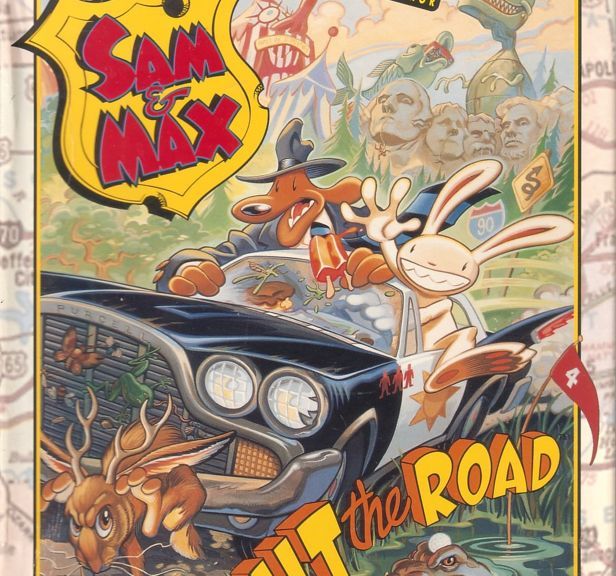
Review: A couple of the more popular heroes in the history of adventure games, Sam & Max, freelance police, spawned many rabid fans and eventually their own morning cartoon (that won an award, no less). Sam is a well-dressed, sarcastic canine that was pulled straight out of 40’s noir. Max is crude, narcissistic, and a self-proclaimed violent lagomorph. And they’re both dedicated to solving their client’s plights, as long as there is substantial monetary gain to be made.

The premise is yet another bulls-eye for LucasArts, and is apparent from the opening sequence, where Sam and Max rescue a damsel in distress from a mad scientist, by the simplest method available, a thorough butt-kicking. Shortly after, they make the following discovery:

Max: He’s not a real guy, Sam! Can I keep his head for a souvenir? Why do you suppose its ticking?
Sam: That’s no head, Max! It’s one damned ugly time bomb! Let’s leave this criminal cesspool pronto!
Max: Good idea, Sam. Maybe we can ditch the head somewhere while the credits are running. Mind if I drive?
Sam: Not if you don’t mind me clawing at the dash and shrieking like a cheerleader.

The exchange would be funny enough in an episode of Police Squad, but is classic coming from these furry creatures. Further, after the credits sequence finishes:

Sam: Well, that was a pleasantly understated credits sequence.
Max: I enjoyed the cheesy retro ambiance.
Sam: What the hell are you talking about, Max?

This self-awareness remains throughout the adventure, with Sam and Max making comments to the player and to the game designers. In fact, how you feel about the game will rely heavily on your taste in humor, as you will be barraged with one joke after another, some subtle, some crass, and some intentionally lame.

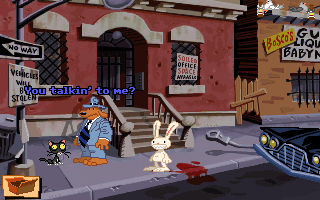
As for the game itself, the plot is quite bizarre. Your case directs you to find a missing “Bigfoot” and a giraffe-necked girl that were kidnapped from a carnival by country-western star Conroy Bumpus. You’ll visit several quirky tourist traps, some based on real places, like the World’s Largest Ball of Twine in Minnesota, with exaggerated effect. The characters you meet are mostly human caricatures intended to dig at pop culture, country music, and Western civilization in general. The interface itself is point-and-click and very intuitive. The graphics are sharply detailed, and the soundtrack is adequate. There are no dead ends, timed puzzles, or other such annoyances for the beginning gamer. And the voice actors for Sam and Max are excellent, with the supporting case up to the task, including a Bigfoot who has seen too many James Stewart flicks.

9526361-sam-max-hit-the-road-dos-outside-of-the-office-anything-can-happ

The puzzles are inventory-based, and few are of the lock and key variety. While you play the game as Sam, Max tags along causing trouble over the screen, but you can use him as an inventory item to solve any number of puzzles!  They usually involve gratuitously disgusting or violent acts, but not always. While nearly all of the puzzles are unique, they unfortunately require leaps of logic from the player on more than one occasion. They aren’t terrible, but slowed down the pace of the game considerably for me, which is the last thing I want in a comedy.

As typical for LucasArts, there are several amusing mini-games to play(including an entertaining variation of Battleship), Lucas films are spoofed (with a hilarious puzzle from Raiders Of The Lost Ark), and a few Easter eggs are present. I enjoyed many parts of Sam and Max, but was not satisfied on the whole. The characters seem more suited for a PG-13 or an R-rated audience, but their humour is necessarily toned down for the PG audience it was also aimed at. And while I laughed out loud a good half-dozen times, I feel as though their potential was never realized.

Thankfully, Sam & Max’s adventures didn’t end here.  They have three whole new adventures thanks to Telltale Games.  If I finished those, I am sure all three would hit the top fifty.  But despite enjoying them immensely, I sadly haven’t found the time to finish any of them.

9526325-sam-max-hit-the-road-dos-max-can-be-very-eloquent-sometimes-and-

Contemporary RatingHigh. While some of the puzzles are unfairly difficult, a quick trip to an on-line walk-through should eliminate most of the frustration.

Cruelty Rating:  Merciful. Like with most LucasArts games, you can’t even die, let alone get stuck.

Indiana Jones and the Last Crusade

Publisher: LucasArts
Developer: LucasArts
Year: 1989
Platform: Windows, DOS, Amiga, Atari ST, CDTV, FM Towns, Macintosh

Review: One of the first adventure games by LucasArts filled me with great anticipation as it is based on one of my favorite movies. I was optimistic as the game was by one of the great software production companies, but hesitant because movie licenses are often botched horribly when turned into games. However, it works here for a few reasons.

For starters, the adventure movie the game is based on feels more like a collection of great scenes than a seamless, timeless story. There are many great set pieces and fun action sequences that take precedence to the father/son subplot and symbolic undertones. One can debate the effect this has on a movie audience, but it’s simply bread and butter for a game. Creating a solid flow to a game with a progressing, engaging plot is very difficult when you must often halt the experience with puzzle-solving. LucasArts never had to worry about this.

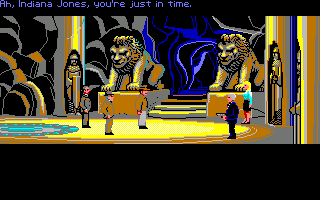
Secondly, much of the movie’s charm came from the wacky, slapstick humor and numerous in-jokes to Spielberg and Lucas fans. The producers and writers of the game took the exact same formula, changed many of the jokes, and hit dead on with quite a few of them. They even made fun of their own material, breaking the fourth wall if the joke works. For example, take the scene near the end of the movie where they enter the palace near Iskenderun. In the game, as in the movie, Indy sees a decapitated head roll in front of him. Here, he turns to the “camera” and says, “Yep.  This is the right place!”

15890700-indiana-jones-and-the-last-crusade-the-graphic-adventure-amiga-t

Lastly, the puzzles have been changed just enough to not be automatic for those who have memorized the movie, yet still fair and sometimes challenging. Many puzzles have multiple solutions, and the game can be made much easier (or difficult!) depending on who you make friends with and who you can trick. Even the obligatory copyright puzzle includes game elements that can make the puzzle easier or harder depending on your adventure skills. There are also four different endings to obtain, only one similar to that of the movie.

And if you get stuck? Forget puzzle solving and fight Nazis using your bare hands! There is almost no puzzle that can’t be solved by fighting, though it is difficult, not all that intuitive, and hard to keep your strength up after five or six fights.  Thankfully, there is no puzzle that requires you to fight.

My only major gripe with the game is the conversation trees. Many of the puzzles revolve around Indy using his wit to fool Nazi guards into letting him pass by without a fight.  Many times, this is done simply by saying the right things. Unfortunately, there are usually no clues as to what may work and what will get you a right uppercut. What will fool one guard will not work with another, even though their is no discernible difference between the two personalities.  So at times it becomes a “guess-and-check” routine, saving and restoring until you exhaust your options and make it past.

Oh, and there is a pointless maze.  @!#?@!

While the game feels dated due to the limitations of the engine used at the time, it is still likely to warm the heart of any true Indy fan. Those who have not seen the movie, or any of the Indy movies, will likely miss many of the jokes and get frustrated trudging through an otherwise mediocre puzzle adventure. I fit into the former and felt it was well worth my time.

Yes, you can punch Hitler. 

Contemporary RatingMedium.  The random conversation trees and frequent need to save and restore would definitely turn off some.

Cruelty Rating:  Polite.  You can die frequently, and you must therefore save frequently.  But you can’t get stuck.