Publisher: KeokeN
Developer: KeokeN
Year: 2018
Platform: Windows, PS4, PS5, Xbox One, Blacknut, Stadia
Rating: 6
Did someone say abandoned space station?
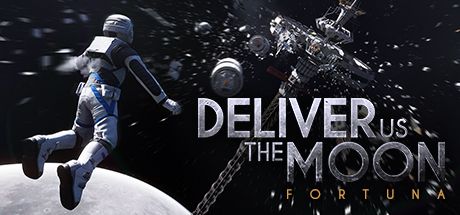
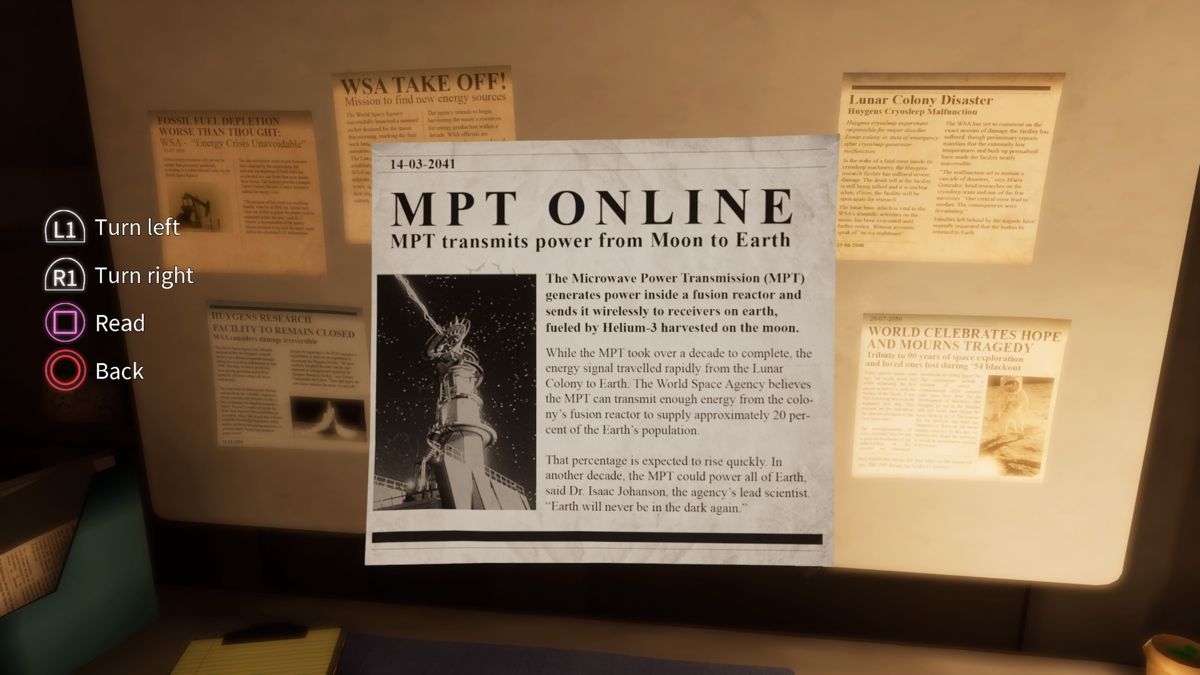
In the very near future, Earth has gone to shit due to climate change and is only barely hanging on due to an incredible mining operation on the moon that delivers Helium-3 to Earth, providing much needed energy to the people. Helium-3 is a real isotope, is indeed on the moon, and has been speculated to be a possible energy source. The rest here is science fiction and is all explained in the opening narration. Unfortunately, the station and mining operation have gone dead, and for five years the Earth has been rapidly becoming uninhabitable. You, Claire Johanson, are being sent on a rogue solo expedition to the station to find out what went wrong and hopefully get that sweet, sweet Helium-3 pouring in again.
I was immediately reminded of Tacoma, in part due to the location, but also because of the game mechanics. The first half hour or so of the game is walking around (at the launching), gathering background information, and then floating around the space station. Despite some very easy early timed puzzles, I was thinking I was dealing with another walking simulator. Instead I discovered a Portal-style game that contains both traditional (non-inventory based) adventure game puzzles and clever physics brainteasers.
The game can be played on either the keyboard or the gamepad, though I found things much simpler on the pad, especially in the weightless, directionless space station. I was wholly impressed by the physics engine in this section and rarely frustrated by the lack of gravity. The last half of the games takes place on the moon and I found myself missing the 360 degree environment. That said, the visuals are arresting, especially on the space station and the outdoor areas on the moon. The sound effects (or lack thereof) also appear to mimic what one would hear in the various environments, space and otherwise. For the most part I did find myself transported to these gorgeous but desolate environments.

The story itself, much like Tacoma unfortunately, holds no surprises. Claire learns about what happened via reading PDAs that are hilariously still on after five years of not being plugged in. More fun are the ways in which she can hear or see previous events. She can capture conversations of crew members that have somehow imprinted themselves in certain areas, and with the help of a cute but mute Wheatley-like robot (named an ASE) that floats by your side like a puppy and can replay visual conversations that have also imprinted themselves by showing holographic outlines of the crew members. ASE can go through tight spaces to access areas Claire cannot, finding vital information or opening doors from the other side. Claire can directly control the ASE, which results in a really cool mechanic where you control the robot and see the world from its perspective.
While these conversations and notes you uncover are generally interesting, I have seen every story beat before and you don’t get to know any of the crew members well enough to care about what happened to them. Or care what happens to Claire, for that matter. To be sure, she (and her father, who works on the planet) have backstories that are supposed to elicit pathos, but there wasn’t enough to differentiate them from every other scientist.

What may turn off some players are frequent timed puzzles that are unskippable. Some factor around you running out of oxygen, while others involve performing an action before something blows up. I found most of them refreshing as they broke up some of the monotony and weren’t terribly difficult. To be clear, I died often, at least once on about half of these events. But the game restores you to seconds before the timed sequence begins and the time limit is generally liberal, especially once you know what to do. Also, like in Portal, there are a couple of areas that are guarded by ASEs programmed to kill any living being, and stealth is required to pass.
As mentioned there are also many physics puzzles that require multi-step solutions; for example, you may need to get through a door, but to do that you need a power cel, which is locked in another room that also requires a power cel, and you only have one and must juggle them while also positioning your ASE in the right place to help you out. Thankfully, these are not combined with timed puzzles and you cannot lock yourself out of solutions.
The plot does drag a bit in the last couple of hours, as more and more unbelievably contrived obstacles get in Claire’s way, putting the backstory on hold for too long a time. And, not surprisingly, I was underwhelmed by the ending that not only left me feeling nothing, but also failed to address a couple of pretty significant loose ends without suggesting a potential sequel. Thankfully, Deliver Us Mars was released five years later that appears to address some of these loose ends. And I will probably play it some day. Despite rarely being wowed by Deliver Us The Moon, I am a sucker for space adventures and did enjoy many of the puzzles that are a rarity in the genre.
 Death By Troggles