Publisher: 3909
Developer: 3909
Year: 2018
Platform: Windows, Mac, PS4, Xbox One, Switch
Rating: 9
60 people on a ship are dead or missing. You must figure out each one’s name, who or what killed them, and the way in which they died. And holy crap is it a lot of fun.
The Obra Dinn was a merchant ship that set sail from London on route to the Orient. It didn’t make it to The Cape of Good Hope, and five years later it was discovered adrift near Falmouth. You are an insurance inspector employed by the East India company, tasked with finding out what happened on the ship so the appropriate estates can be either fined or rewarded. A mysterious benefactor has given you a book that contains the crew manifest, a map of the route, artist sketches of the crew, as well as a ship’s glossary. And finally, you’ve been given a watch that is able to capture the exact moment each crew member died, transporting you to that moment.

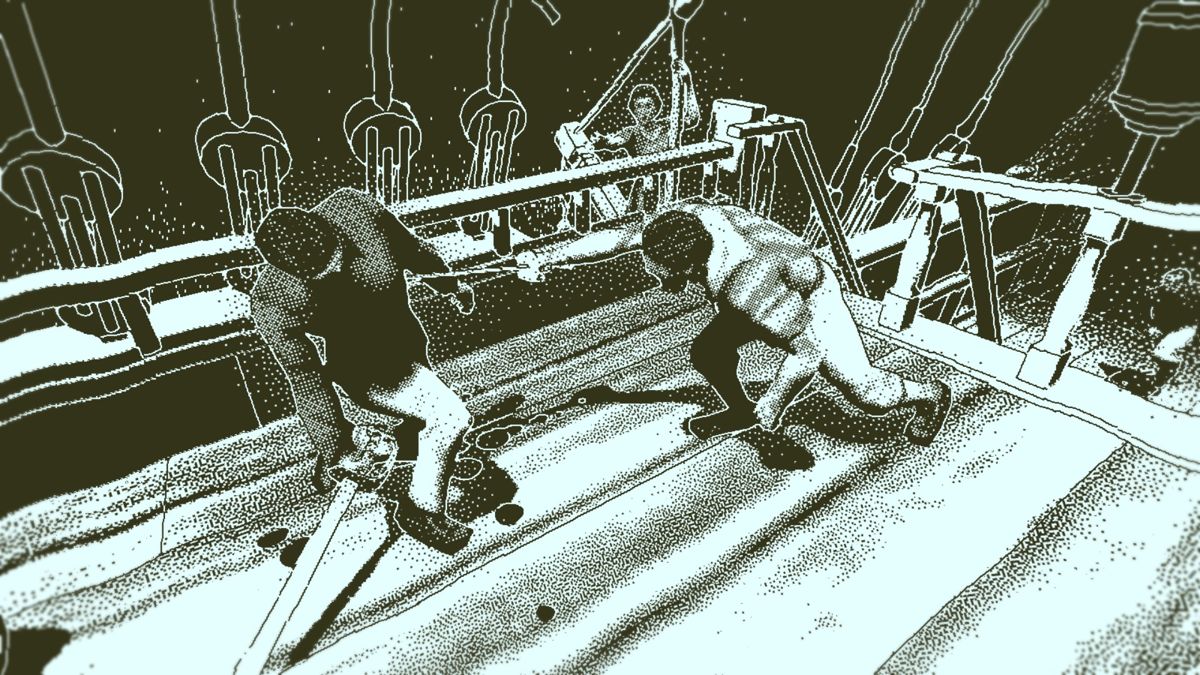
There is one observable set of bones at the outset a few feet outside the captain’s quarters. After activating the watch, you hear someone bark demands at the captain, the captain barks back, and then a shot rings out. Then a fully 3-D imprint–from the moment the shot occurs–appears on the screen. You see the captain (which can be deduced from the context of the conversation) and a few others guys, one of them with a bullet in his chest. You can move around the environment to witness the event from all angles (usually; sometimes there’s an object, person, or locked door in the way). Sometimes you’ll see another dead body in the scene and can activate the watch Inception-style to witness that moment of truth as well. Or the game will open a previous locked out area within a scene and guide you to the next dead body.
While not every player will witness each scene in the same order, the game generally progresses you backwards through a block of time until you reach the genesis of the events that lead to the deaths you’ve already seen. When all the bodies have been discovered, you will be presented with a door to exit the scene and return to present day on the ship. If you unlocked a new area during a flashback, you will be able to then access the area in present time as well. How this is possible is neither important nor necessary to enjoy the game, especially since it allows for such excellent pacing as you peel back layer by layer the onion of horrors that befell the Obra Dinn.

Each scene you witness will then be drawn into the book you’ve been given, with the option to enter in who you think the body belongs to and how they were killed. In the first scene mentioned, it’s very obvious the victim was killed by the captain, with a gun. But who is the victim? That you’ll have to deduce as you move through each scene and take notes. Some deductions are straightforward. For example, in one scene a character’s specific name will be mentioned, or it will be clear they died from being struck by falling parts of the ship. Others you will have to piece together observations. Perhaps you notice that this one character is referred to as a Dane, and the crew manifest only lists one person that hails from Denmark. Or this character seems to be delivering food and you’ll narrow them down to likely being the cook or the steward.
What makes this exercise more difficult is that you are not immediately told if you’ve deduced anything correctly. Once you’ve correctly identified the victim, perpetrator (be it a person or a thing), and the means of death (or disappearance), the game will only confirm you are right if you’ve nailed the details on three separate characters. This turns out to the perfect challenge; had it been only one, it would be too easy to blindly guess. Had it been more than three, it would have been discouraging. And boy I’ve rarely been more satisfied playing a game than when hearing the audible notification that I nailed a set of three. And once your suspicions have been proven correct in one area, it usually provides you additional reassurances of other deductions you’ve been toying around with. While I did get a little lucky a few times, over 95% of my deductions felt completely earned.

One other facet makes the deductions tougher. While the victims are limited to the list of 60 folks on the manifest, the games allows you to select many methods of dying that don’t actually occur in the game. While I appreciate that this further actively discourages blind guessing, a few of the false options were needlessly tricky. In one instance, I knew who the victim was and the perpetrator, but wasn’t sure if they were speared or spiked by that sharp thing? Given how similar those verbs are, forcing the player to make the distinction is pointlessly aggravating.
It’s difficult to say much about the story, in part because it’s revealed non-chronologically, but also because so much of the story has gaps that need to be filled in by the player’s imagination. Some plot points are eventually made clear, and some are left in the gaps between scenes or between deaths. While I thought I would find this frustrating, it actually enhanced the horror of what I was witnessing. My only wish is that some of the characters were developed a little more. In all but a few cases, motivations of those on board are quite unobvious and while you may figure out who killed who, the impact of gaining that knowledge is muted when all you know about the people are their names and occupations.
My other primary criticism is the graphics. They’re in monochrome, which I generally loved. The hand-drawn artwork is incredible and for me it made the experience more visceral while leaving the gore less detailed. Unfortunately, there were times when the pixelated detail is so limited that it’s practically impossible to tell what exactly you’re looking at. At one point I literally couldn’t tell if what I was looking at was a ball of fire, a dead body, or both. In these cases, it led to more guessing than deducing. And some players have found it hard on the eyes.
Thankfully, the soundtrack is perfect. Music is rare, and generally harsh and punchy to enhance each scene. But most of the time the music is absent, and you’re left with the rolling of the waves, the patter of rain, or creaks of floorboards to punctuate the isolation. I definitely found myself lost in this world for a while.
Return of the Obra Dinn is certainly tailored to puzzle lovers. Those who love pen and paper logic puzzles will likely find themselves at home, using disparate clues to eliminate options until only the solution is revealed. If you don’t mind all the death and horror that comes along with it, it will likely be one the most satisfying games you’ve ever played. Count me as one of those lucky players.
 Death By Troggles