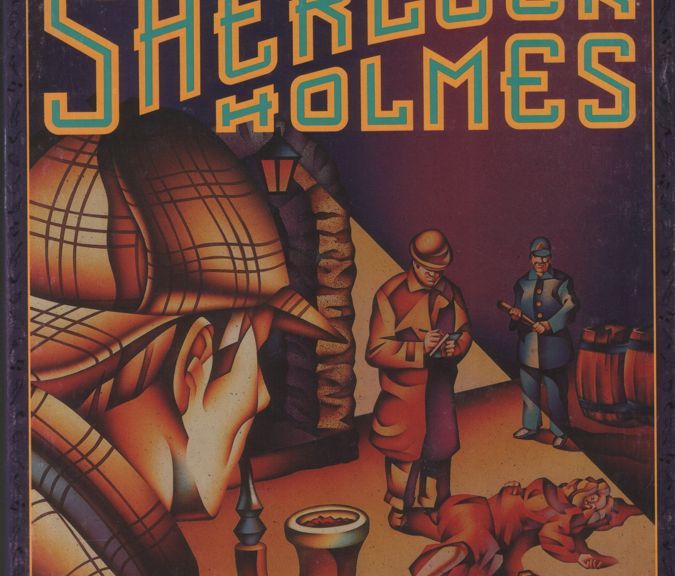
Publisher: Electronic Arts
Developer: Mythos
Year: 1992
Platform: DOS, 3DO
Rating: 3
Widely considered one of the best Sherlock Holmes games ever made, I very much wanted to enjoy this authentic recreation of Arthur Conan Doyle’s version of the London crime scene. But what I found was a fairly compelling story ruined by some obtuse puzzles, mediocre production values, and a frustrating user interface.
The intro sequence is quite lovely as we watch an actress enter the back alley of a theatre and get murdered by a shadowy stranger. The game begins as Holmes receives a letter from Inspector Lestrade asking for his help on a case that quite resembles the recent murders of Jack the Ripper. Investigating the crime scenes raises more questions than answers, and what follows is an intricately woven plot of deceit that involves many a significant player in capital city.

The player is greeted with a standard point-and-click interface with nine verbs at their disposal. While this is fine, one quickly discovers that “Move” “Pick Up” and “Use” are annoyingly not interchangeable, even with the most basic of actions such as using a door knocker. Not only that, multiple action verbs must be used in multiple situations, such as first unlocking a drawer, then opening the drawer, then looking at the item inside, then noticing something fall out, then taking that thing if you can find the pixel it represents. Perhaps I could have dealt with this, but on at least two occasions, a verb simply didn’t work for me until I reloaded a section and used it again, this time with success. I stopped trusting that any wrong action I took was actually wrong and was forced to use a walkthrough to cope.
One specific frustration that occurs repeatedly is the need to restart conversations that you assume have been exhausted only to suddenly find the character willing to talk again. For one puzzle, I had to restart the conversation eight consecutive times before the person was willing to engage, with no indication that I was making progress. Without a walkthrough, I would have never thought to keep trying.
Outside of that, progress through the game is pretty simple. With a couple of exceptions of moon logic (including the assumption that you can turn a basket into a hook to fish something out of water), most puzzles have straightforward answers that don’t require the inductive reasoning Sherlock is famous for using. Indeed, Sherlock will often use such reasoning in the game without the players input, explaining his thought process so you don’t have to figure it out. Another potentially interesting set of puzzles include using Sherlock’s home lab, though instead of having to learn some science to navigate his instruments and many chemicals, all it takes is a couple of clicks and all the hard stuff is done for you. There are many items you can pick up that are simply red herrings; while I am generally okay with this, your inventory becomes quite large, full of useless items or ones you used once and never will again. Several items you only obtain because you have to purchase them in order to bribe a store owner. That they serve no other purpose other than to clog up your inventory is just plain silly.

Now these problems are not that uncommon for the old-school adventures, but the game fails to make up for it in other ways. While the locations definitely evoke a time and place, with incredibly detailed rooms, the low-resolution graphics dull the experience a bit. The animations are fairly well done, and things are generally pleasant to look at, but there’s not much that stands out. More concerning is one of the most banal and inappropriate soundtracks in memory. There are several pleasant jingles that accompany most scenes that do not bother to match the mood at the time. At one point you can watch an opera, and all you hear is the same light tune you’ve already been listening to. And the game’s few tense situations hardly ramp up the auditory theatrics, relying on some slightly more foreboding jingles. There are a few impressive sound effects, but they’re lost among the music.
The best part of the game is the conversations. Sherlock speaks with his usual sagacity and wit and Holmes plays off him well. Sadly, Holmes is mostly worthless, though on a couple of occasions gives you a gentle nudge in the right direction if you consult him. Mostly, he’s just there for some mild humor and to transcribe everything into a journal (which you can helpfully access to read old conversations). During three cutscenes you can hear digitized speech, and the acting is fairly poor. I haven’t played the 3DO version, which uses full-motion video; I can’t speak to its quality, though that version is not as highly rated.

The plot itself, as noted already, is fairly impressive. You can work on different lines of investigation simultaneously and they all marvelously come together. You’ll be going all over London, visiting Scotland Yard, the morgue, the prison, law offices, mansions, a rugby pitch, the zoo, and piers along the Thames. My favorite location might be a shady bar where everyone has a checkered past and the only way to pry helpful info out of their mouths is to beat them in a game of darts. While I imagine many players found this arcade game obnoxious, it was probably the most satisfying part of the game for me as the difficulty progressively increased but never frustratingly so; winning my final match gave me an adrenaline rush and a new lead.
While I was initially charmed by The Case of the Serrated Scalpel, once I discovered I could no longer trust the game to play fair with me I kind of went through the motions. Still, there’s enough promise that I do intend to play the sequel at some point.
 Death By Troggles
Thoroughly entertaining and well written article about one of my favourite games.
Thank you! I know several people who adore the game so I tried to give the game its due.