
Publisher: Application Systems Heidelberg
Developer: Grundislav Games
Year: 2018
Platform: Windows, Mac, Linux, iPhone, Switch
Rating: 5
Take the historical aesthetic of The Lost Files of Sherlock Holmes, the general structure (and occasional voodoo angle) of Gabriel Knight: Sins of the Fathers, and the characterizations of The Blackwell Legacy series, mix them in an anachronistic blender, and you got yourself Lamplight City, an ambitious detective game with superb production values. Sadly, however, the game forgets to accomplish what should have been its primary goal: to give the player actual detective work.
Taking place in 1841, in the fictional American steampunk city of New Bretagne, detectives Miles Fordham and Bill Leger are tasked with investigating a flower shop thief. In the course of chasing the perp, Bill dies, leaving Miles alone with his guilty conscious, but also not alone enough as Bill’s spirit stays around to nag Miles incessantly. Miles leaves the force, but manages to get work as a private investigator thanks to a friend of his at the station who feeds him leads (and cash) under the table. Over the course of the game, Miles takes on five cases that while separate on their own merits, all help him towards finding the truth about Bill’s murderer.
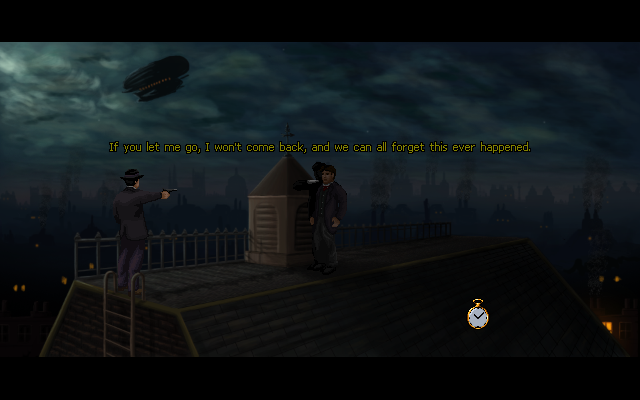
The setting is extraordinary, deservedly winning an Aggie for its presentation. Indeed, it helped to mimic Gabriel Knight, one of the best received adventures of all time. The city of New Bretagne runs the gamut, with an ostentatious neighborhood of the wealthy nestled across the river from the crime-ridden working class district. Along the way you’ll visit mansions, bars, a mill, a taxidermy shop, the docks, a university, parliament, and the list goes on and on. Every location is just fucking gorgeous, expertly detailed while evoking the romance of both New Orleans and London. Most of the city runs on steam, and while some of the new inventions, like pneumatic tubes, were around at the time, ferrotype photos were still a few years away. Regardless, it feels mostly authentic for what a city at the cutting edge of technology would be in the mid 19th century.

The rest of the production values are generally top-notch. While the character models are not quite as elegant as the backgrounds, they are still well drawn and the animations are truly excellent. The original soundtrack by Mark Benis sports 41 original orchestral tracks (with emphasis on percussion) that fit seamlessly in this world.
Also quite welcome are the diverse cast of characters. Miles is married to a black woman and his partner Bill is gay. While they both experience discrimination, and racism and homophobia is ever present in New Bretagne, there are so many characters that accept them and its a nice alternate way to experience this time period.
Miles and Bill are a bit tough to like at first. Bill is just obnoxious, a trait Miles comments on regularly. He serves not only as Miles’s spirit guide, but also the game’s narrator, and he likes to hear himself a little too much. He did grow on me, however, delivering an abundance of witty one-liners that left me chuckling on occasion. Miles’s personality is more measured, but it’s hard to watch him be a terrible husband (especially since you’re forced to go along with it) during his depression. He’s afraid to tell his wife Adelaide about hearing Bill’s voice, and like what always happens when there’s no communication, things break down. On the flip side, Adelaide is an utter delight, and she will help Miles out during several cases when she has breaks from her own job as a hairdresser for the rich. Watching her carry the emotional weight of her work, racism, and her husband’s negligence is both heartbreaking and touching. The cast overall is well-voiced by professional actors.

Frustratingly, all of the game’s problems reveal themselves within the first hour or so. In fact, for the first sixty minutes I solved but one incredibly easy puzzle. The rest of the time was spent interviewing witnesses and suspects. Interrogation is copied directly from Gabriel Knight, with a separate screen showing nicely drawn and animated close-ups of the characters with a list of topics to run through. The order in which you ask questions matters not, though in a few cases your response to a question shot back at you can affect whether the witness feels comfortable continuing the conversation. For the most part, though, the game is endless interrogation without any need for your deduction, as Miles and Bill will do most of that for you. I can honestly say not a single puzzle in the game was beyond novice level, and they’re so infrequent anyway that your brain can take a backseat to all the talking heads.
To be fair, you can make mistakes. If you make some obviously bad interpersonal faux-pas, you can lock yourself out of solving a case. And each case has at least two suspects with motive, means, and opportunity. But leaving a case unsolved or arresting the wrong person doesn’t halt the game (unless you do it repeatedly), and either way the true perpetrator in each case is blindingly obvious as long as you follow up on every lead, especially since the first person suspected in every single case only has circumstantial evidence against them. I suppose that’s a spoiler, but honestly I don’t want to give even the mildest suggestion that there’s detective work to do here. The only times I got stuck for even a few minutes turned out to be related to missing a few hotspots with the cursor. An in-game journal with a list of suspects, documents, and clues is quite helpful in keeping track of everything, though it only further absolves the player of deploying independent thought.
I did enjoy my time with Lamplight City, though admittedly I was hoping it would end a bit sooner than the 12 hour mark I hit. There’s just so, so much dialogue; I wouldn’t be surprised if three-quarters of the game is just exhausting conversation trees. Designer Francisco Gonzalez was able to tell an interesting, tightly plotted mystery in a fascinating world, but a general lack of character development killed the mood for me given how much of the game is about the characters. There’s plenty of amusing achievements to hunt down, and there’s an extensive commentary mode you can play through as well, though given how much talking is in the actual game, I can’t imagine sitting through even more commentary no matter how insightful or amusing it may be.
 Death By Troggles