
Publisher: Sony
Developer: Quantic Dream
Year: 2013
Platform: Windows, PS3, PS4
Score: 4
After gushing over the first three games I’ve played by Quantic Dream (in fact, I ranked them all in my Top 15), I was still eager to dive into the less acclaimed Beyond: Two Souls. Yet, despite some spectacular motion capture and impressive performances by the leads, I was ultimately let down by a poor script and exhaustive repetition.
Beyond begins in a small town police station, as the local sheriff is trying to interview a disheveled young woman who refuses to speak. A SWAT team shows up to the sheriff’s dismay, and soon to their own dismay as after the screen blacks out, the camera draws back to show every last one of them (except the sheriff) dead and the station in ruins.
We then travel far back in the past to see this woman as a child. Her name is Jodie Holmes, and she’s in a laboratory being tested on her telekinetic abilities. As you test them out, you scare everyone in the lab and wind up with a bloody nose to boot, a scene that carries heavy Stanger Things vibes. Similarities between the two abound throughout, though Beyond came out first, and both borrowed heavily from others.

The next scene sees Jodie grown up as a member of the CIA and a mission she’s on that will benefit from her powers. The game continues as such, going back and forth through Jodie’s sheltered life as a test subject, a member of the CIA, and her broken life afterwards. We soon learn that her telekinetic abilities come from an invisible being named Aiden, who is spiritually linked to her and is capable of doing serious damage to anyone who threatens her.
The gameplay, while unique, is also frustratingly inconsistent. You either control Jodie doing normal human things, or control Aiden doing normal spooky things to protect her. As Jodie (and in normal Quantic Dream fashion), you will move around, talk to others (with the occasional conversation tree where choices matter), and use quick-time events to open doors, climb ladders, or kick some ass. As Aiden, you will (by controlling two sparkling lights on the screen) break locks, throw objects across rooms, connect Jodie to other people’s minds so she can experience flashbacks from their memories, choke enemies, or–and my favorite–even possess their bodies.
What’s frustrating is that when and how you use Aiden seems completely arbitrary. Sometimes Jodie will ask him for help and sometimes Aiden will make decisions on his own. Sometimes Aiden will act on his own to help Jodie, and sometimes he will act on his own to sabotage her. Sometimes Aiden acts pre-scripted outside of the player’s control. There’s no consistency and ultimately it feels very unsatisfying as player choice is often dangled and then ripped away. That’s not to say you never get to make choices of consequence while as Aiden, but the act of playing as him feels quite disconnected.
A prime example of this is Aiden’s body control ability. It’s often used to help Jodie out a jam by forcing a foe to take out themselves or other combatants. While it’s a lot of fun, there appears to be no rhyme or reason on when you can use this ability and on whom. And the reason, I’m guessing, is that if you were allowed to use this ability any time you wanted, it would literally solve every problem in the game within seconds. So the game only allows Aiden this ability when it’s cool for the script. There is an option to play with a friend where you each take charge of one of the protagonists, but as you never play simultaneously, it’s no different than just hanging out and passing the controller back and forth.
The non-chronological way the story is told is mostly effective from a storytelling standpoint, but it’s another example of how the game ensures that you feel almost no agency. After all, if you’ve already seen how something plays out in the future, you know for sure that nothing you do in the past makes any difference at all as to how the story plays out. So all of the other game’s little choices (including, possibly, killing innocent people!) have no bearing on Jodie’s future at all. There are a dozen or so endings, but only two main ones with small deviations based on choices you make after the climax and most of them available regardless of what decisions you made to this point. There is an option to play the game in strict chronological order, but that leaves the game very-bottom heavy on the action scenes while not providing any illusion that your choices matter anyway.
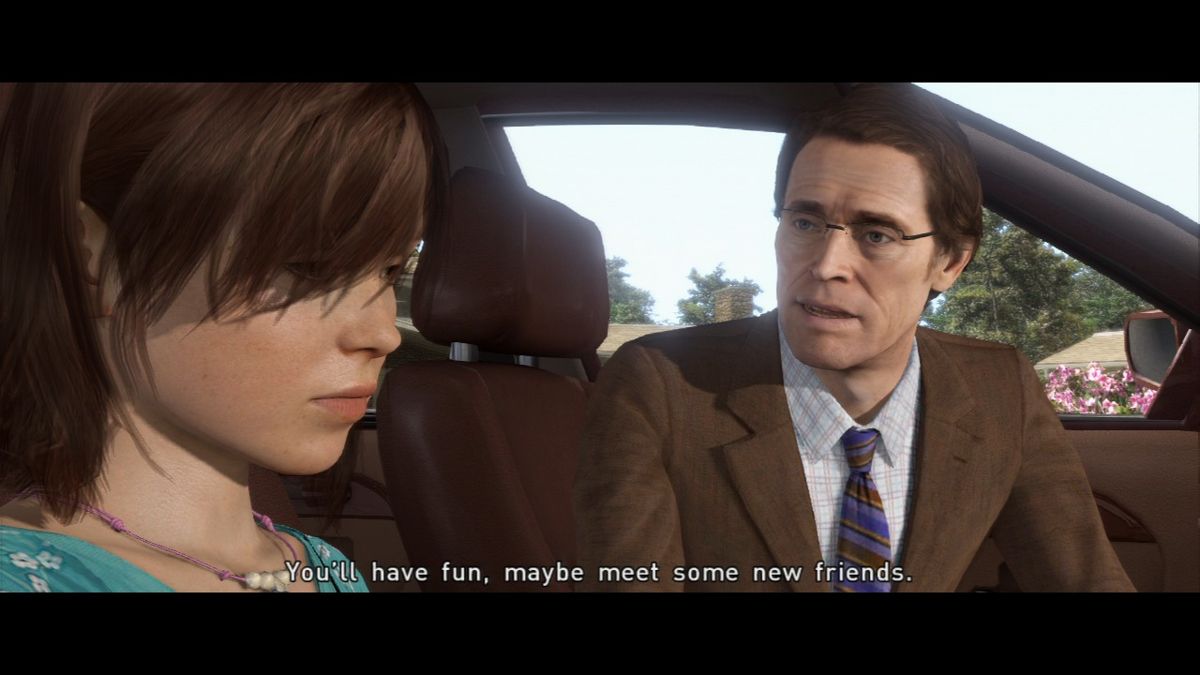
While all of this could work if the story was amazing, it simply isn’t. For starters, so many of the game’s characters are just ridiculous. An easy example is Jodie’s foster father, who helps raise her prior to her admission to the research facility. He’s understandably scared and angry about Aiden, and he convinces his wife to give her up to the facility for everyone’s safety. But when they drop her off, he throws a mini-tantrum when his wife wants to say goodbye to Jodie, even though he just spent time saying his goodbyes as well. There’s no subtlety in the moment, as if the game doesn’t trust the player to know he’s abusive without showing it at every possible second.

Other minor characters are incredibly inept at their jobs. Jodie tricks a security guard with the least tricky excuse possible. Trained combatants will pass up obvious opportunities to kill Jodie, or take the most silly, circuitous routes to make her escapes possible. But the game’s most stupefying moment comes when Jodie is staying with a Diné family and an event endangers the lives of both Jodie and the family’s shimá sáni (grandmother). With both characters lying on the ground, possibly dead, one of the grandsons rushes to Jodie’s side rather than to his beloved grandma’s, even though he’s only known Jodie for about 36 hours. This dude becomes a potential love interest for Jodie and at that moment I immediately didn’t care. It also doesn’t help that Jodie ends up playing the white savior to this cursed Diné family.
Despite all this, I was rather enjoying myself for a good portion of the game. It helps that Elliot Page (Jodie) and Willem Dafoe (the scientist and father figure in charge of studying her) give excellent performances. No matter how ridiculous the line, Page gives it his all in an emotionally earnest performance. The motion capture is ridiculously good, with characters looking like their respective actors while moving in a fluid and realistic manner. The soundtrack is also generally good, though admittedly not as memorable as those in other Quantic Dreams games. And there are some fun vignettes, including teenage Jodie at a party and another period in the future where she’s homeless and struggling to survive. All in all, I was invested in Jodie’s fate.

That is until the game longest section, where Jodie, in the CIA, must infiltrate a political network in Somalia. It’s a culmination of all the tools and strategies you’ve learned so far as you’ll be using a combination of stealth, Aiden’s abilities, and quick-time event fighting if necessary. While I found it engaging for a short-time, I eventually felt like I was playing an FPS war game. While some fights can be avoided, some require killing complete strangers who aren’t paying you any mind. I was left emotionally burnt out and a bit angry at what the game made me do; while this is reflective of Jodie’s experience as well, I didn’t know what I was signing up for and it killed my goodwill for the game and my interest in the outcome.
After completing the game in a little over ten hours, I looked up some alternate endings and story choices on YouTube. While a couple of them would have been fun to figure out on my own, for the most part they’re just for flavor and I could never see myself replaying Beyond: Two Souls given how little control I had over the story. Some people adore this game, finding the story quite moving. I was left feeling cold.
 Death By Troggles