
Publisher: Revolution
Developer: Revolution
Year: 2020
Platform: Windows, Mac, Linux, iOS, tvOS, Xbox One, Xbox Series, Switch, PS4, PS5
Rating: 6
I was so enamored with Beneath A Steel Sky (and so unenamored with my job) that I pulled an all-nighter to win it one sitting and then took a long daytime nap. I am eighteen years older now and the thought of staying up past midnight to play a game makes my brain hurt. And the thought of playing Beyond A Steel Sky in one sitting makes my butt hurt. Nevertheless, it’s a solid sequel that captures the imagination of the original before making of an absolute muck of the ending.
Our hero Robert Foster is ten years older and enjoying his family in the Gap when a mysterious machine with legs (and some Union City men) steal a young boy named Milo from their tribe. Foster battles with them and fails, but follows its tracks back to Union City. This introduction is shown in a snappy comic book style, similar to the actual comic book that came with its predecessor. Outside the gates of the steampunk monstrosity of a city, you must puzzle out how to sneak in.

A lovely job is done introducing you to the slick controls (with either gamepad and keyboard/mouse) and the types of puzzles you will encounter. The 3-D world (made up of graphic novel style backgrounds and character models much like The Walking Dead) is easy to move around in and swapping inventory items is a breeze. While there are a few standard fetch quests, these are relatively rare. Early on you acquire a gadget that allows you to log-in to various consoles throughout the city to view the algorithms that control them.
For example, there’s a vending machine outside that will only dispense to people who are members of Union City. When you hack into it, you can see the logic flowchart that outlines this, along with a code to deny a drink to non-members. You can simply swap the statements “Dispense Drink” and “Play Refusal” and the result will be that members will be denied and non-members will get that refreshing can of Spankles. These types of logic puzzles are everywhere, and become delightfully more difficult and more clever as the game progresses, sometimes requiring multi-step solutions between consoles throughout the city. After acquiring this hacking device I was hooked. And that was before being blown away by a sweeping and panoramic credits roll upon entering the city.

Robert has little luck finding Milo. The citizens he meets scoff at the idea of kidnapped children in their Utopian society. And the androids are even less helpful. Using a stolen identity of a dead soldier, Robert finds his home much to the surprise of his “wife” who is being investigated due to the curious absence of her husband when he walks in. As she cares more about her social status than her late husband, she plays along so she can continue her climb down the social ladder where the elites in Union City live.
Joey, Robert’s robot companion from childhood, is hailed as a God to the citizens. However, he was said to have left the city after creating this Utopia where everyone has their place and want for nothing (other than increased social status for those who excel at demonstrating how happy they are). None of it makes sense to Robert, who begins investigating Joey’s disappearance along with Milo’s.
The plot more or less moves from point A to point B with rare instances of being able to solve multiple puzzles at once. That said, the game manages to be engaging by creating so many optional things for Robert to do. He can engage in conversation with many droids, who range from sardonic to enthusiastic, including one particularly hilarious droid who yearns to create the perfect poem. Some droids charm you with visual emoticons. Robert’s butler droid is also unwittingly hilarious. When a big wig is off interrogating his wife, Robert can ask the droid about him, eliciting a response of “Would you be referring to that man probing your wife in the bedroom?” In addition to the droids, there is an engaging help desk avatar whom you can engage with to kill the time. And when you’re tired of the droids, you can walk around and listen in on the conversations of passerby. It’s not necessary for any puzzles, but is just another way in which the city is immersive. Death is also possible in a few cases to keep things interesting, though auto-saves protect you from any real danger.
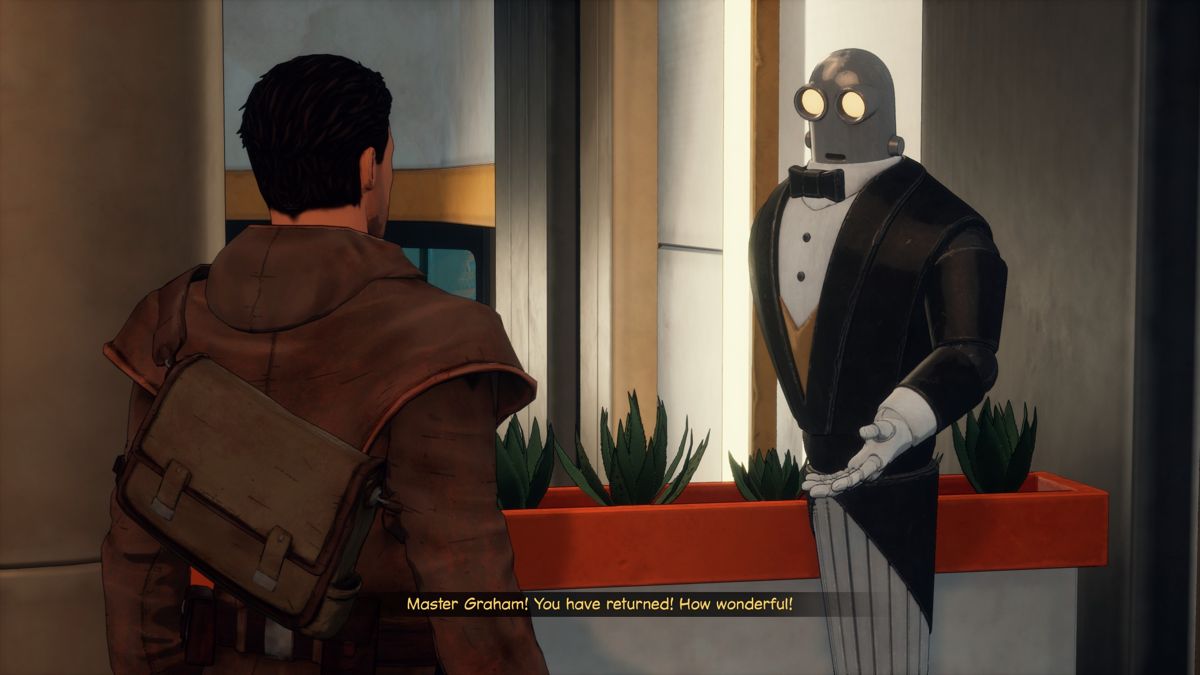
Conversations are simply exhausting available topics, though thankfully most of them don’t drone on too long. The voice acting is above average, though on occasion the dialogue gets lazy. Robert will narrate at times, and at one point after securing an agreement with another character, he says “An unspoken deal had been made,” despite just having a thorough conversation about said deal.
The story also gets a bit lazy as things progress. About halfway through the game there is a pretty significant reveal that could have hit like a ton of bricks had it been revealed organically throughout the course of the investigation; instead, a fairly unimportant character casually drops the bomb and Robert just moves on like nothing happened. The puzzles become uneven as well, with an incredibly pointless water weight puzzle as well as a fairly unintuitive mathematical riddle that while logical is poorly clued.
Despite these grievances, there’s plenty of action, charm, and clever puzzles to keep things at a fun and brisk pace. But then woof, the ending. There’s a dramatic moment that is meant to be emotionally charged, but comes completely out of nowhere and requires a previously intelligent character acting in a monumentally stupid fashion for it to happen. Considering all the time invested to that point it feels like a kick in the teeth. Still, I can easily recommend this for fans of the original or cyberpunk in general.

 Death By Troggles