
Publisher: Focus Entertainment
Developer: Rundisc
Year: 2023
Platform: Windows, PS4, Xbox One, Xbox Series, Switch
Rating: 6
Games where you have to decipher alien languages always feel like a lot of work to me, and Chants of Sennaar is no different. I suppose the language processing part of my brain gets tired easily. Yet I was able to get past that here and enjoy myself thanks to some forgiving gameplay mechanics and a compelling, albeit mostly silent, narrative.
You, an anonymous hooded figure, arrive in a village that has some parallels to the ancient Middle East, and in fact the story is largely based on the story of the Tower of Babel. You do not understand the language of the people, though you’re not alone. The city you arrive is at the base of an enormous tower, each level home to a different culture that speaks a different language; they barely understand each other as well.
The only way to progress is to use context clues and inferences to break down the language of the people. The first words you learn are ‘open’ and ‘close’ after coming across a door with a helpful sign with directions for either. In addition to signs, you will use murals and dialogue to decipher words. For example, a character may wave at you and say one word (represented by a glyph in their language in a dialogue bubble), and the presumption is they are saying something like ‘hello” or “greetings.”
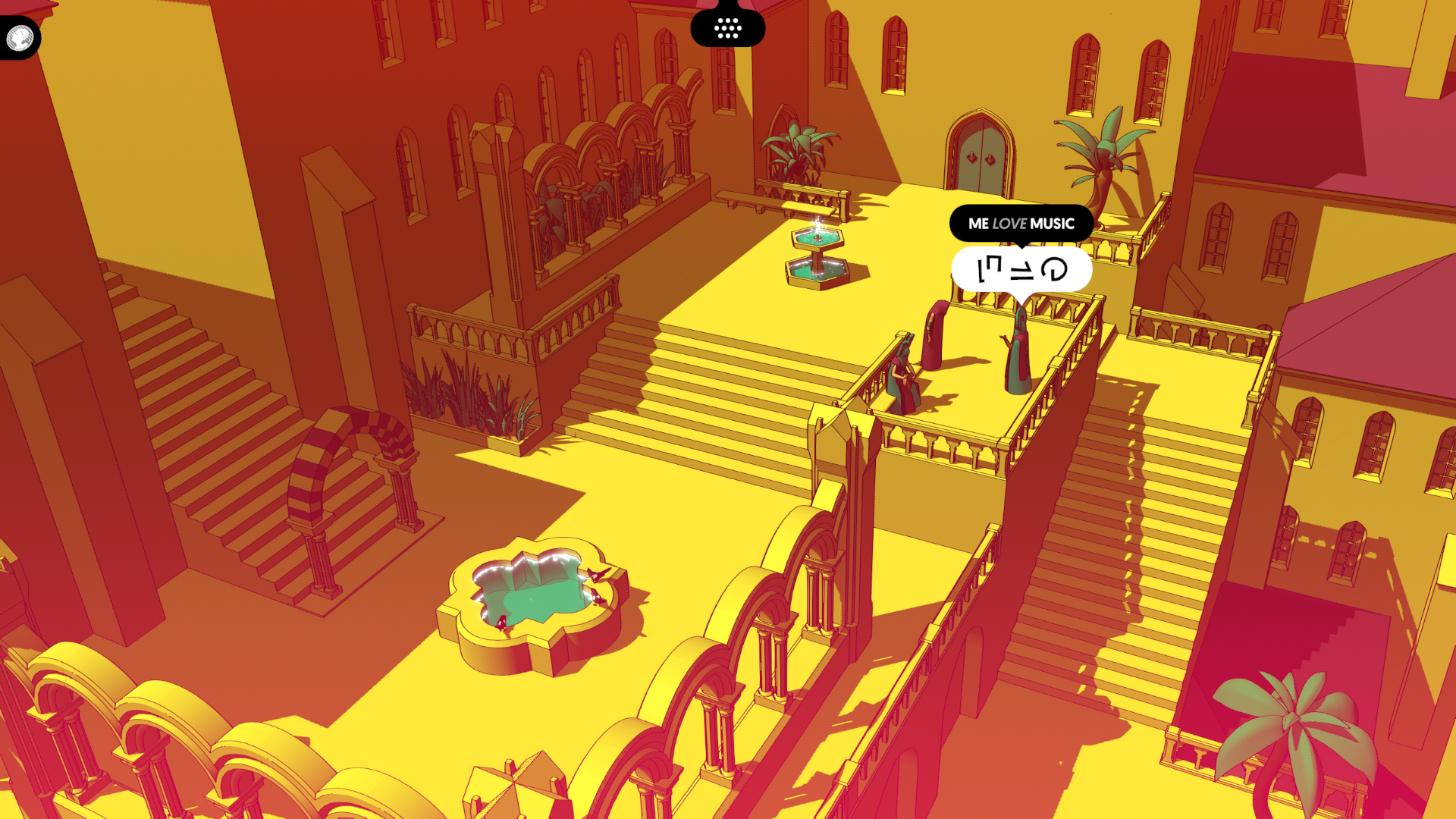
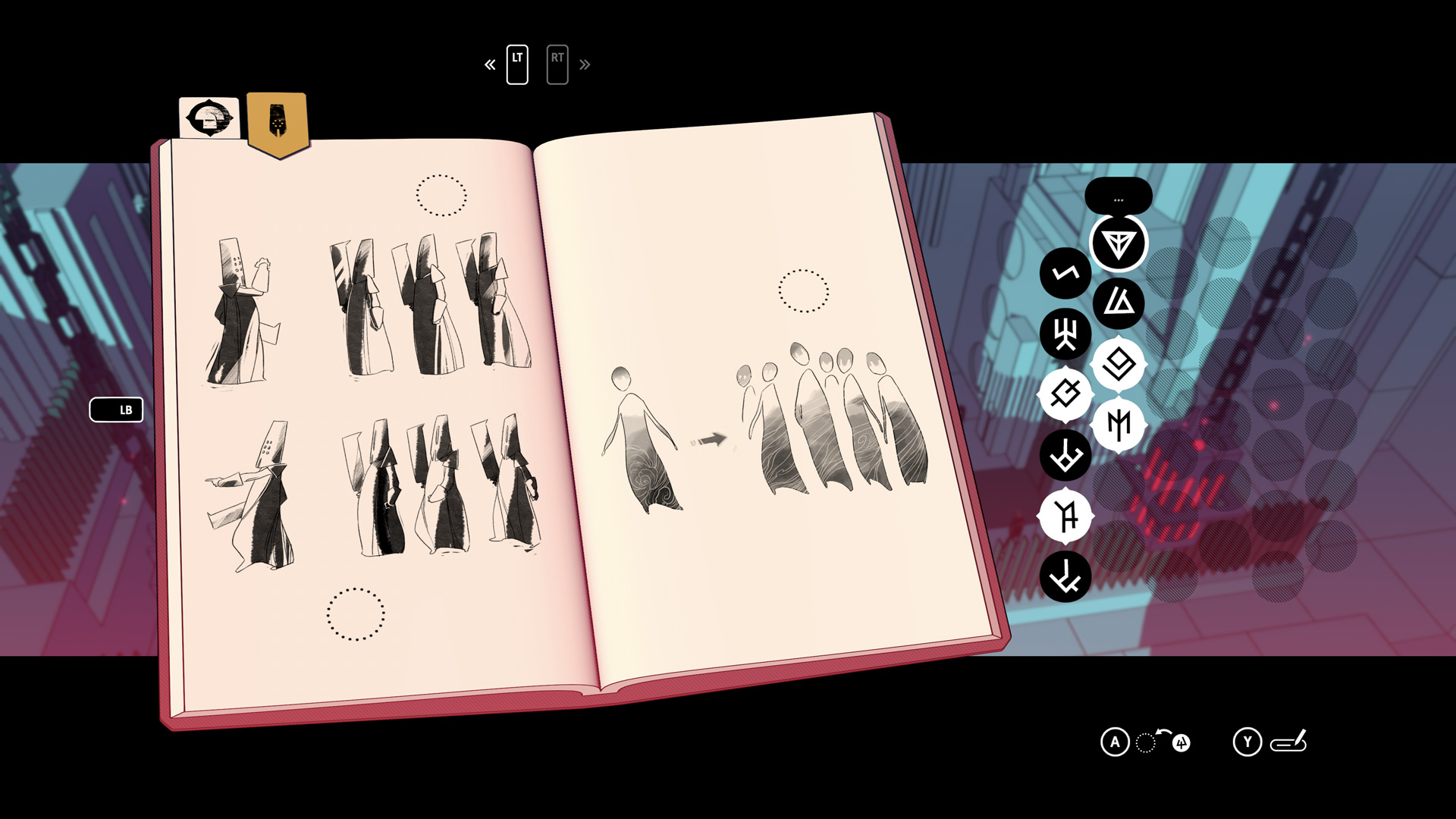
You have a notebook that can be pulled up at anytime, and the various glyphs you hear/see will appear in the notebook. Once you think you’ve deciphered a word, you can select it and type what you think you’ve learned. Now, every time you come across that glyph, your guess will be added to the dialogue window. At the same time, your character will make various drawings in their notebook to represent different words or action. For example, in this case, you may see a picture of someone waving to another person. You can then move the glyph you think ‘hello’ is into that spot. However, the game will only confirm your choice if you’ve correctly determined all of the words (usually three to five) on a given page, reminiscent of Return of the Obra Dinn and The Case of the Golden Idol. These words will then be permanently etched into your notebook and will appear in any future conversations or signs you come across. And, naturally, it’s almost impossible to solve most of the puzzles (such as unlocking doors or operating machinery) until you understand the language.
Early on you’ll notice the people at the base of the tower are forbidden from going to the second level by warriors guarding the gate. These warriors speak an entirely different language. Once you reach the second level, you’ll have to start from scratch to learn their language. On rare occasions there will be signs or murals that will reference both languages at once. While this is helpful, it often isn’t a 1:1 translation as the syntaxes also change. The culture at the base doesn’t have a glyph to indicate a word is plural, and therefore uses the same glyph twice in a row. However, the warriors do have a symbol for pluralization, and you need to deduce where that goes. The culture on the third level make things even more complicated, as they begin their sentences with nouns while the other two begin their sentences with verbs. All in all there are five cultures, each with their own language quirks (not to mention large divides in religious belief and use of science).
What makes the game interesting from a narrative perspective is learning why these cultures are so xenophobic and how it impacts their lives. You will glean most of this by observation, as most of your conversations are no more than one or two brief lines. The nature of the game keeps the narrative lighter than I would like, but it remained compelling throughout.
In addition to lock and key puzzles, there are also many brief stealth sequences. They’re not overly difficult, and mostly consist of watching for patterns from guards and sneaking into shadows when they turn around. A few would have been a nice diversion, but it gets old as they’re all kind of samey. At least there’s no serious punishment for getting caught. A shadow will overtake you to represent your death, but then you just get revived to the entrance to that screen to try again.
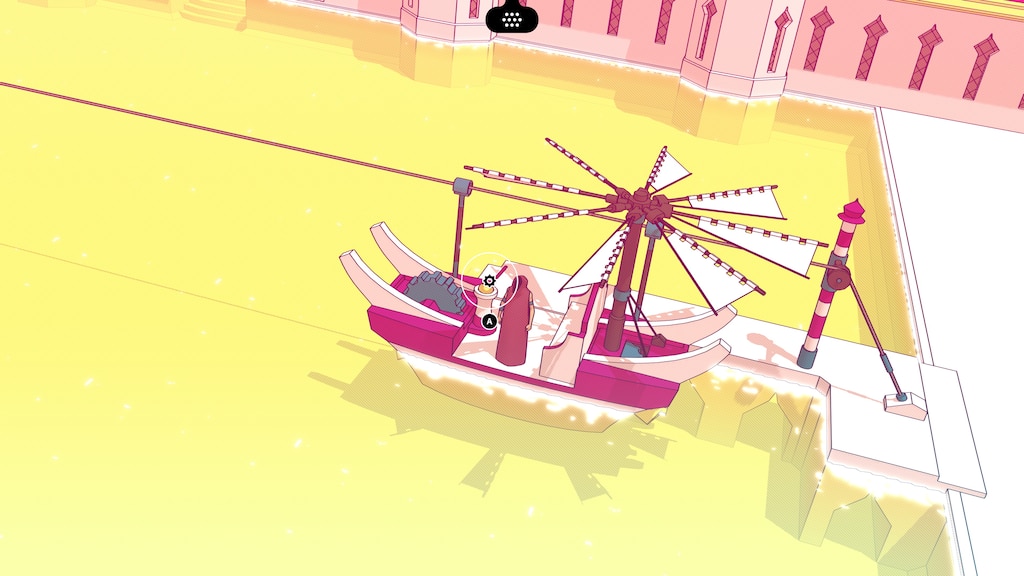
The graphics are very simple, with mostly basic 3-D shapes, hard lines, and bright pastel colors. While this leaves the world not overly detailed, everything is easy to discern, including where you should focus your investigating. A hotspot highlighter is only one button press away (which you can thankfully hold down indefinitely) if you do happen to miss something. The music, consisting mostly of string and other orchestral sounds, has a Middle East vibe that is generally pleasant.
The controls are also simple. You can use mouse or a gamepad to move around, but you will need a keyboard to type in your answers. I alternated between these controls and also played for a while on the Steam Deck, where an on-screen keyboard popped up when necessary. Regardless, all of these options are smooth and intuitive.
Advancing to the top of the tower is not the only goal. You also have to help these cultures learn to appreciate each other. This part of the game may be my favorite, though it’s also oversimplified. Through each level of the tower there are one or two terminals. You can use them to quick-travel to any previously accessed terminals, which is an absolute must to keep your sanity. The second feature is to help facilitate conversations between two representatives from different cultures, by acting as an interpreter in a conversation. Successfully doing so allows them to appreciate how similar their cultures really are, and the fruits of your labor will be seen throughout the tower, making it more lively.

Unfortunately, I soured a bit on how the game ended. When it generally follows the Babel story I was intrigued, but it takes a bizarrely surreal trip at the end that seems there mostly just to throw the player a loop rather than enhance the actual narrative. It doesn’t ruin the ending, per se, but it makes the ride there a lot less pleasant.
Despite the satisfaction at deciphering the language, I can’t see myself returning to Chants of Sennaar as the narrative just isn’t strong enough to want to experience again. But I have no problem recommending this to any adventurer who enjoys language puzzles.
 Death By Troggles