
Publisher: 11 bit studios
Developer: Starward Industries
Year: 2023
Platform: Windows, PS5, Xbox Series
Rating: 5
Based on the 1963 hard science fiction novel by Polish writer Stanislaw Lem, The Invincible is the first game by Polish indie developer Starward Industries. A walking simulator with eleven possible endings based on choices you make, this game does a fine job at honoring the spirit of hard science fiction, while unfortunately allowing the game to be slower-paced than actually reading the novel.
With first-person gameplay similar to Firewatch, you take control of astrobiologist Yasna (not in the novel) who has awoken on desolate planet Regis III, with scattered memories of why she’s there. Based on maps and a journal you find in your backpack, you remember that you have five crew mates and a base camp to get back to. Walking through the desolate terrain, you eventually come to your first decision in the story: find the rope you saw in the distance to climb down a sheer rock face, or slide down and pray. Rest assured your decision matters not, and only changes some of Yasna’s narration as well as a panel of the ongoing old-style comic book that tracks the game’s plot. A few flashback scenes with all six crew members play out that are triggered by Yasna finding something familiar; they do a nice job outlining the plot and thankfully are only used in the beginning.
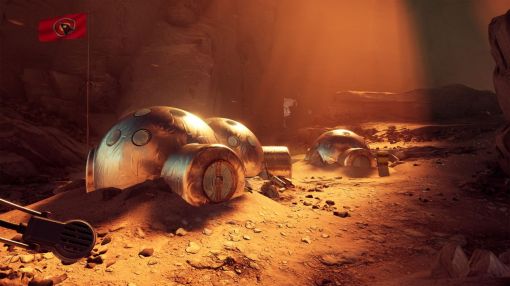
Eventually you reach camp only to discover a malfunctioning andro bot and a malfunction crew mate, who is in stable condition but catatonic. Stealing his communication equipment, you are able to connect directly to your orbiting ship where your mission commander and astrogator Novik is there to help guide you and keep your company for the rest of the game. You learn your mission is as follows: your team is a member of the Interplanetary Commonwealth, a space faction that is in a space race with the Cosmosolidary Alliance, who appear to be winning. Your faction got word that their adversary’s super large and super powerful space cruiser, the Invincible, was on their way to Regis III, and Novik decided to take the Dragonfly, which was considerably closer, to the planet in order to discover what the Alliance was hoping to find. After several days of excavating, your crew appears to have been in an accident of some kind. Yasna decides to try to find the rest of the crew and find out what the Alliance is up to.
Gameplay is somehow both exceedingly simple at times and pointlessly obnoxious at times. You are generally told what to do and where to go, and given that the game has no puzzles, there’s little in the way of thinking you have to do for the duration. At the same time, moving around is generally a chore. There are large swaths of nothing in between destinations. And while Yasna can run, she can only do so for about six or seven seconds before tiring and returning to walking speed. While this is realistic, it means that a significant portion of the game is just walking around looking at space rock. Beautifully rendered space rock, but space rock all the same. Moreover, you cannot jump, and climbing can only be done at specified locations that don’t reveal themselves to be until you’re right on top of them. Early on, there’s one rock face you need to climb, and for no reason the only point you can ascend is at one of its higher points.
Conversation is often interactive. When Navin is speaking to you, you often have two or three possible responses, or in some cases you can decide not to speak at all. How you respond almost never impacts the game in any way, but at least it gives some interactivity.
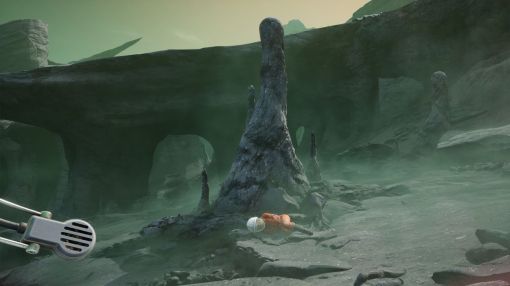
Yasna has tools at her disposal, including a set of powerful binoculars, a human/robot detector, and a metal detector. They are easy to use, but sadly are only helpful when the game explicitly tells you they are. Rather than use this cool technology for sci-fi puzzles, they are simply storytelling devices. For a time you also get a floating androbot (that you can name) to follow you around, but again its only uses are predetermined by the game.
The graphics are great, but everything is just a bit muted by how utterly drab a rock planet appears. There’s only so much you can do with tan and dark tan. Everything human-made is covered with tan dust. The aesthetics are atompunk, which is to say that the futuristic technology has the appearance of sci-fi projects from the 50s and 60s. This means fewer buttons and computer looking devices, and more vacuum tubes, levers, and key cards. I also had the misfortune of purchasing the game not realizing my computer didn’t meet the graphics card requirements; thus, I played it on the Steam Deck, which while fully functional, probably didn’t do the majestic planet justice. Even so, the face models of characters appear lifeless, and not just for those rendered catatonic.
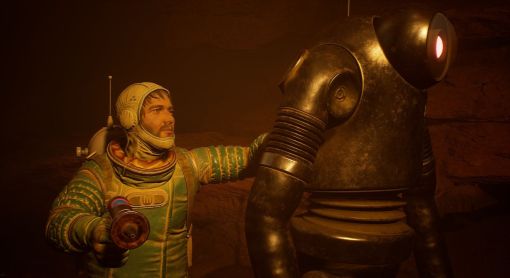
Thankfully, the voice acting is exceptional. British actress Daisy May has a very soothing voice, whether she’s humming to herself, making a desperate plea for help, or waxing philosophical about microbots. She sounds so much like Charlotte Ritchie (Dreamfall Chapters) that I assumed it was the same person. Jason Baughan also plays a convincing and likeable commander. It’s a good thing, too, as Yasna and Nivan make up 90% of all the dialogue.
The story itself, as alluded to before, is hard sci-fi. There is a lot of technical speak, the robots aren’t cute or snarky (in fact, they don’t talk at all), and there aren’t cheap thrills or jump scares. The overriding theme is that space is brutal, unforgiving and relentless towards life, and humans’ understanding of the universe is infinitesimal. The theme comes across well, and with the likeable lead characters you would think I would have loved this game. But man, it just drags. Not only is there a ton of silent walking (and silent driving), but the final third of the game is endless exposition. This comes to a head in the game’s final moments, when decisions you make can branch off into many different endings. I just didn’t have the patience to find them all, as you have to sit through so much dialogue you can’t skip (which is odd, since you can skip almost every dialogue during the rest of the game).
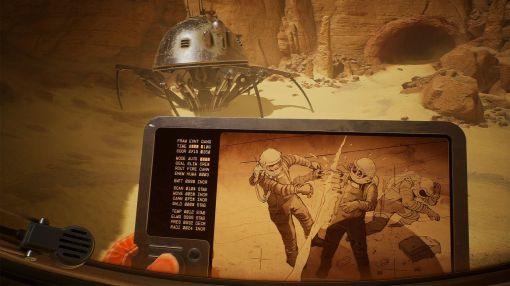
I did go on-line and watched the endings, and other than one particularly cool ending (which is probably considered the “best”), most of them are ambiguous and not terribly satisfying, even the bad ones. Though, to be fair, apparently the end of the novel is even more ambiguous. It’s not that I need a fairy-tale ending, but when you sport eleven possible outcomes, it would be nice to have each of those endings be distinct from one another, and perhaps answer some of the many dangling plot threads.
One thing that could have greatly improved the game was to deepen the lore, especially when it comes to the history of the Alliance. While you can find the occasional note or journal entry in some of their deserted camps, the game could have tripled the amount of clues to find and it still wouldn’t have felt like too much. You learn so little about almost everyone (including Yasna!) that the enjoyment of the story mostly boils down to the enjoyment of the science, characters be damned.
Ratings on the game are definitely mixed, with many people adoring The Invincible, and many in my camp who feel like there was a lost of missed potential. Even so, it’s certainly a comfortable game and I remained motivated to the end.

 Death By Troggles