
Publisher: Tlön Industries
Developer: Montraluz
Year: 2025
Platform: PC, PS5, Xbox Series
Rating: 1
Full disclosure: Outside of The Stanley Parable, I have never played a game about liminal spaces. That game relied on narration to engage the player, but from what I gather, many others about suspiciously empty rooms go for horror, with stalking entities or jump scares to keep you on the edge of your seat. Montraluz’s first game, Dreamcore, strips away all of that, creating enormous labyrinths of mostly nothing, almost exclusively relying on the player’s imagination to create tension and intrigue. However, while I appreciated the occasionally entertaining visual aesthetic, long before the end my imagination had been dulled by exhaustive monotony.
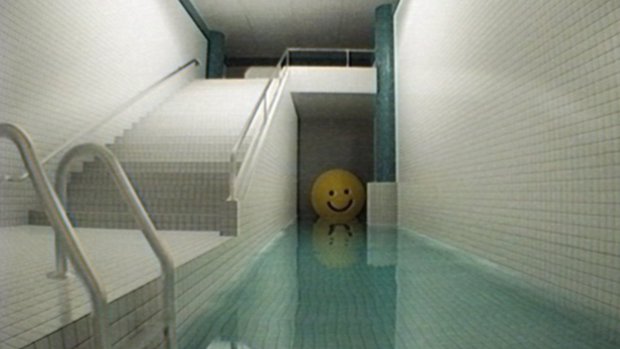
Based on familiar levels from the “Backrooms” fictional universe, Dreamcore currently offers two (presumably unconnected) dreamlike worlds to explore, with three more still planned as part of the base purchase price. The first is titled “Dreampools,” presenting you with simple instructions: “Do not underestimate any detail. Patience and observation is key.” You then find you have tumbled out of a long water slide (sans water) into a brightly lit room with porcelain tile, stainless steel bars, and a still wading pool. Playing with a first-person camera and using the mouse and keyboard (the game said it offered partial support for my Xbox controller, but every time I tried it the game crashed), you simply move through rooms until you find something important.
Soon you come across a darkened room and are told you need to find a flashlight to enter. And so is presented your one and only puzzle, searching through 500 rooms to locate it. Almost every room has at least two exits and some have up to a dozen, with long winding staircases and twisty turns to make it truly disorienting. While one could presumably map the area, it would be incredibly difficult given how few rooms are similarly shaped. Also, the location of the flashlight is randomly generated, further encouraging you to sit back and enjoy the exploration.
For my first hour, I was somewhat enjoying myself. The default graphical setting looks like found footage, the VHS-like visuals giving the experience a slightly creepy vibe. While the whole complex is filled with tile, pools, and brightly colored water slides, there’s enough variety in the architecture of each room to keep things interesting. Very occasionally you’ll see something out of the ordinary, such as a sculpture or hand-written drawings on the walls. There’s also plenty of giant yellow smiley face balls around, and every once in a while one will creepily move and stare at you. Disappointingly, you can’t travel down any of the slides, but I still felt like I was making progress just by finding new and interesting rooms.
But after two plus hours of walking through the same mostly empty rooms, I gave up and looked online for a hint. As it turns out, finding the flashlight includes listening for an audio cue that I had never heard in my entire two hours searching. Wondering why I had never heard this cue, I switched from external speakers to headphones and immediately noticed it. Do I have garbage speakers? Probably. Should the game advise players to use headphones? Absolutely. Should the game be better suited even to less-than-optimal speakers? Definitely. It doesn’t help that your footfalls while moving around are very loud (especially while running, which is necessary for sanity), capable of drowning out the mild cues and likely tempting you to turn down the volume.
After I found the flashlight, I entered the next area and somehow completed it (by finding an exit) in a mere five minutes, apparently by luck. If there were hints, I neither noticed nor needed them. As “Dreampools” ended, I was frustrated but at least understood how this environment would appeal to the right player. But then I played the second scene, “Eternal Suburbia.”
Waking up in an abandoned house, you make your way outside, only to discover rolling hills and dozens and dozens of nearly identical empty homes (each with two or three exits), reminiscent of an atom bomb test site. All the homes are surrounded by impassable fencing, with usually no more than two or three accessible at any time. After exploring a few homes, you’re likely to find a helpful hint on where to go. Of course, that destination is far, far in the distance and there’s no straight line. Due to the asymmetrical yards and fencing, it’s impossible to deduce a clear path. I spent a good hour tracing and retracing my steps, finding nothing remotely interesting to look at along the way. And even once I solved this area, there were two more suburbs to tackle, both with still more endless lines of empty buildings to navigate, looking or listening for the most subtle of clues. A rare couch or change in wall color did nothing to lift the glaze from my eyes.

Other than your own footsteps, there is little ambient sound. There’s a generic splashing water sound as you trudge through the wading pools, and doors will creak when you open them, and that’s about it. In the first level of suburbia, some old-timey jazz is playing on the outdoor speakers, but I was tired of that too before things were over.
I am sure there is an audience for this sort of pure exploration game that will enjoy the experience. Needless to say, I would have preferred more substance, and perhaps the next three levels will provide it. However, while the visual aesthetic may be worth the price of entry for some, the settings so far are too bland to be creepy, and too stale to be peaceful. As these scenarios are ostensibly dreams, I didn’t expect them to have coherent plots or extensive lore to dissect, but with few exceptions, Dreamcore is stubbornly determined not to offer any sensory input. In turn, my imagination stayed dormant, failing to conjure up thoughts or feelings to keep me interested.
 Death By Troggles