
Publisher: The Chinese Room
Developer: The Chinese Room
Year: 2012
Platform: Windows, Mac, Linux, iOS
Rating: 4
Released just a month before Journey, Dear Esther is often considered the OG of walking simulators (even though it isn’t) and is similar insofar as there is little to do outside of walking and experiencing the story. Unfortunately, a questionable storytelling mechanic severely mars this otherwise gorgeous trip.
As the game begins, you are walking up a boat landing on a remote island of the Outer Hebrides (west of Scotland). The narration, appropriately, begins with “Dear Esther…” and you hear a snippet of an apparent letter. Who Esther is (or the narrator for that matter) is not explained. The goal is also elusive, though it’s not too long before you see a flashing beacon at the top of the island’s highest point, and eventually the narrator tells you that making it there is indeed his goal.

The purest form of walking simulator, the only two things you can do is walk or zoom in (which is never necessary). Running is not an option, which makes sense given the story that unfolds; and considering it only takes one and a half to two hours, is not an inconvenience. The story is told through 34 voiceovers, which are triggered walking over various paths along the isle. Many are impossible to miss, though several only occur if you walk slightly off the beaten path. To be clear, the game is still mostly linear. There are four chapters and only one way to reach the beacon.
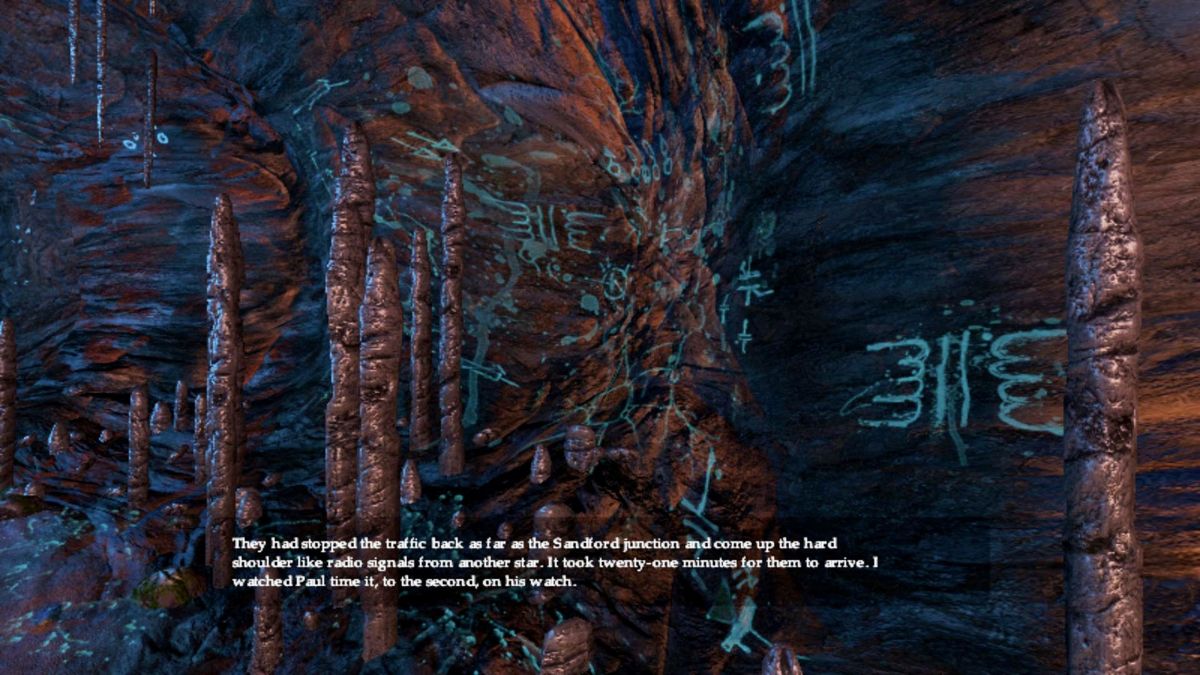
The isle mostly consists of grass, shrubbery, and lots of rock, though visually it is more arresting than it sounds, and that’s not even including the gorgeous cave you explore in the third chapter. This place was once inhabited, and you will come across old ships, flotsam, and decrepit buildings. You can’t interact with anything (with one minor exception), and most items are minimally detailed; still, it feels quite real. The orchestral soundtrack is above average, minimalistic, with relaxing and haunting tunes playing at just the right moments.
Nigel Carrington does an excellent job with the voiceovers; both his voice and tenor are immediately captivating. Sadly, the content was mostly lost on me. The letters are fairly obtuse, with unexplained references that require a diligent ear and extensive interpretation to have the foggiest clue what is happening.

As the game ended, I went on-line to read musings about the story’s meaning. And the theories are pretty cool! So much so that I was annoyed that I hadn’t figured out much of it myself. But then I learned the reason why: nearly every voiceover is randomly selected from a list for each specific location. There are four separate opening monologues, and two separate closing monologues! Some items and sounds are also randomized throughout the journey.
Now, if the game had indicated at any point that this was the case, and that multiple playthroughs will help piece the story together, I might have given it a shot despite the lack of gameplay. I’ve since read the script and while none of the voiceovers give clear answers away, some are more illuminating than others. So in a way I felt a bit cheated given how confusing my randomized playthrough had been.
Those who enjoy relaxing walking sims and don’t mind doing some heavy interpretation will likely enjoy Dear Esther. Meanwhile, my admirations are saved for many of the future games it inspired.
 Death By Troggles