
Publisher: NEXT Studios, 505 Games
Developer: NEXT Studios
Year: 2019
Platform: Windows
Rating: 6
If you’ve been following along you may have noticed my recent obsession with what Andrew Plotkin calls the “static deduction” genre. These are games where you don’t have to dig up clues in a specific order and there are no random elements to interfere with progress; everything you need is given to you from the start and all you need to do is review the information and deduce the answers.
I had played most of the big ones and was searching Reddit for other examples when I came across Unheard, a mystery from Chinese developer Next Studios that has you solving criminal cases just by listening to audio recordings. I’m glad I found it. Despite some inconsistent voice acting, the puzzles are unique and rewarding.
As the game begins, a voice of a female detective informs you that you have been brought in to help with investigating some cold cases using a new technology. She tells you to treat it like a game and presents you with a tablet. When you click on it, the game shifts into a bird’s eye-view mode of a police station, with minimalist depictions of the environment that give it the feel of a blueprint.
The first scene is a tutorial, with one simple question: Who hid the drugs? There are four people in the station, and they are represented by broken white circles. Four names are listed in the corner of the screen, though at the start you don’t know who is who. Your job is to listen to a recording of the interactions, assign a name to each speaker, then answer the question about the drugs. The police officers are easy to determine as they call each other by name. The suspect identifies himself as Tyler right away, but you later learn he lied and his real name is Cameron; Tyler, his twin brother, is in another room being interrogated by the other officer.
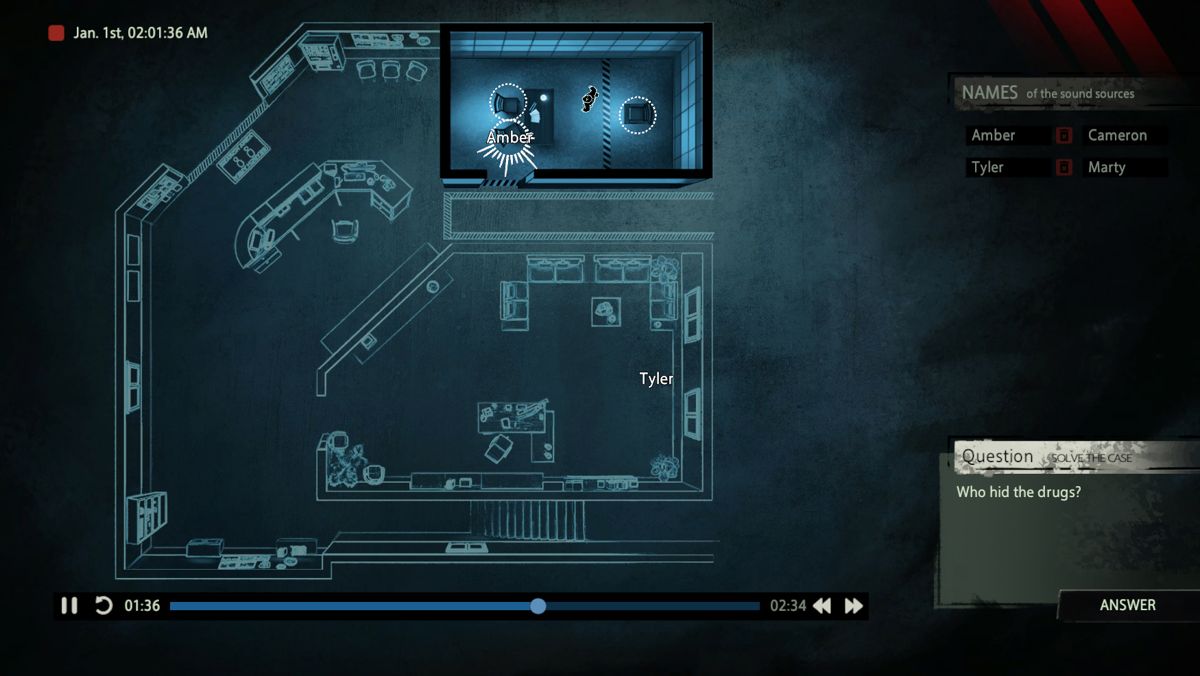
But who hid the drugs? Well, if you only follow the police offers around, you won’t know. But you don’t have to follow the action. Using an avatar on screen, you can move around as you like. When the officers are in one room, you can head into the other and listen to Tyler on the phone or Cameron talking to himself.
If you get anything wrong, there’s no penalty; you’re even told how many characters you got right, if not which ones specifically. However, when I was able to solve a case 100% on the first try, it was much more satisfying. A couple of clues I found a bit too obscure for my logic sensibilities, but for the most part I felt like the answers are straightforward once you put the pieces together.
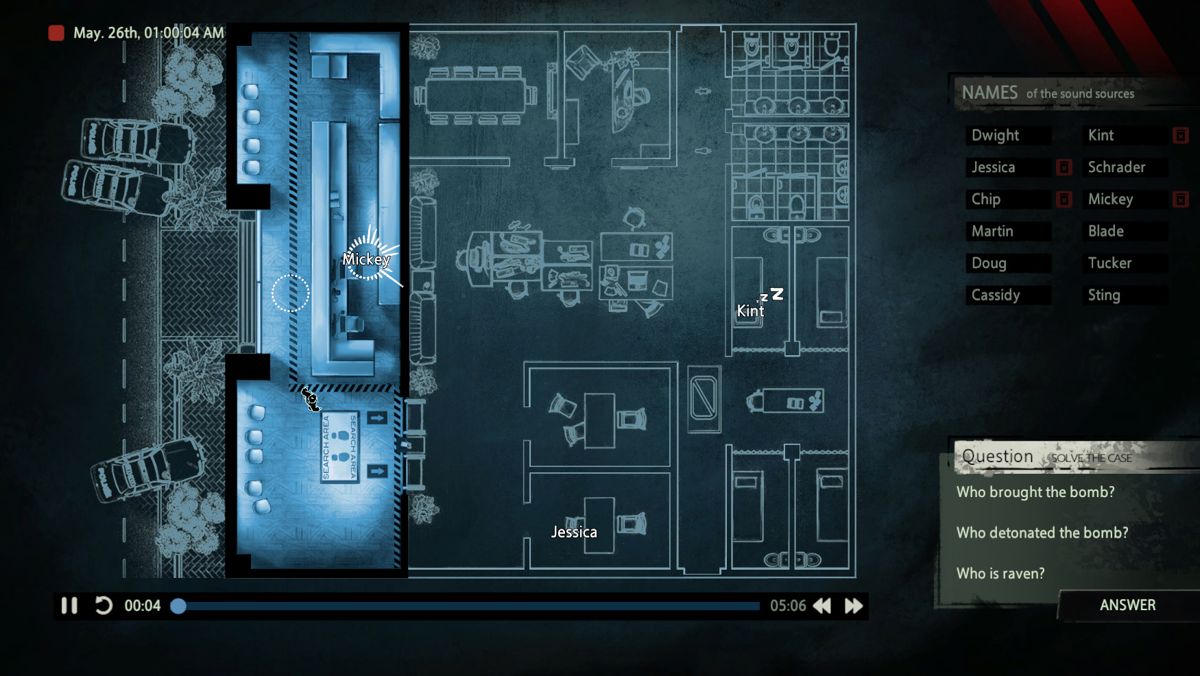
There are four more scenes after the tutorial (five with the DLC), which seems quite minimal. But each scene grows increasingly more complex. The next scene, which takes place at an art gallery, has seven people and two questions for you to answer. The third scene, at a police station, has twelve people and three questions. The final scene has fourteen people to track.
How does one keep track of everything and everybody? For starters, you can pause the recording at any time to catch your bearings. Once you’ve listened to the whole thing once, you can rewind and fast forward to your heart’s content. And you’ll have to listen to each scene multiple times so you can catch conversations happening in every room. Often, you won’t be explicitly told who’s who or what’s what, so you’ll have to deduce answers by combining details you’ve heard in different sections. The recordings have a super helpful notes system to help you keep track.
For example, let’s say a character makes a call on his cell phone, and you want to look to see if anyone else in the room is accepting a call at that time. You can pause the recording, type “Phone Call” in the notes. And when that timestamp occurs, a white chyron scrolls the words “Phone Call” no matter where you’re located. You can then systematically check each area at that timestamp to see if you hear someone else taking a call. There’s no limits to how many notes you can take, and I found them significantly more helpful than taking notes on paper.
At first each scene seems completely disparate, but you’ll eventually begin to recognize some similarities. I honestly would have been fine with just solving a bunch of random cases, but everything is tied up in a delicious little bow at the end game; the a-ha moment when the whole thing came together was quite satisfying.
I would have rated the game higher, but unfortunately the voice acting is pretty uneven. The translation from Chinese is mostly solid, but it’s as if the actors were told to really distinguish themselves so that none of the characters sound similar, and the result is some voices sounding like caricatures. While there’s a definite film noir vibe going on with the dialogue, it’s a bit over the top, even for me. Given the game’s overarching story, I would have appreciated the acting to be more serious.
As mentioned, there’s a DLC that’s quite difficult and satisfying; there’s two more that haven’t been translated into English and it doesn’t look like they will be any time soon.
I think just about anyone who likes deduction games would find the short time with Unheard to be worth their while. It’s certainly a unique sendup of the genre and I’d be happy to play something of its ilk again. There’s something about using one’s ears instead of one’s eyes that gives puzzle solving a satisfying twist.
 Death By Troggles