Publisher: Baggy Cat
Developer: Baggy Cat
Year: 2015
Platform: Windows, Mac, iPad
Rating: 5
I tend to give detective mysteries a wide latitude when it comes to plausibility. Real detective work is mostly boring and spicing it up with smoking guns and gotcha interrogations is often necessary to make it entertaining. Contradiction, the first game by Baggy Cat, is a full-motion video mystery that sees you investigate the death of a local college student by shaking down everyone that’s been in contact with her. A user-friendly interface, enthusiastic performances, and the occasional deduction make this a fun ride, though the sheer implausibility of every waking moment make this hard to take seriously.
Kate Vine was found drowned in the lake in a British countryside village. The evidence points to suicide given Kate’s well-known history of depression, impulsive decision-making, and drugs in her system. But you, Detective Inspector Frederick Jenks are back in town for one more night to see if you can uncover the truth behind her death. Kate’s driver’s license being found by the lake is suspicious, as well as a sketchy business course of which Kate was a member. Your plan is to take one more look around for evidence and interview the five townsfolk most closely associated with Kate: her best friend Emma, Emma’s boyfriend Simon, and the Rand family (Paul, Ryan, and Rebecca) associated with the business course.
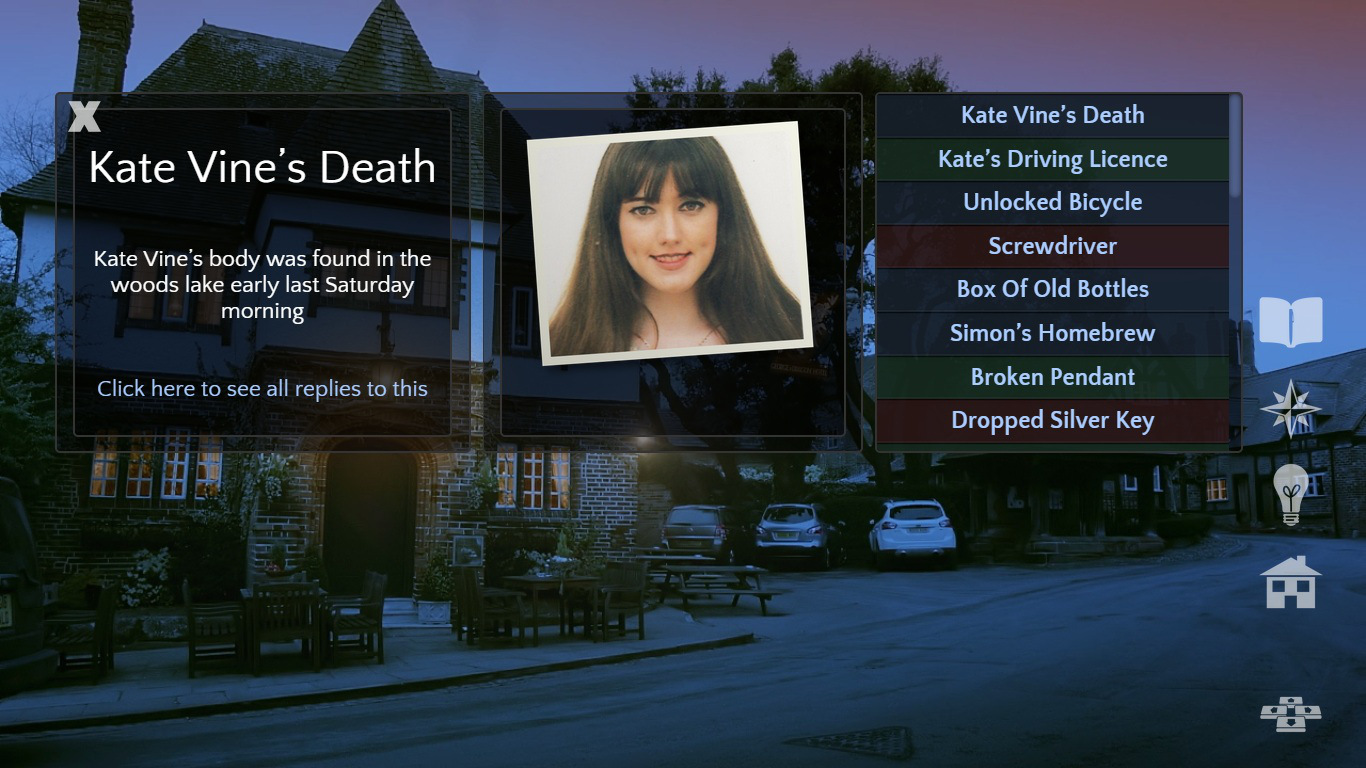
Play is welcomingly simple. You can move throughout the town via pre-rendered shots either by clicking on the labeled exits or pulling the map and clicking your destination. If there is something to investigate in a scene, a magnifying glass will appear; click on it and Jenks will automatically find the evidence in the area. The bulk of the game, however, is your one-on-one interviews of the witnesses and potential suspects.
Each person you interview readily invites you in and answers your questions. Evidence and topics of interest will be displayed on the screen, and simply clicking on them prompts a video of Jenks and the witness diving into it. When the video ends, that topic will then include below a summary of the witnesses’s responses. As the game’s title suggests, your primary way of advancing the story is to find contradictions in their testimony and point it out to them. So after exhausting all available topics with a witness, you may have five to twenty independent statements to sift through. When you find two that seem to contradict each other, you can click on them. If you find a correct match, a video will play where Jenks surprises the witness, sending them scrambling to tell you a different story.
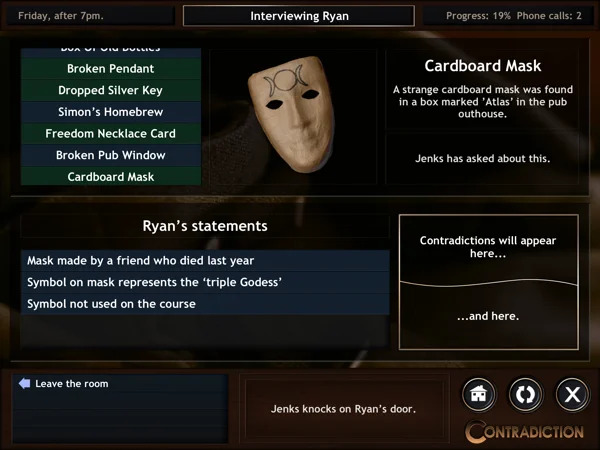
And that’s the game. It’s rather easy at first as you only have so many conversation summaries to sift through. But by the end of the evening, your witnesses may have given you forty statements each, so finding the contradictions becomes a bit more challenging. Hints are readily available when you get stuck. Clicking on the light bulb will nudge you in the general direction of which witness to tackle next (or which location to visit), and you can call your chief for advice at the local telephone booth. The chief will push you towards a particular witness, sometimes more explicitly about which topic to pursue further, narrowing down your options. If that’s not enough, you can request a “cheat” that will give you the answer to keep going.
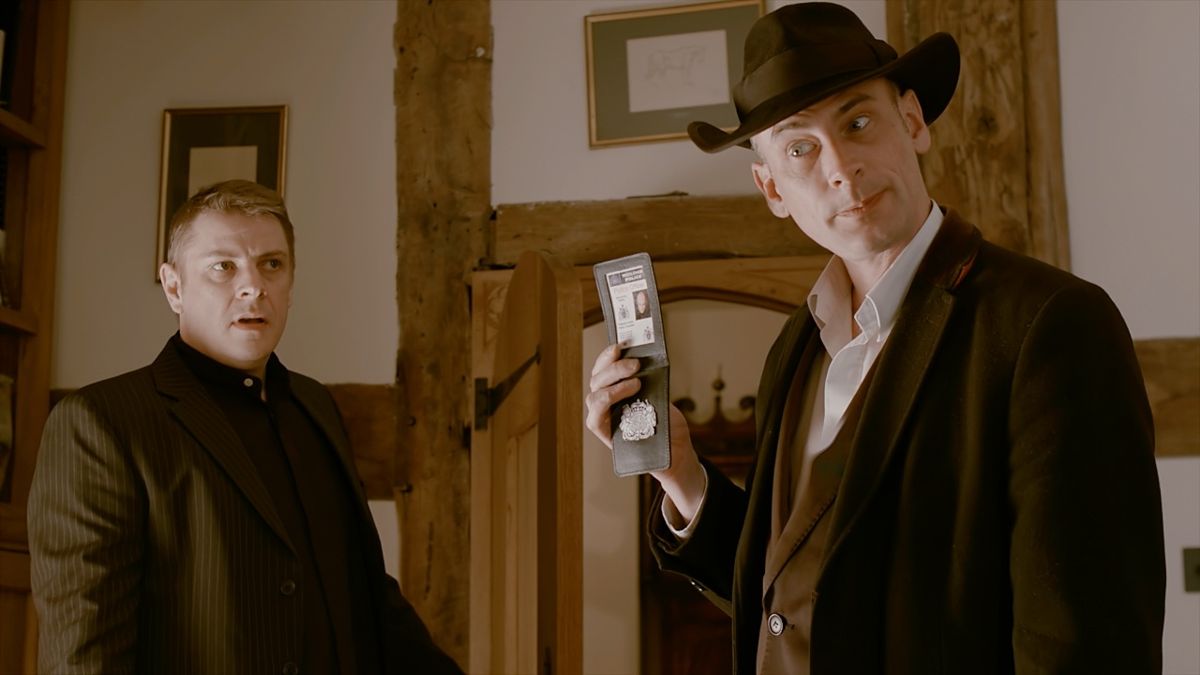
The interviews themselves are delightful. Jenks himself is preposterous, using exaggerated facial expressions and tonal inflections, coming off as disingenuous as possible. At no point does he try to make the witnesses feel comfortable or validated; he’s mostly just smarmy and condescending. This would work better if the witnesses acted the same way, but most of them play it straight, making their willingness to engage with Jenks laughable. However, the actors appear to be having a lot of fun, which went a long way to ensure I was having fun as well.

John Guilor is hilarious as Ryan Rand, the creepy teacher of the Atlas business courts, always holding a tumbler and gesticulating at every opportunity. He sips his brandy approximately ninety-seven times throughout the game, yet is somehow still sober by the end. Melanie Gray (who has since been cast in a couple of episodes of Outlander) is excellent as Ryan’s cold but loyal wife Rebecca. My favorite performance, not surprisingly, is by seasoned actor Paul Darrow from the hit sci-fi show Blake’s 7. He is pitch perfect as Paul Rand, the founder of Atlas, as he takes sadistic pleasure in making Jenks uncomfortable.
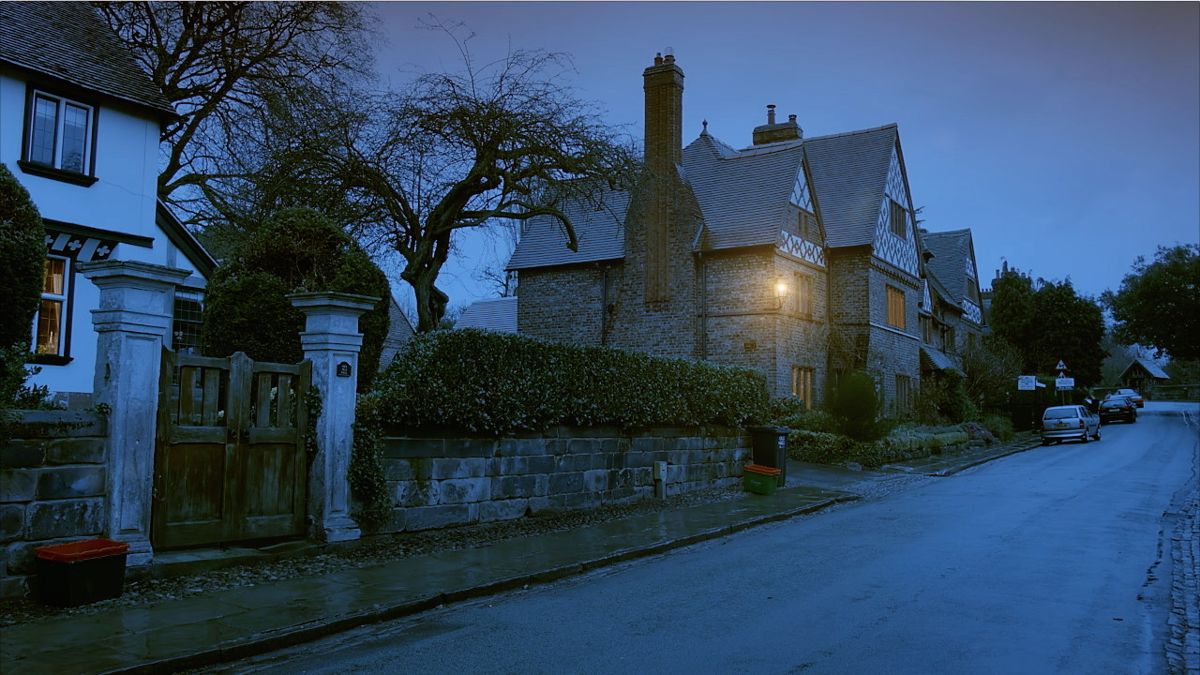
The scenes are shot on location, primarily in the village of Great Budworth in Chesshire. The setting is gorgeous with its rolling hills, brick homes, and shrub and stone fences. All of your interviews, however, take place indoors. The background music seems to take the game more seriously than its plot deserves, but it’s pleasant all the same.
Where the game falters on a pretty grand scale is the overall implausibility of the investigation. To wit:
–Witnesses keep allowing you to re-enter their homes again and again and again, often to ask just one more question, even though they’re under no pressure to stay put.
–Jenks interviews Emma and Simon in separate rooms of their house, which they for some reason not only readily agree to, but then never compare notes when you’re away.
–Some of the contradictions could easily be explained away by poor memory, yet the witnesses often crumble immediately.
–Several times witnesses contradict each other, but Jenks never uses that to his advantage.
–Jenks regularly breaks into people’s private areas and steals evidence without a warrant. Yes, real police do that. But the witnesses are never shocked or angry at Jenks for doing so. They all be like, “Oh, so you’ve snooping around, good work.”
–Jenks interrupts a violent act at one point, but without further questioning anybody present, walks away to think about other contradictions.
–The climax is preposterous, catching the guilty party in the flimsiest of lies with circumstantial evidence, yet they spill everything on the spot.
On top of that, several other mysteries remain at the game’s end, making you feel like you’re only scratched the surface of a much more interesting story we never get to see. It doesn’t even feel like it’s being set up for a sequel, so all the dangling threads seem rather pointless. And then at one point Jenks make a tasteless joke about police brutality that left a sour taste in my mouth.
Contradiction is by some seen as reviving full-motion video games, doing away with a lot of the sins of the genre from the 1990s, though I’m sure Her Story, which came out a few months later and is a much better game, contributed to the renaissance as well. I would certainly recommend Contradiction to the fans of the genre, as it’s easy to play and an entertaining diversion. As long as you don’t go in expecting a thrilling, realistic mystery, you’re bound to have a good time.