Publisher: Wadjet Eye
Developer: Wadjet Eye
Year: 2013
Platform: Windows, Mac, Linux, Android, iOS
Rating: 3
The Shivah, released in 2006, was Dave Gilbert’s first game released under the Wadjet Eye Games label, though it was freeware. I haven’t played it, and appears there is no reason to given that the commercial re-release–known as the Kosher Edition— was not only ported to a bunch of new systems, but also significantly improved the graphics, audio, puzzles, plot, and added live voice acting. It’s a short, somewhat endearing adventure about a rabbi who is coming to terms with his past while investigating the murder of one of his former congregants. While competently produced, there is a severe lack of character development and almost nothing that happens feels remotely realistic.
Russell Stone is a cynical Rabbi in Manhattan who is having a crisis of faith, which has led to an increasingly diminished membership and financial woes. He’s on the verge of calling it quits when he is visited by the police, who inform him that Jack Lauder, who Russell kicked out of the congregation almost a decade ago, has been murdered. Russell is suspect number one as Jack has apparently left Russell a cool ten grand in his will, though this comes as a total surprise to Russell. Intending to clear his name, he sets out to investigate the murder on his own.
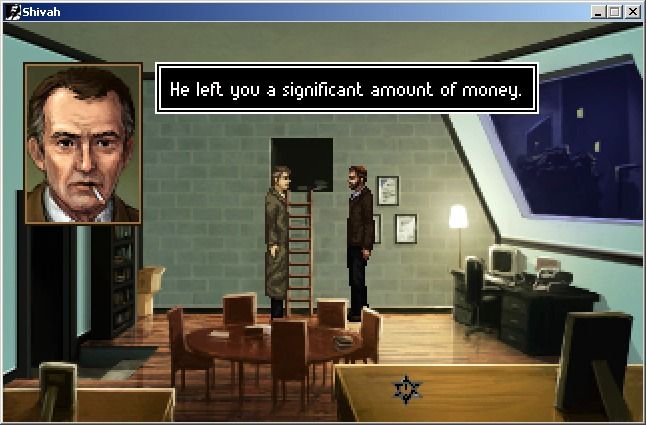
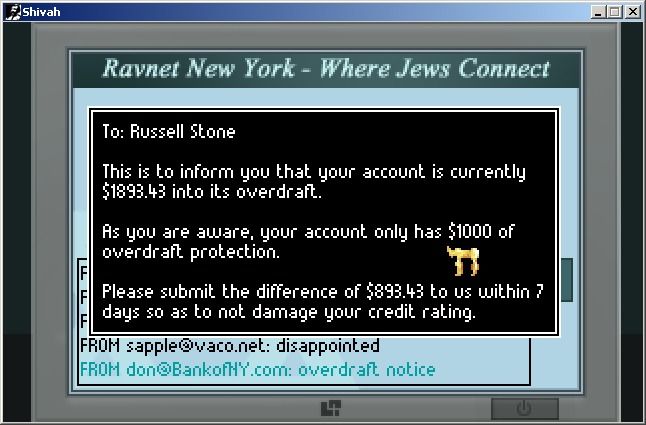
The first thing Russell must do is one of my adventure game sins. He must log into his computer, and while he clearly knows the password, you have to deduce it yourself from clues at your disposal. It’s clear that Russell is not a computer aficionado, but the game doesn’t even suggest that he may have forgotten his username and his password. And while figuring out the username is easy enough, the password is a complete guess-and-check exercise.
With no drag-and-drop inventory puzzles, using the computer is a good portion of your detective work. And by computer I mean the local Rabbi network you’re plugged into. You get your own personal e-mail, but you share the same search engine intended to only produce results related to the local Jewish community. And there’s a button you can click that will spew synagogue-friendly jokes at you. You can’t write any e-mails, and you will not get any new ones as the game progresses. But some of them hold clues. And the search engine is done nicely, as it will bring up relevant results for places or names you type in, alternate spellings included.
After using your network to locate the late Jack Lauder’s wife, you pay her a visit under the guise of offering your support during her mourning (hence the game’s title). Jack married a (non-Jewish) Indian woman, which is the primary reason he and Russell are on the outs. Rajshree Lauder, while voiced competently (though by a white woman for some reason), does not feel like a real person. She is too nonchalant, not to mention not very busy, for someone whose husband was literally shot the day before. Nevertheless, she gives her blessing for you to investigate her husband’s murder and a few more leads follow. You will investigate their place of business, another synagogue, and a dive bar in the area.
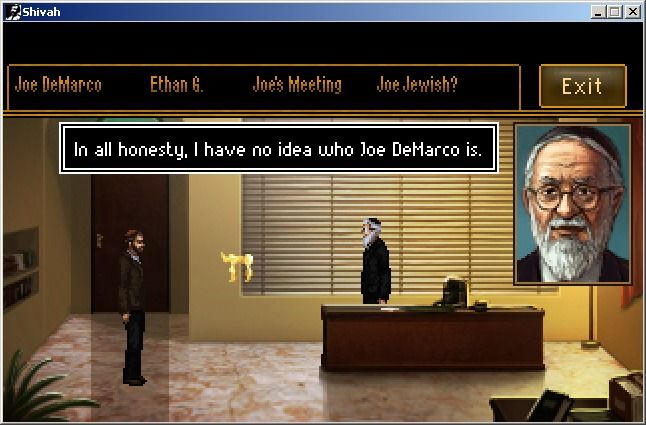
As I mentioned earlier, there are no standard inventory puzzles. However, clues will appear in your inventory (such as a character’s name), and you can combine them to get Russell’s thoughts on the matter, which sometimes creates a new clue. You can also ask other characters about these clues, which takes the place of your standard conversation tree. When characters ask you a question, you are offered three choices of how to respond, including a “rabbinical response” which amusingly means always answering a question with another question.
Russell is a trained boxer and two puzzles near the game’s end are reminiscent of sword fighting in The Secret of Monkey Island. While deducting how to win these fights is relatively easy, I was amused. However, you will definitely want to save your game regularly in case you lose these fights.
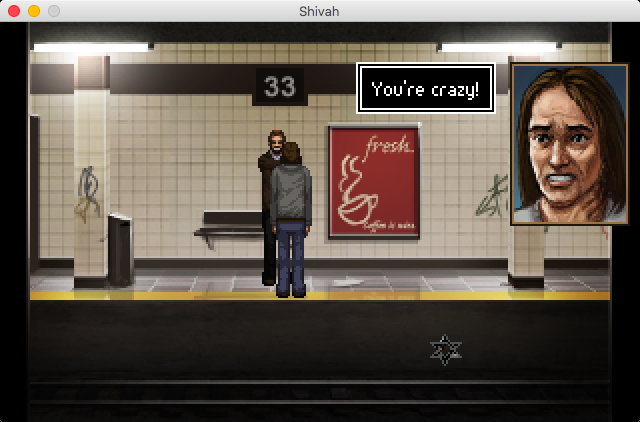
While the graphics are serviceable, they look quite amateurish. The perspective feels off regularly, and the colors are rather drab. When character speak, they do get a nicely drawn close-up headshot. The somber soundtrack is pleasant, though unmemorable. And the voice acting is underwhelming. Abe Goldfarb, in his debut role as a voice actor, plays Rabbi Stone. Abe was in his late 20’s at the time (and mid 30’s for the remake), and it’s clear he’s trying to sound like a weary, well-traveled older man and it doesn’t work. I just kept thinking to myself that this old guy sounds like a kid.
While I found nothing to really write home about while playing The Shivah, I would still recommend it to those who want to see where Wadjet Eye got their start. At only a couple of hours long, it’s worth the time to see the brief flashes of ingenuity that came to define perhaps the most well respected company in the adventure game genre. And, well, when else will you get the chance to play a pugilist rabbi?