Publisher: Bandai Namco
Developer: Supermassive Games
Year: 2020
Platform: Windows, PS4, PS5, Xbox One
Rating: 2
While the first game in The Dark Pictures Anthology (Man of Medan) was a hot mess, it utilized the same general design as Until Dawn while improving the graphics, motion capture, and maintained the solid acting performances. So I was optimistic that Supermassive Games would have learned from their mistakes for their next offering. Sadly, while Little Hope still offers scares, it duplicates nearly every issue of its predecessor while deploying more inane dialogue and uninspired acting performances.
As the game begins, you see a bus driver pulling out of a diner parking lot late at night. He stops at a roadblock up ahead, and an office directs him to take a detour through the ghost town of Little Hope. The driver obliges, but then soon sees a young girl in the middle of the road. Swerving, he crashes the bus.
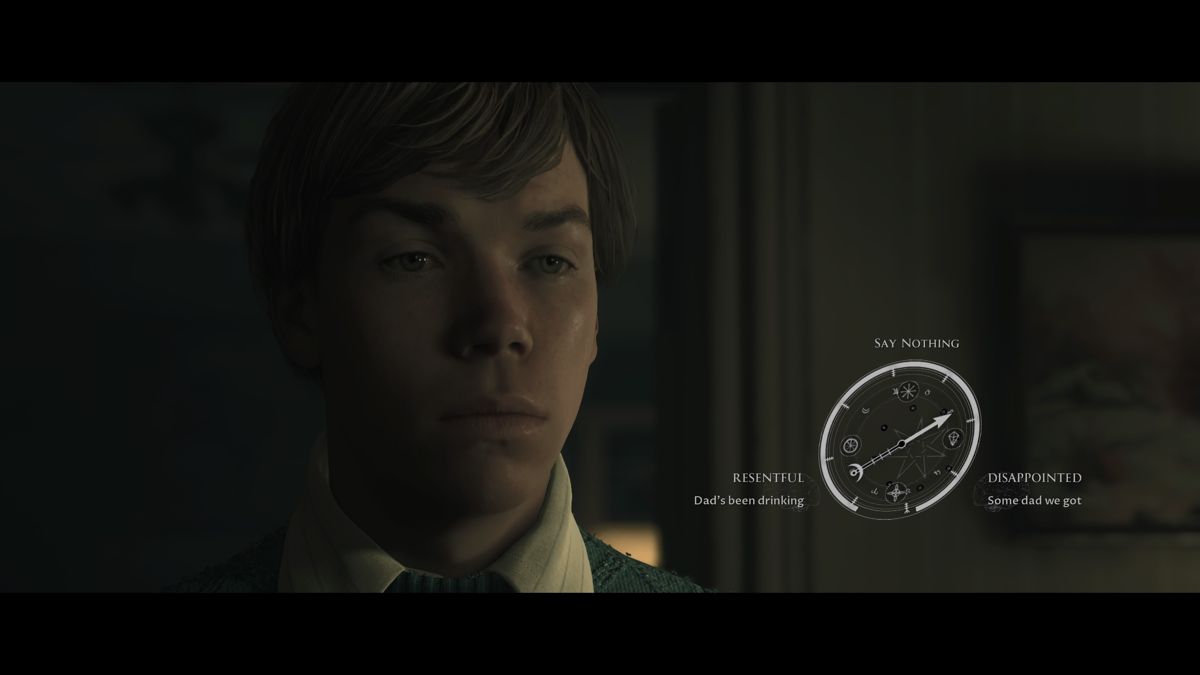
We then cut to a two-story home. The dad comes home drunk, he argues with his wife, and the four children (three teenagers and the young girl we just saw) get annoyed with each other. You take control of teenager Anthony in a fully three-dimensional environment, learning some basic mechanics such as picking up and examining items, practicing a breathing technique (more on that later), as well as making conversation choices in a timely fashion. No matter what you do, however, a series of unfortunate events occur that lead to the house starting on fire. No matter what you do, everyone in the house is killed by the fire, and Anthony, distraught, runs back into the house.
We cut one more time to the bus accident as five people, who all look and sound virtually identical to the five people in the house fire (minus the young girl), are gathering themselves, mostly uninjured. We learn that the older man is a college professor, and he was on a field trip with his students. Taking charge, he leads his students away from the bus and into the town of Little Hope. Unexplainable things occur from the get go. If they walk through fog, it sends them back to their starting location, forcing them to walk straight into town. Some of them begin hallucinating. And most crucially, they start having out-of-body experiences.
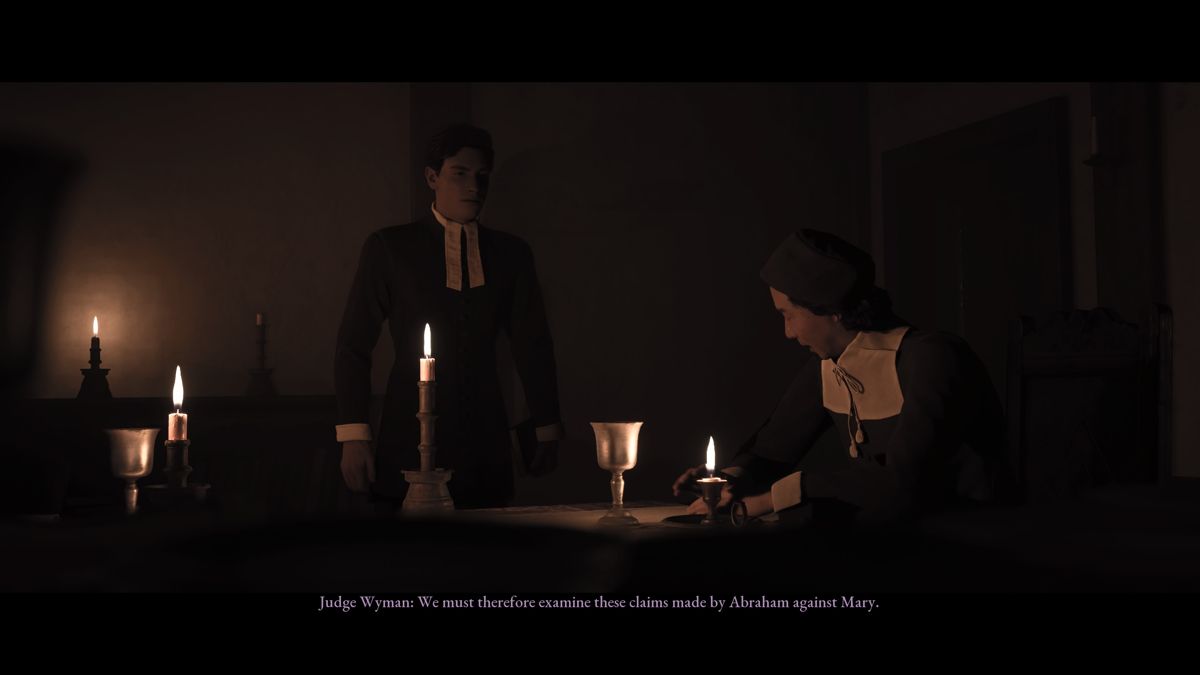
Every so often, a ghost will reach out and grab one of the protagonists. They will then be transported to the late 1600s and watch a scene play out. At this time in Little Hope’s history, fear of witches has brought the town to its knees. You will be witness to key moments in the witch trials. But rather than being mere hallucinations, you are actually there, able to be seen and heard by the town’s citizens. Oh, and did I mention everyone then also looks like everyone in the present?
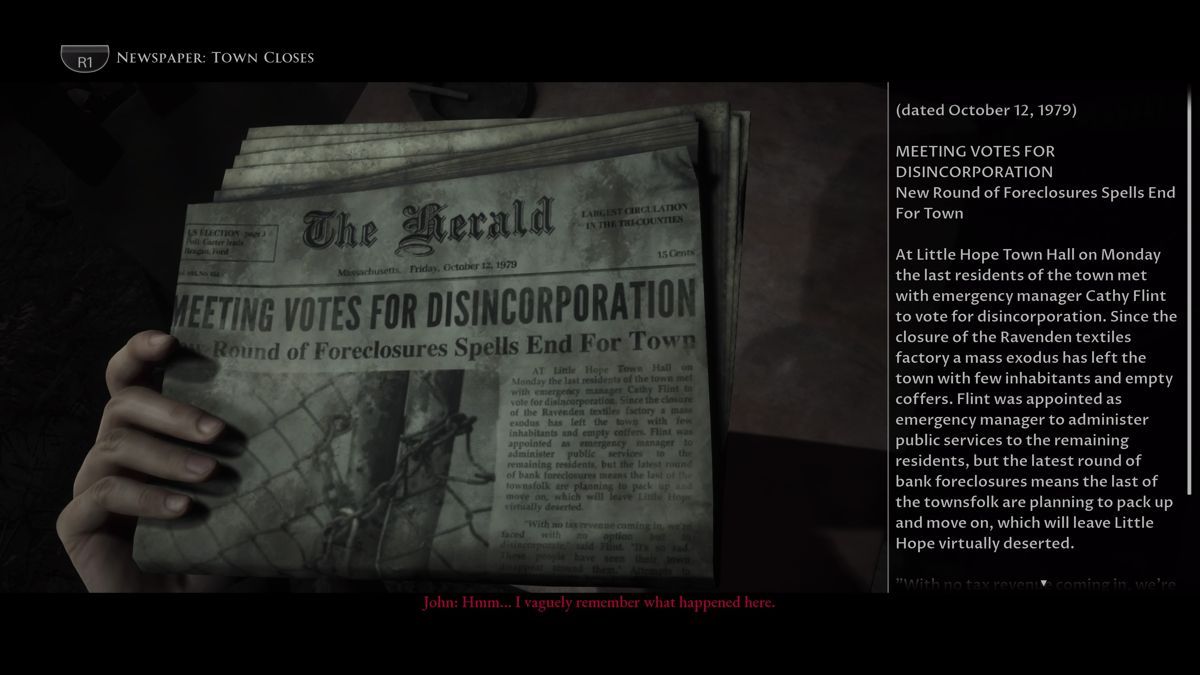
That complex mystery is complemented by near constant-tension. You will take turns playing as the main five characters on multiple occasions. In general, you will walk around a limited area (such as a short road, a bar, or a museum) and examine anything that is highlighted by a small, flashing white light. Many things you observe will just be lore about not only the witch trials, but also the economic conditions in the 20th century that led to the town being abandoned. But you also have a couple of opportunities to pick up a weapon (which may or may not be a good idea).
There’s the occasional jump scare during these sections, but the real scares come from pre-scripted events where you’re being chased by…well that’s a spoiler. At times you will need to perform a quick-time event, which usually consists of pressing the correct button. But there’s also some spots where button-mashing is required, something I thought we left back in the 90s. As mentioned earlier, there will be times where you are hiding and have to press a button in time with scrolling heartbeats; while generally easy, I did mess this up a couple of times. Finally, there will be brief moments where the scene goes into slo-mo, and you have to quickly move a target over your assailant to attack them, whether it be with a rock, branch, your own foot, or a weapon you’ve acquired.
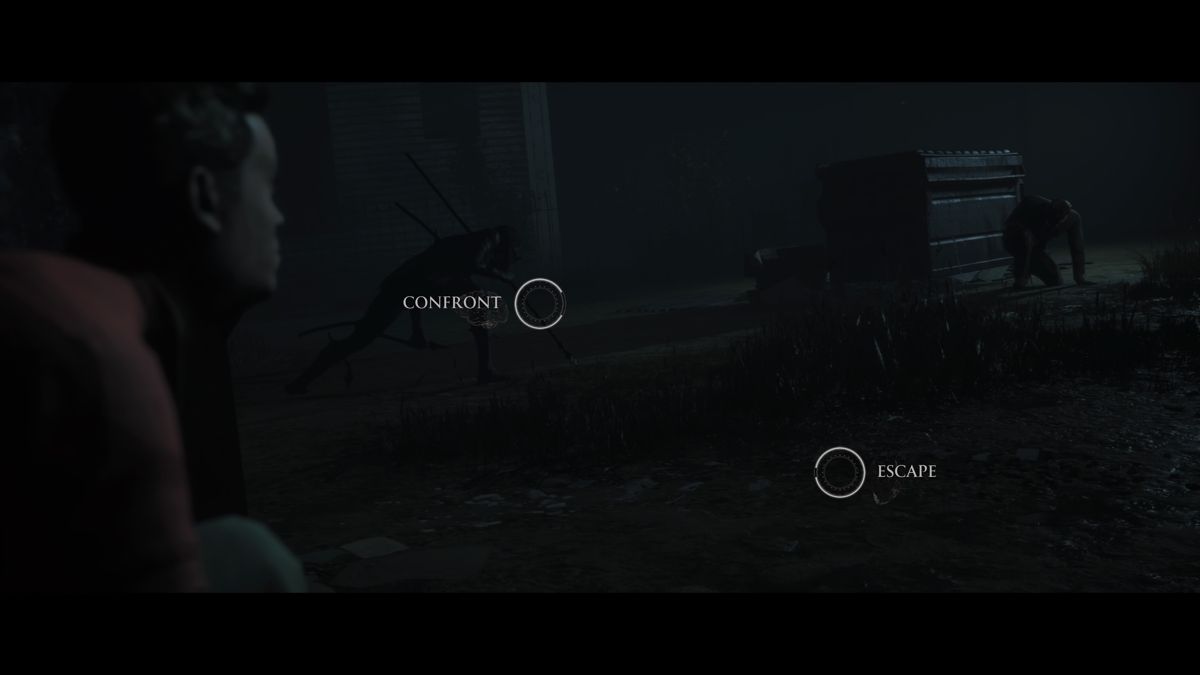
Most of the time, thanks to music cues or long cuts, you can mentally prepare yourself for the life-or-death sections. Occasionally, however, they will spring up quickly, requiring you to generally be on alert at all times. Many sections do allow you to fail a QTE or two and still survive, but you never know when you can be afforded a mistake. These were easily my favorite parts of the game, giving me the adrenaline rush that was sadly needed due to be being utterly bored at nearly every other moment.
The game’s worst sin is the insipid dialogue. I swear at no point did I feel like anybody was having a real conversation. Part of this is due to some clumsy cuts, as with so many choices to make and different possible game states (often depending on who is still alive), conversations occasionally fail to flow naturally or cut off abruptly. Beyond that, I think at least eighty-four times a character says a version of, “We need to get out of here.” Not only is the line cliché, it is frequently said right after another character says, “We need to stay right here.” Nobody ever gives a reason and nobody ever has a plan. They mostly just fill the silence with chatter, often loud enough for the whole town to hear. One of the few things I enjoyed about Man of Medan is that the protagonists shared intel and acted logically. Here they’re just a bunch of bumbling idiots. We barely get to know them, and it doesn’t help that the acting leaves a lot to be desired. The exception is the game’s star, Will Poulter. His non-verbals are consistently excellent, and even when he’s given shitty lines, he makes them believable.
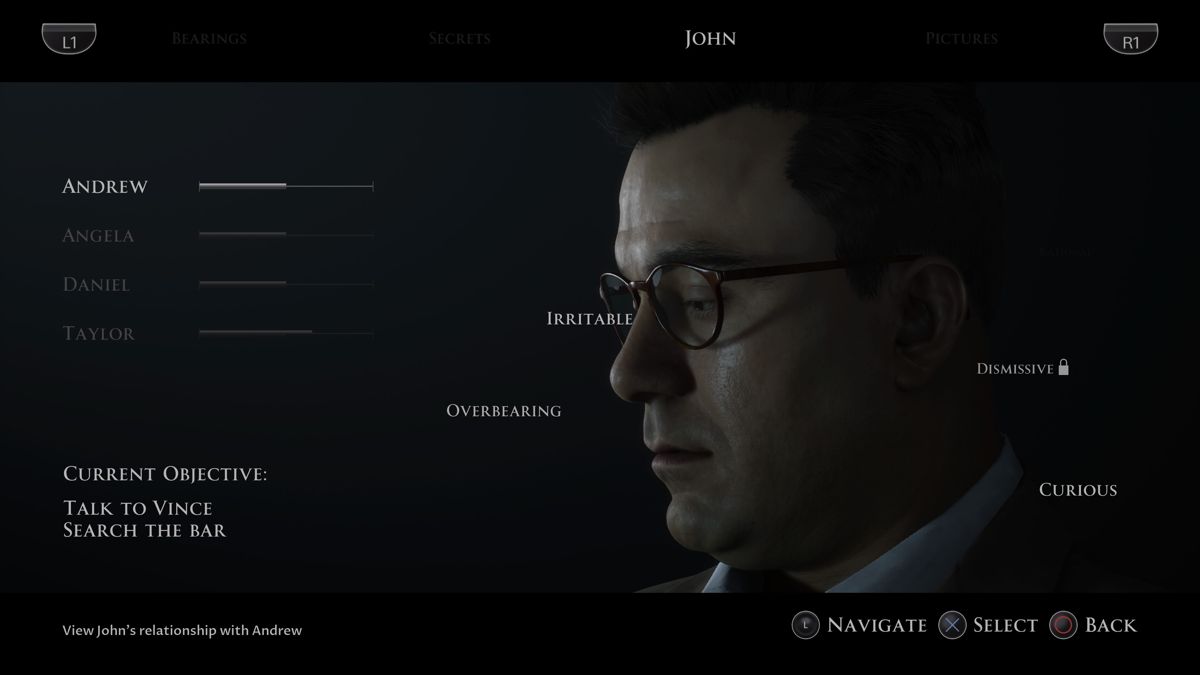
Choices are ever present, whether they be dialogue choices or decisions on which way to go or what to pick up or leave behind. Many of these choices affect your relationships with others in the group, which affects other choices down the road. At a few points, just like in Man of Medan, the curator will give you a break as he shows off his library, commenting on your progress and occasionally offering you a hint.
Each character is also saddled with “locked” personality traits. Making decisions the game finds to be virtuous can unlock those traits. Now, mind you, I only learned about this by reading reviews after the fact, as the game is quite shy in informing you of this feature.
I guess I should advise you to pause if you really don’t want anything else spoiled, but dangit I can’t write this review and fail to mention that there’s almost no point in agonizing over your choices. While I lost none of my characters due to failed QTEs, I did lose one because of a choice I made that feels completely arbitrary. But even worse, the ending, while certainly clever, negates almost every decision you’ve made up until that point. Only one choice in the game truly impacts the ending, though a couple of other minor choices makes it play out slightly differently. I could have stomached the ending–perhaps even praised it–if this was a straight dramatic piece with a strong script and superlative acting. But it’s not, and reaching the end only to find out that a random number generator would have likely achieved the same result left me cold and no desire to replay it.
The graphics are sharp, with excellent motion capture. There’s a general cinematic feel, with camera angles changing while you walk. While the game is dark, I rarely felt as if I had to squint to tell what I was looking at. And the death scenes, should you encounter them, are sufficiently grisly. The soundtrack has a few licensed vocal tracks that I enjoyed, with your prototypical eerie instrumentals in between.
There is also a two-player mode for those inclined. One cool feature is that if you and a friend each have a copy of the game, you will experience it differently. You’ll be assigned separate scenes, and choices one of you makes will impact the other. And in some of the chase scenes, the QTEs will quickly switch between players.
Supermassive has an instinct for choice-based adventure games, and they’re willing to tweak their formula to see what works. While I didn’t like many of the choices made here, Little Hope‘s relative brevity and frequent adrenaline pumps at least made it playable. But due to the mind-numbing script and lifeless characters, about two hours in I couldn’t wait for it to be over.

