Publisher: Annapurna
Developer: Simogo
Year: 2024
Platform: Windows, Switch, PS4, PS5
Rating: 7
More so than any game I’ve ever played, Lorelei and the Laser Eyes (by Swedish developer Simogo) weaves hardcore puzzles with an abstract story. I’m not entirely sure that combination works for me, as one side of my brain was constantly spinning from the difficulty, while the other side was spinning trying to understand what was happening. But I enjoyed both enough to recommend this to puzzle lovers.
The game begins in media res, with you controlling a woman who’s arrived at a hotel following an invitation by an eccentric 1960s filmmaker named Renzo to view his final piece before his death. Walking around a three-dimensional black and white space, your first goal is to get into the hotel. Play is exceedingly simple whether you’re using a keyboard or the gamepad. All you do is move around and use one action button. If you’re in front of something you can manipulate, the button will either activate what you’re in front of (like an elevator button), or bring you to another screen to solve a puzzle or read a document. If you’re not in front of anything, it will bring up an extensive menu screen.
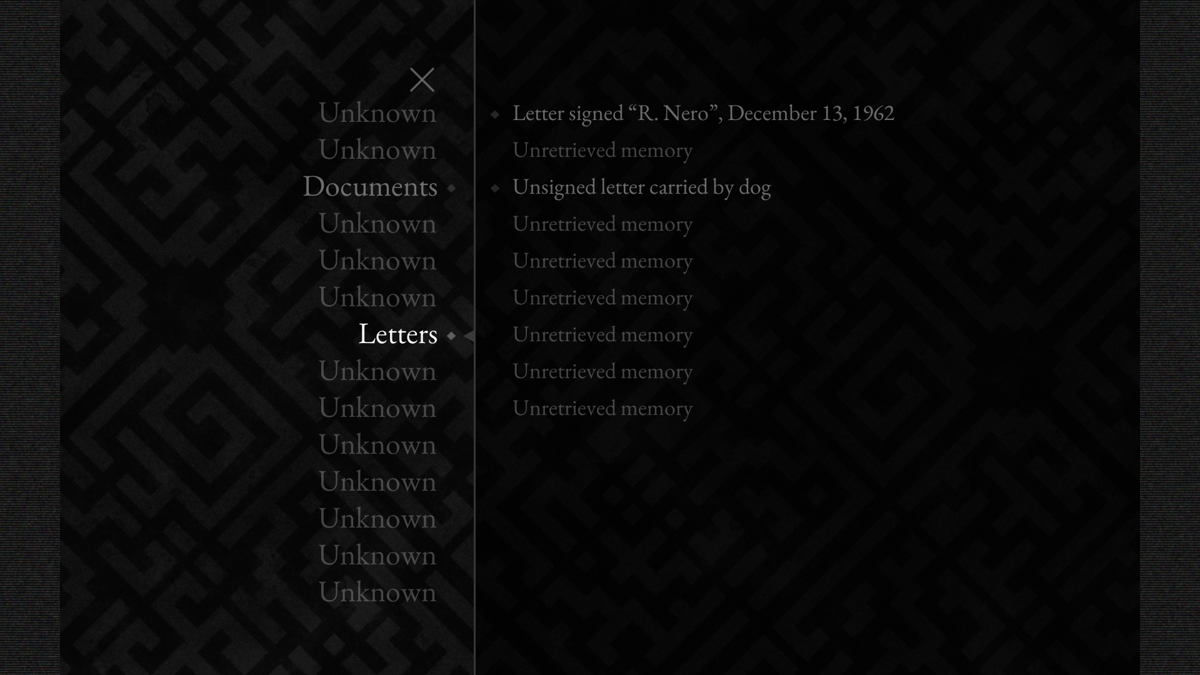
The menu screen shows your inventory. Selecting an item will give you more information about it. Unlike most games, your inventory screen will automatically load if the puzzle requires an item be used (even if you don’t have that item in your possession yet). You also have a photographic memory, and many of the important documents you read or clues you find will automatically be rendered here. That said, extensive note taking is required and I filled up a dozen or so notebook pages during play. You can also see how much money you have, which can be found around the estate and be used for both accessing certain puzzles but also for some optional achievements.
A black lab will approach you at the gate with a letter in hand, a cryptic welcome letter from your host. Hidden within that letter is the combination to the lock. It took me five to ten minutes to figure that one out, and it’s one of the easiest puzzles in the game!
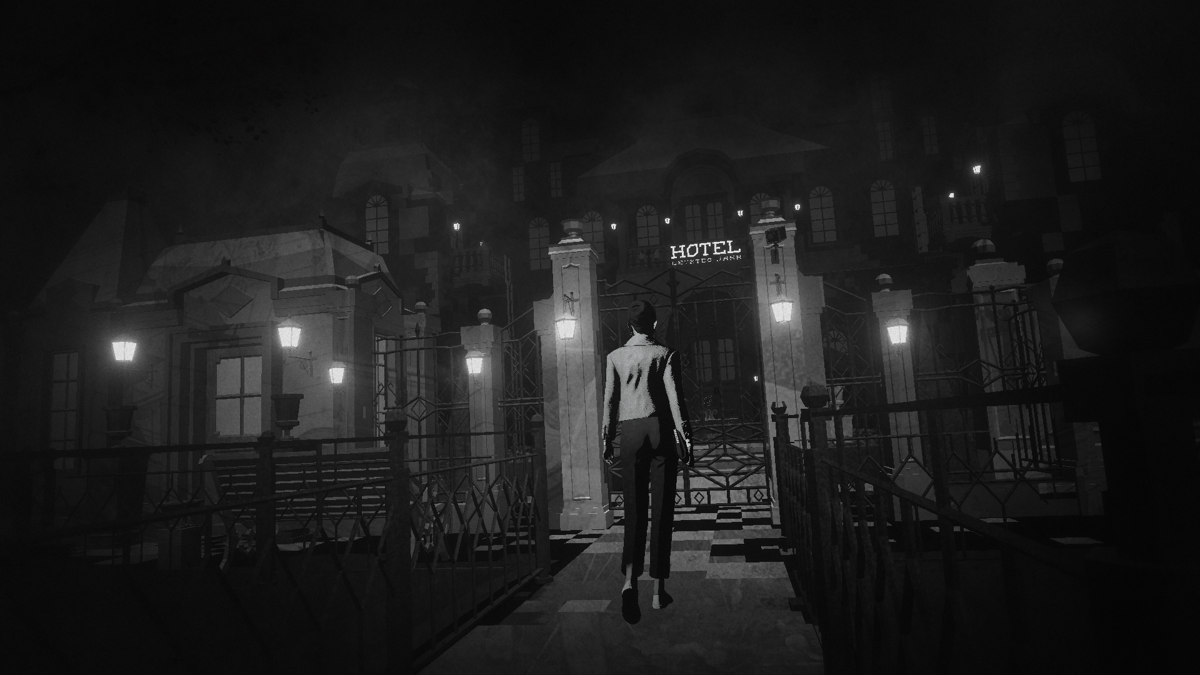
Once you get into the hotel, you can freely explore several rooms, running into many, many more locked doors. The hotel behaves a bit like a Metroid or Zelda game, in that a good deal of the map is open from the start with many puzzles available, even if you don’t have the information to solve them yet. But it smartly keeps many more areas locked off until you’ve gained more knowledge of the lore behind not only this current art piece, but also the history of the hotel. On top of that, several puzzles have randomized solutions, so a walkthrough is only helpful insofar as guiding you how to approach an obstacle.
The types of puzzles run a wide gamut, with puzzle boxes, cryptographs, mathematics, environmental deduction, spatial recognition, mazes, and interpretation of the many documents, letters, posters, and even old movies lying around. One thing I appreciate about them is that for the most part, solving the puzzle relies more on recognizing the approach rather than complex mental gymnastics. In other words, many of the solutions are easier than they first appear.
You quickly realize that Renzo’s art project is not just a single piece, but rather your entire experience uncovering his secrets. You will bump into him at several preset times, where he espouses romantic thoughts about art while giving you only the vaguest of hints as to what to do next before disappearing. These scenes, while rare, are a treat, as we cut to movie-style close-ups replete with musical crescendos. You definitely feel like you’re being led on a leash into danger.
Danger does exist in a couple sections of the game, though you are given forewarning and have the ability to easily save the game right before (at various computer terminals throughout the house). One of these sections is in fact the time I had the most fun. It’s not too much a spoiler to say you are in an area where you have to answer more progressively difficult trivia questions (about the in-game lore) in order to proceed. You are given the chance to not answer if you want to leave and come back. But should you answer any question wrong, it’s instant death. Answering correctly, though, is incredibly satisfying thanks to a suspenseful crescendo leading up to a snap of the fingers.
Speaking of which, every time you unlock a combination, solve a puzzle box, or reveal a secret, you are rewarded with a click, snap, or tune, which feels like the pat on the back deserved given how difficult the game is overall. Otherwise, the music mostly stays in the background. There are two original songs, and I enjoyed them enough to want to hear them again, which is something I don’t often do.
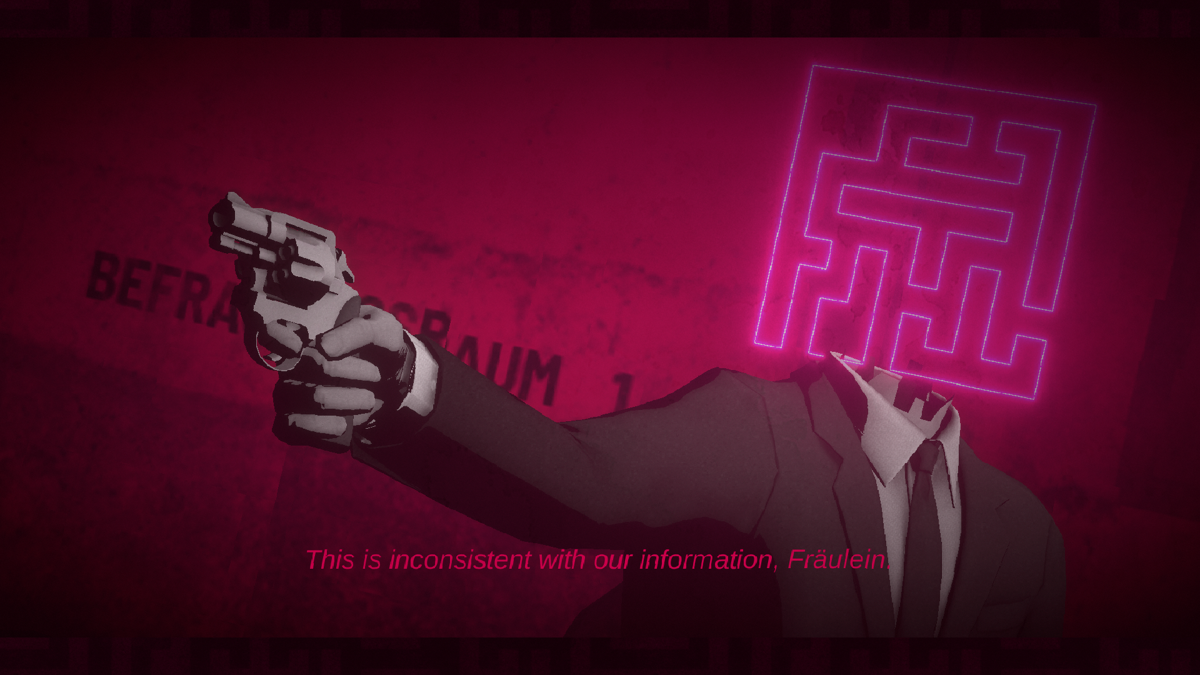
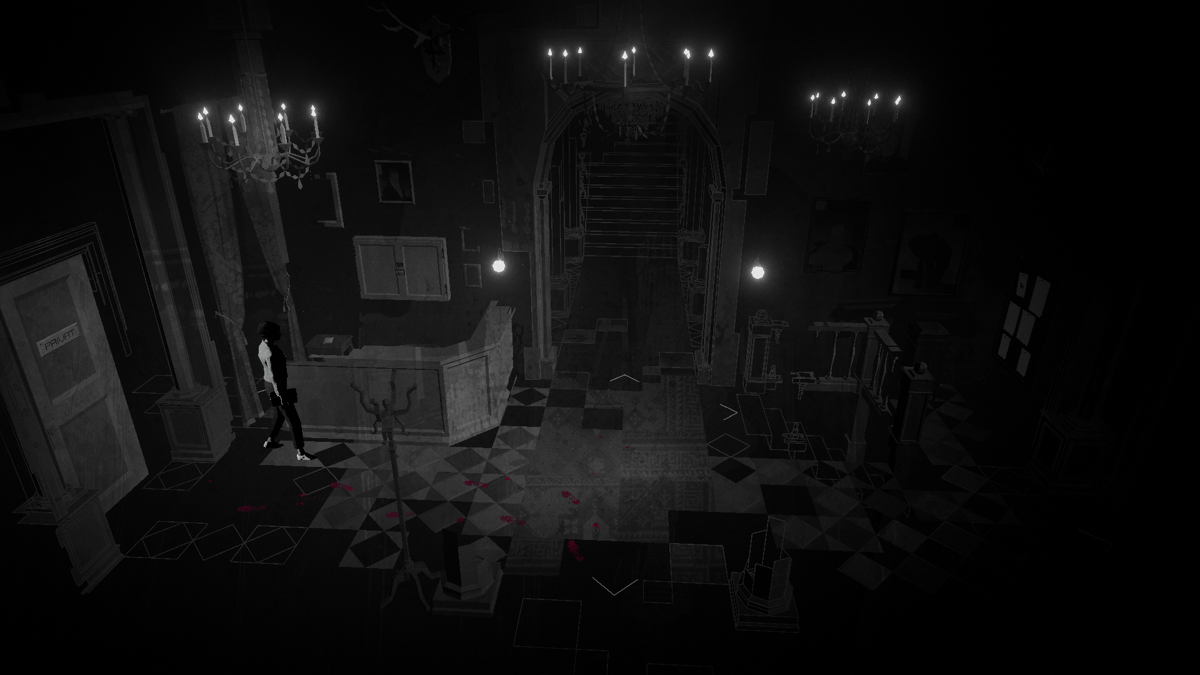
The graphics are visually arresting as well. Photos were taken of Kronovall Castle to inspire the hotel’s look. The characters are toon-shaded, and the geometry is low poly with black and white photos projected onto them. A laser-like red color is used judiciously to draw attention to things, giving the entire game an eerie computer-like vibe (not dissimilar to The Terminator himself). Everything looks sleek, and most rooms are only shot from one-angle, giving your movement a more cinematic feel. To change things up, a few sections allow you to move 360 degrees. Some areas look like a Playstation 1 style survivor horror game, and some look like 1-bit games from the early 1980s. Despite everything and the kitchen sink being thrown in here, the mishmash adds to the avant-garde nature of Renzo’s piece.
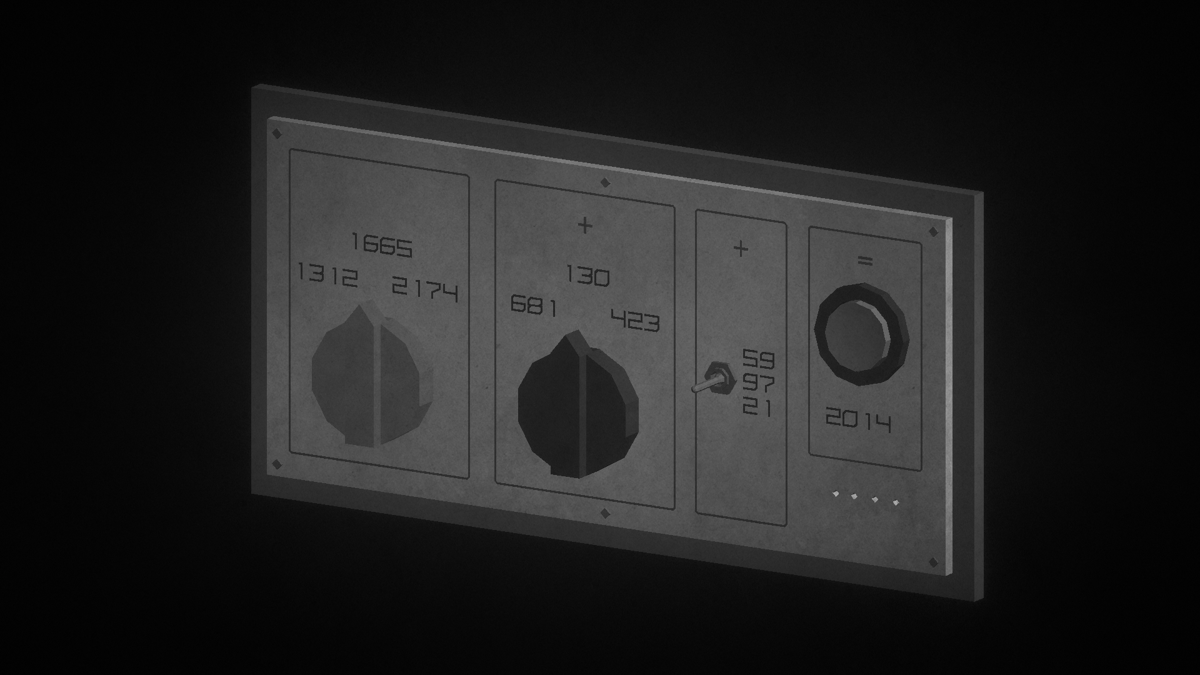
To say much more about who else you run into or what mysteries lie therein would spoil the fun in discovering them for yourself. But I would recommend having a walkthrough handy if you need it. I think I solved about 80% of the puzzles on my own, and used progressive hints for the others. A few times that I did so I was surprised to discover a simple answer, but most of the time I felt no shame. I can confidently say that it would have taken me weeks if not eternity to complete the last series of puzzles necessary to win.
After an abrupt but intriguing ending, I went to Reddit to get help interpreting Renzo’s final work. I’m glad I did, as while there’s no official interpretation provided by the designers, the masses helped me take a step back and appreciate the grand scope of Renzo’s work. Like most abstract art, I wish it was less abstract, though this certainly wasn’t made for my tautegorical preferences. That said, I’m quite glad I played Lorelei and the Laser Eyes. For those who love puzzles and don’t mind non-linear storytelling, this is a unique experience you’re not likely to forget.
 Death By Troggles