Publisher: Surprise Attack
Developer: Osmotic
Year: 2016
Platform: Windows, Linux, Mac, iOS
Rating: 5
I have an affinity for games that entirely takes place in a computer database. Orwell is billed as a surveillance game where you play the role of Big Brother, and must make decisions on what information you decide to send over to the police for further investigation. While the premise is dynamite, the execution is middling thanks to a somewhat clunky interface with very little investigation required.
In a country simply called The Nation, led by an authoritarian government known as The Party (Orwell would be proud), a recent bill was passed to allow the government to spy on every citizen with no guardrails. A covert surveillance system named Orwell has recently launched, and they have hired foreign investigators (under the veil of being impartial) to do their dirty work. Oh, and you’re one of them.
A bomb explodes in a heavily populated plaza, killing several people. The only suspect is a young woman named Cassandra, who has a recent arrest record related to assaulting a police officer at a protest. An advisor within The Nation guides you, explaining that he is not allowed to use the surveillance system himself. All he can do is take the data you find and upload to their servers and then take appropriate action based off of that. He will guide you through uploading a picture of Cassandra to her profile, as well as her occupation, which can be found in the newspaper. Once you find her social media handles, Orwell will notify you if she is talking to anyone and you can watch their message exchanges.
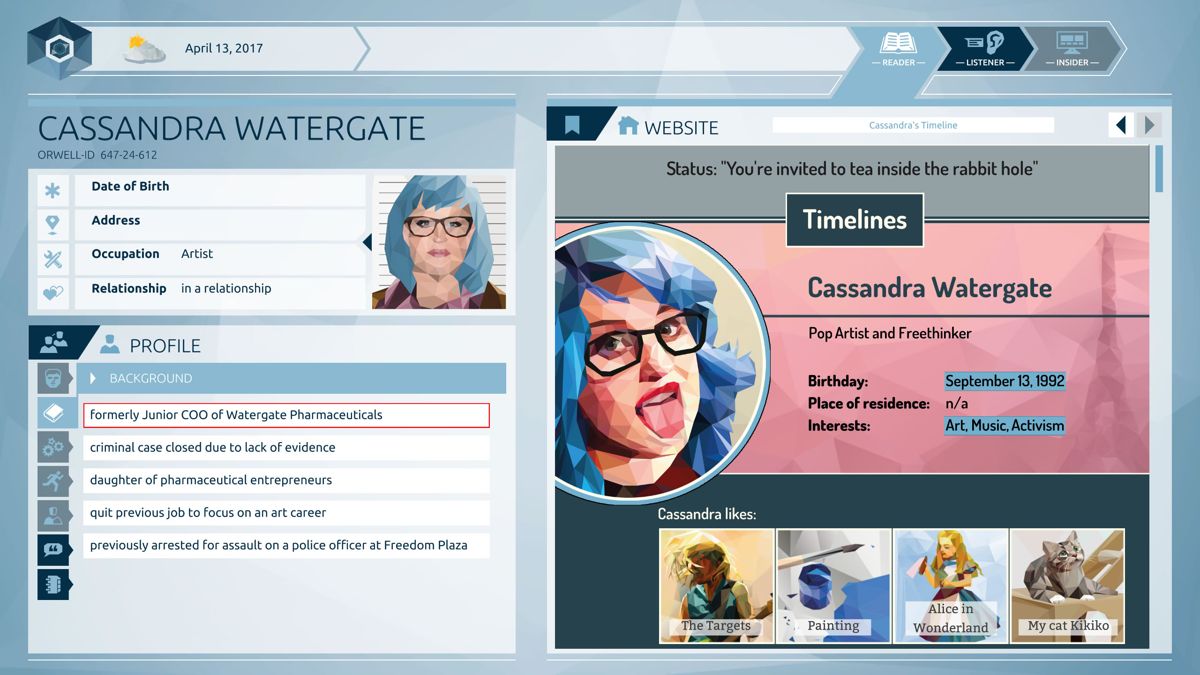
Unfortunately, rather than doing any investigating yourself, anything you can drag-and-drop into the server is already highlighted for you. The exercise is not completely mindless, as you are, in theory, supposed to decide what information is relevant to the case. It’s more or less an AI that is highlighting relevant bits, and it’s up to you determine what to use. For example, on her website, Cassandra says she lives “over the rainbow.” The AI highlights this and you can try to drag and drop that onto the server as her official address. Your advisor admonishes you for this because it’s an obvious mistake. But as the game progresses, it becomes less obvious what information is real, and your advisor will accept whatever you give them.
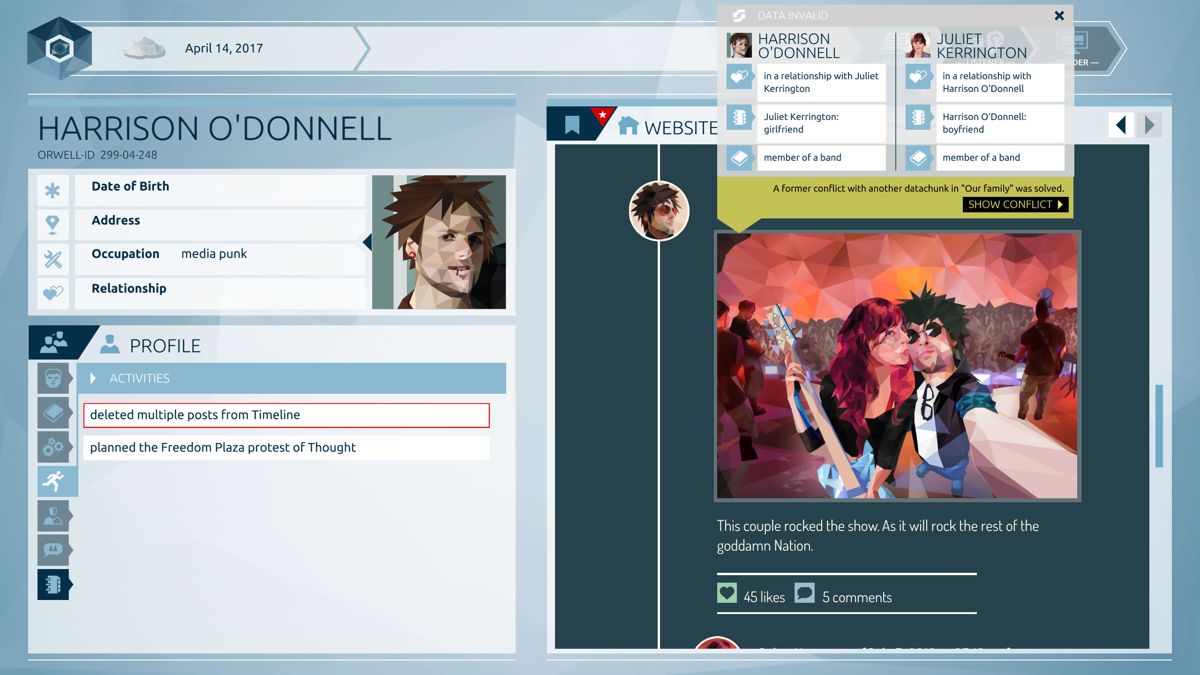
While some information about Cassandra you have no choice but to upload, you will eventually reach a point where you have two convincing pieces of evidence. One appears to implicate Cassandra in the bombing, and one appear to exonerate her. These two data points will be highlighted in yellow, indicating that the facts contradict each other. It’s up to you decide which one you think is true, or alternatively, which one you want your advisor to believe is true. And this is entirely where the fun lies.
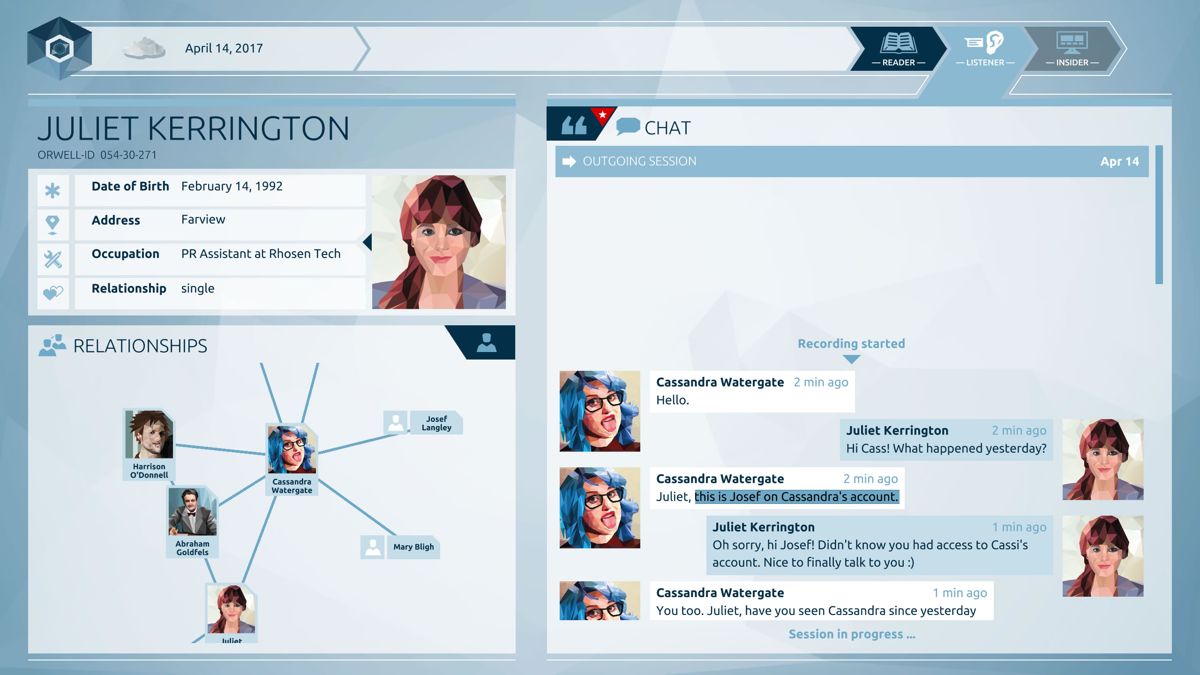
Of course, you wind up way more suspects than just Cassandra. Thankfully, you can access a web map that helps visually link them, lest you forget who’s who. Your investigation–which includes combing not only social media and cell phones, but also e-mail, websites, and servers–will lead you down a tangled web of activists, militia groups, and scorned citizens, most of them who have good reason to hate The Party. Despite your decisions, you often get pigeonholed into investigating certain people. However, there are four distinct endings to the game depending on whom who choose to investigate and implicate. And you can lock yourself out of some endings before the final chapter, giving some weight to your mid-game choices.
But while the story is compelling, the sheer repetitiveness of dragging and dropping chunks of data without any serious investigation makes the whole experience drag. Even though it only took me a handful of hours to beat it, it felt like much longer.
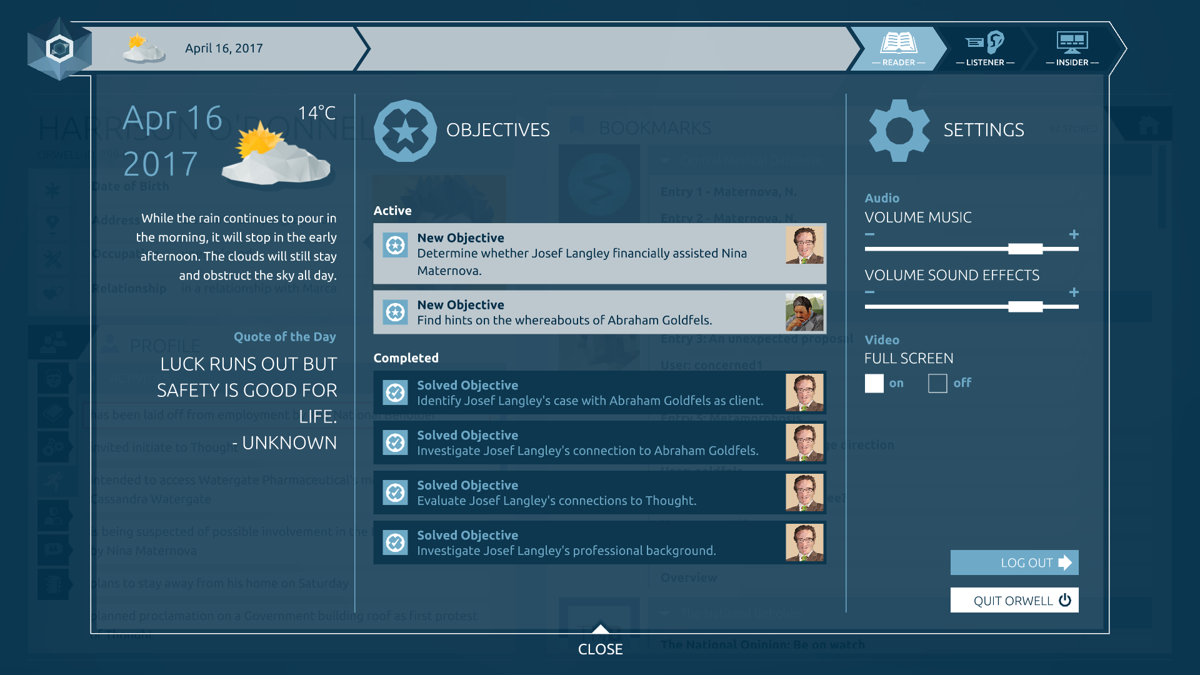
The graphics and sound are appropriately minimalist. The Orwell system employs slate-blue and gray colors, making everything easy on the eyes and easy to read. Pictures are not realistic; rather they are a bit blocky and impressionist, with a watercolor like aesthetic. While I didn’t hate it, I think given the serious (and clinical) subject matter, I think making the characters feel more real would have gone a way to get me more invested. The ambient music stays in the background, with appropriate tonal shifts when something significant occurs.
Orwell was a fun enough diversion that I would recommend it to those who like computer surveillance games and don’t mind the minimal investigation. While I wasn’t as engaged or moved as I hoped I’d be, I was entertained enough that I might play the sequel some day.