Category Archives: PC Games

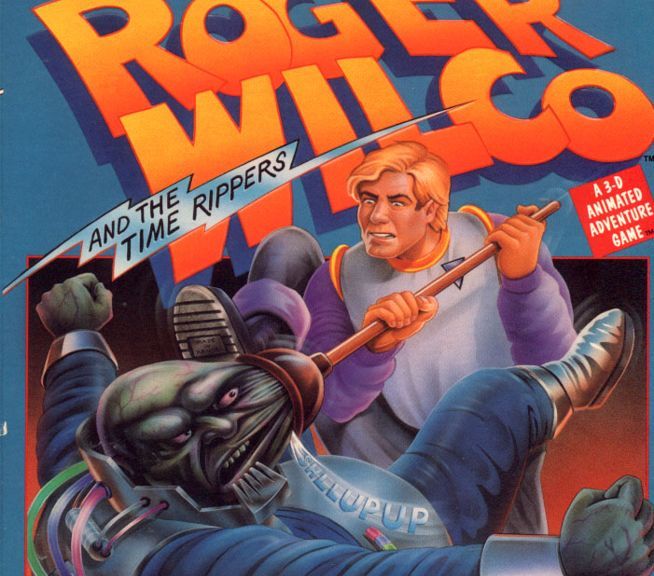
Space Quest IV: Roger Wilco And The Time Rippers

Publisher: Sierra
Developer: Sierra
Year: 1991
Platform: DOS, Windows, Mac, Amiga, PC-98

Rating: 1

One would think that taking a previously hilarious science fiction character and throwing him into a time travel story would be an easy formula for success, but Space Quest IV is one of the laziest adventure games I have ever played, putting me to sleep even with a walkthrough at hand.

Roger Wilco, per usual, is gloating about his success in the previous Space Quest games when he’s captured by Vohaul’s goons. At the last minute, he’s saved by some mysterious men and zapped headlong into Space Quest XII, where he finds his home planet in ruins. After figuring out where he is, Roger must prevent this catastrophic future from coming to pass, save his own skin, and get back to his own time. Along the way, he’ll travel to other Space Quest games while trying to avoid Vohaul’s police force.

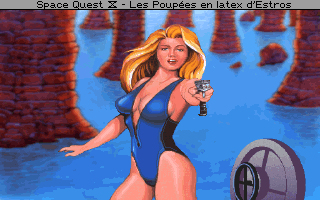
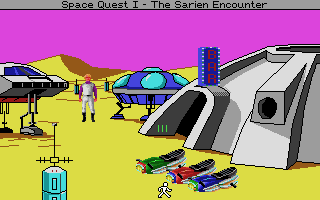
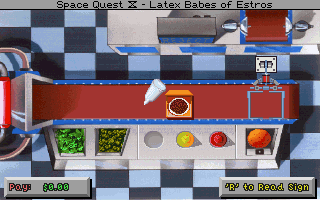
Sadly, most of what happens during the game, including the over-the-top voice-acted narrator , feels more like it belongs to Leisure Suit Larry’s universe than Roger’s. Very few of the game’s puzzles relate to science fiction. Most are tacky (which also describes the graphics), and some being unbelievably boring (and long) arcade sequences, like making burgers! Worse yet, many of the puzzles require extensive backtracking; I think I spent more time walking from one place to another than I did interacting with the game world. The only interesting diversion is a trip to Ulence Flats from Space Quest 1, but this excursion lasts only a few short minutes.

When Sierra updated their engines for point-and-click play, their games in every one of their long-standing series temporarily suffered (even Police Quest 3, which I enjoyed). It was as if the designers and producers spent so much time playing with their new toy that they forgot what made their games great in the first place.  Many people consider this their favorite game in the series and one of the best adventure games ever made. Usually when I hate a game, as with Broken Sword or Syberia, I understand why people would love it. With Space Quest IV, I’m left utterly baffled.  

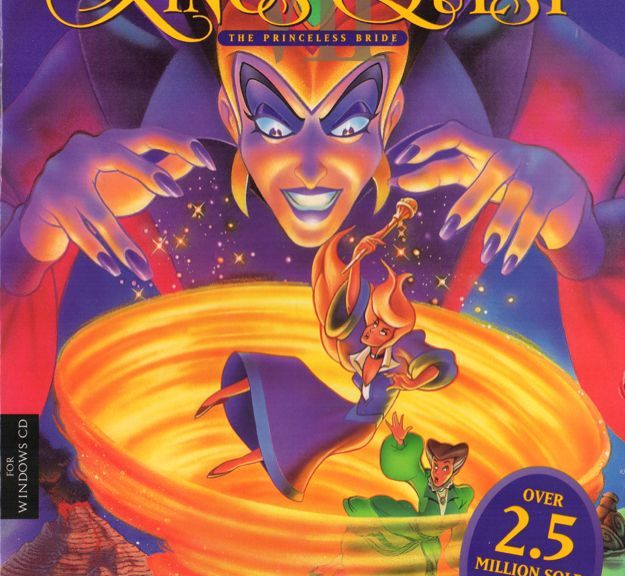
King’s Quest VII: The Princeless Bride

Publisher: Sierra
Developer: Sierra
Year: 1994
Platform: DOS, Windows, Mac

Rating: 1

Inigo Montoya: Do you hear that Fezzik? That is the sound of ultimate suffering.

Fezzik: From what?

Inigo Montoya: People playing “The Princeless Bride.”

Vizzini: Inconceivable!

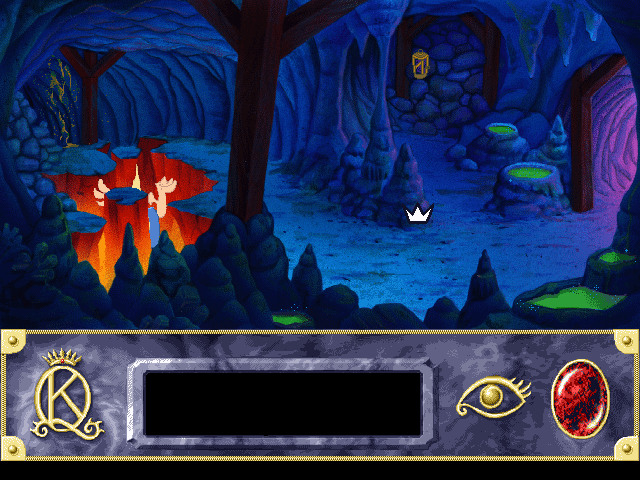
While I adapted to the four-icon point’n’click style of adventure gaming, I longed for a change that was more intuitive while remaining challenging (much like the LucasArts catalogue). Well, once again Roberta Williams ushered in a new style of gaming with the single icon. The fucking thing lights up whenever you run the mouse over something important, removing virtually all the thinking. The entire game is mostly reduced to clicking everything on everything. Since KQ7, some developers have been able to utilize a single icon and hotspot highlighters and still make engrossing, challenging games, either by adding other mechanisms for solving puzzles than simply point and click, or by altering the course of the game if you mindlessly click the wrong thing. Not surprisingly, Roberta Williams failed spectacularly.


Also, not surprisingly, the story is insipid. Valanice is quite perturbed with her only daughter because Rosella has decided that marrying handsome hunks at the drop of a hat like her mother was so last plot line. Valanice taunts her daughter with stories of blind matronly love (after all, she took in Graham’s love without questioning it), while Rosella covers her ears and yells “Shut up! Shut up! Shut up!” But her mother does not comply, which drives Rosella to dive into an obviously dangerous whirlpool, because she’d literally rather risk death than listen to her mom for one more second. Valanice, determined to bring back her daughter to the sophisticated world, dives in after her. Unfortunately for her, she gets dumped off in a desert, far away from the place. Meanwhile, Rosella winds up bemoaning, over and over and over, her new troll status. Oh yeah, spoiler alert, she becomes a troll.

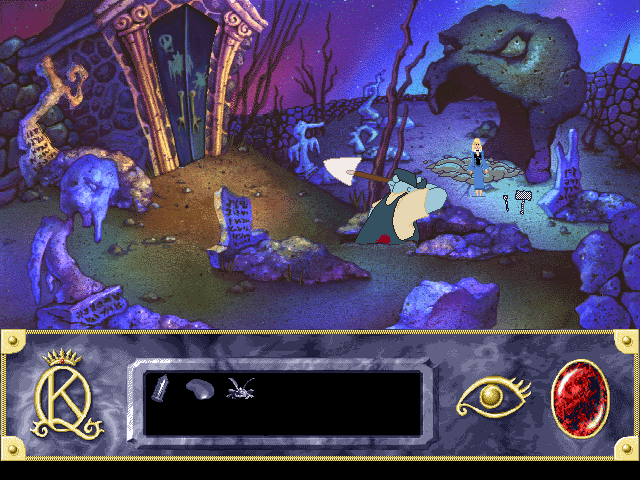
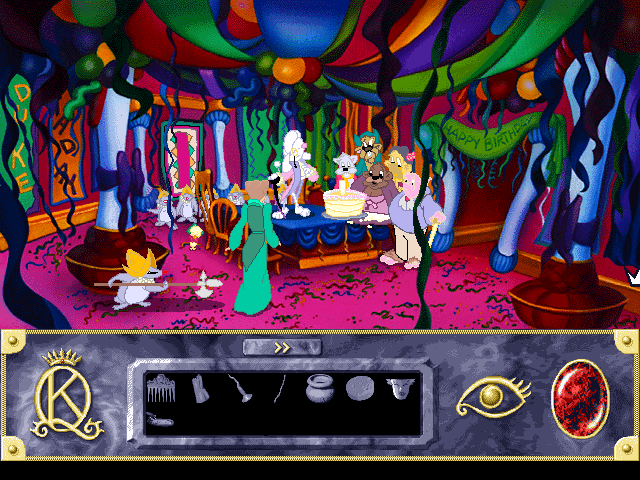
Amazingly, the plot actually develops in this game.  Chapter by chapter, the player learns more objectives while maneuvering plot twists. It’s a shame then that the game has no other redeeming qualities. The graphics consist of a poorly defined cartoon world with characters that are generally unpleasant to look at. Everyone feels kind of pasted into the scene from Microsoft Paint, unlike Sam & Max where everyone feels neatly integrated into the scenes. Not only that, every sentient being is caricatured (replete with exaggerated emotions and grating voice-acting) to the point of skin-crawling pain, making the game devoid of the minimum amount of pathos necessary to give a shit about the creative plot twists. Puzzles range from incredibly easy to incredibly nauseating. There are even walking dead scenarios, which is ridiculous in a game that is otherwise insultingly easy. As for the sound, well, nothing memorable.

There are exactly three points during this game where I enjoyed myself:

1) The introduction, where Rosella tells her mother to bugger off.
2) The ending, and not just because the game was over.
3) The raven who spouts countless degrading insults at both Rosella and Valanice. I used some of them myself.

I was grateful the series was over after this game. Yes, there was a 3D action game that came a few years later utilizing the King’s Quest name, but the series’ death was already established.

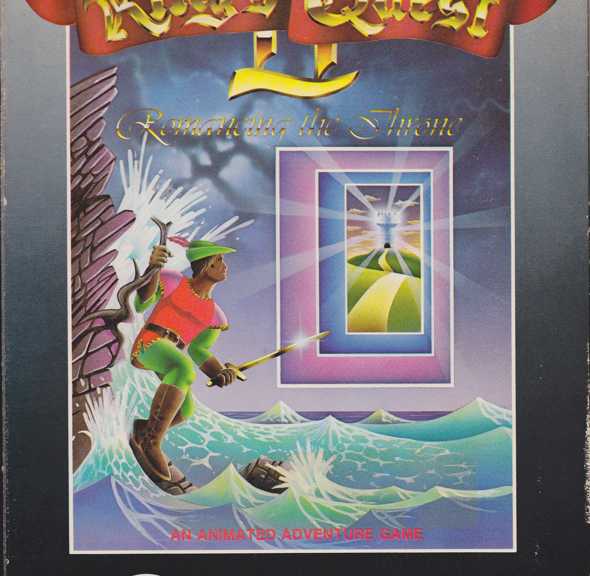
King’s Quest II: Romancing The Throne

Publisher: Sierra
Developer: Sierra
Year: 1985
Platform: DOS, Mac, Apple II, Amiga, Atari ST, PC Booter

Score: 2

Second verse, same as the first. Only worse. King’s Quest II falls right into the “Hurry up and write a sequel by next Christmas” genre.

The only technical aspect improved upon from 1984’s King’s Quest is the brighter hues the time’s best 16-color RGB monitors could display. Otherwise, there is nothing particularly fascinating to gaze upon, except those highly accentuated items that no adventurer can resist taking, even if it is private property.

You are King Graham of Daventry, lonely, horny, and in need of a fair maiden to quench the fire in your loins. After many months of turning down every wench not suitable to your fine tastes, you yield to desperation and ask your trusty magic mirror to be your pimp. Thankfully, your mirror succeeds in finding you a delectable young morsel. Alas! She is locked inside of a castle by an obviously inhumane being, likely using her only for selfish, unseemly acts of nature. While Graham begins fantasizing about his future quest, and pondering exactly how in God’s name he shall find this formidable castle, his body goes poof and rematerializes in a faraway land. Now, you may ask, is this the land where the castle is erected? Of course not. Graham has been transported to a land where he must first hone his fine adventuring skills, finding three keys of various colors to unlock the doors necessary to reach the land where he can lay claim to the woman that will surely melt under the charisma bestowed within every member of the royalty of Daventry.

While the plot for Romancing the Throne is a little tighter than that of its predecessor, the ideas therein are rather humdrum. Most puzzles are of the lock and key variety, and are for the most part highly contrived. Several times, one puzzle cannot be completed until another one has, even though they bear no relation to one another. Like the first game, there are points to be won that are not necessary for the game’s completion; however, these extra points generally are rewarded for solving puzzles in a particular order (irrelevant to the game’s plot), or by disposing of enemies that may or may not present themselves depending on random events. And just like the first game in the series, there are more random enemies that make the PC speaker go berserk and test the integrity of your digestive system.

The one merit this game possesses is some sporadic humor. Look out for Batman and a plug for Space Quest. However, when the Easter eggs are more entertaining than the game itself, you have an idea of what you’re getting into. If you enjoyed King’s Quest: Quest for the Crown, you may enjoy the sequel. But Romancing the Throne has nothing to offer for most adventure gamers. Its saving grace is that it is probably the easiest of all the King’s Quest games, and can be won in less than a week by even the average adventurer.

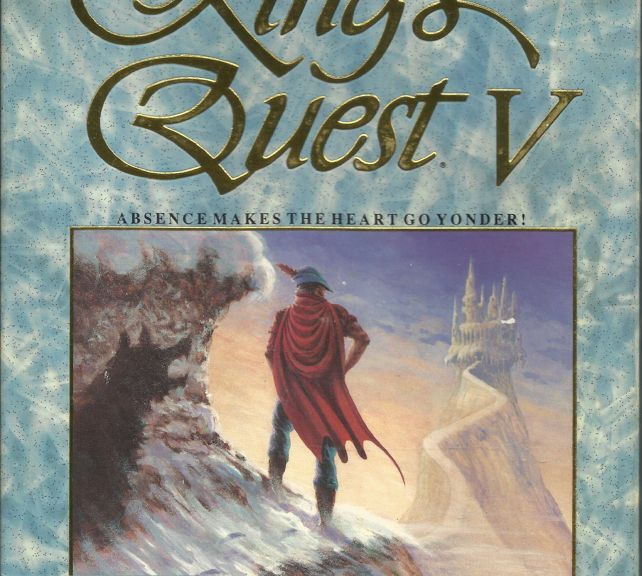
King’s Quest V: Absence Makes The Heart Go Yonder!

Publisher: Sierra
Developer:
Sierra
Year:
1990
Platform: 
DOS, Windows, Amiga, Mac, NES, FM Towns, PC-98

Score: 2

Possibly the first big-name adventure game to be on CD-ROM and completely eschew the need to use the keyboard, King’s Quest V spends way too much time focusing on its shiny new features, leaving the actual game to suffer immensely.

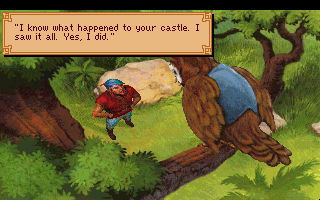
After a leisurely walk through Daventry, Graham returns home just in time to see the castle vanish before his eyes. A nearby owl–a talking one, natch–reinforces Graham’s despair by recounting the details of the tragedy. He then sends the king to go see the local benevolent wizard. A lengthy dialogue ensues where the Good wizard tells Graham that a Bad wizard (who is related to Mannanan from King’s Quest III), is out for revenge against the royal family. The Good wizard gives Graham the wand necessary to destroy the Bad wizard, and more or less leaves Graham to his own adventuring wits, which he will need to get anywhere near the Bad wizard. While the plot does help tie the series together a bit, it is in true Sierra fashion detailed in full before the player even touches the mouse. Seriously, there is virtually no plot development the entire game.

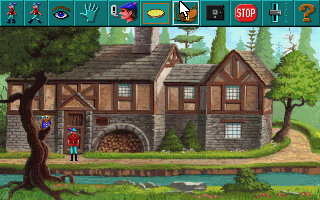
The point-and-click interface that Sierra introduced here substantially changes gameplay to merely finding the correct pixel or combining the right inventory items. While this does relieve the player of parser ignorance, and the dreaded “You can’t do that” messages, many of the puzzles in KQ5 require arbitrary logic (such as needing to navigate a desert very precisely to avoid dying of thirst). The term “pixel-hunting” may have been born out of this game, creating even more “You are a pathetic imbecile” responses than ever. And at some point with all the frustrating clicking and combining you’re bound to solve a puzzle by sheer accident, which isn’t exactly satisfying.

The one thing this game does get right is the implementation of all the pretty features. The graphics are excellent, and were simply amazing in 1990 to those who were used to sixteen-color games. The voice acting is mostly pleasant; however, whose idea it was to create Cedric, Graham’s sidekick owl, should be given a medal by Satan, as I’m sure he uses Cedric to torture the damned.   Cedric follows Graham practically everywhere, is rarely helpful, and when he would be helpful, he is nowhere to be found. And if you want an idea as to what he sounds like, think of Jar-Jar Binks, only condescending.

But what really gives the game a black mark is the cruelest walking dead situation in history. While Leisure Suit Larry 2 had several cruel walking dead scenarios, they were aggravatingly funny in an Andy Kaufman sort of way. Not only is the situation here not funny, it is one working channel and there’s a marathon of King of Queens cruel. Either that, or an honest mistake that the shittiest beta-testers in history missed. There’s a spot in the game where a mouse is being chased by a cat. You must save this mouse by throwing a boot at said cat. Then, later in the game, the mouse will save you from an otherwise lethal predicament. But this event ONLY HAPPENS ONCE, and it happens so fast that if you turned away from your computer for a few seconds, you would never know it happened! And if you don’t figure it out then, it isn’t even obvious later that you would need a mouse to save you. I know walking dead situations occur in nearly every adventure game before 1995 (heck, there’s even more in this game), but this one pissed me off more than any other. Having Cedric taunting me probably wasn’t helping.

Take all of the above annoyances and leave the player with a clichéd and suddenly insultingly easy endgame, and you have a game you couldn’t pay me to play again.

The Five Worst Games Made by Sierra

Sierra had 17 games make my top 50 adventure game countdown, so I certainly don’t harbor any negative feelings towards the company. They’re not LJN. But every once in a while they would produce a title that was offensive to the sensibilities of the even the most patient gamer. With that said, I know there are ardent fans of the five games that will be highlighted this week. If you’re one of them, by all means defend the hell out of it.

I have not played every game made by Sierra, though I have played most of them. For reference, I have not played any of the pre-King’s Quest games such as Mystery House or The Dark Crystal, and I have no desire to rip into the games Roberta Williams made in her basement, even if they are bad. I also have missed most of the Quest for Glory, Conquest, Shivers, and EcoQuest series as well as a smattering of other games. I’m sure Space Quest VI: Roger Wilco in the Spinal Frontier would make the list, but the opening is so awful I have never been able to push my way through it.

I can’t say these will be as enjoyable as Roger Ebert’s scathing reviews of the worst movies, but I’ll do my best. See you tomorrow for some awfulness.

Kickstarter: Precinct

This is not something I would normally do considering the size of my audience here at Death by Troggles, but I desperately want this game to become a reality, so hopefully this post reaches a few people who can help.

Jim Walls was the principal designer of my favorite series of games, ever. On my countdown of the Top 50 Adventures Games, the Police Quest games he designed ranked 11th, 1st, and 30th respectively. He also was a designer on Blade Runner, the 28th game on the countdown. I can’t say he’s the best game designer in the industry (see: Tim Schafer), but I’ve always been crazy about games that take place in the real world with real human problems involved. He had a couple of misses with Codename: Iceman (submarine adventure) and Blue Force (lackluster Police Quest clone), but I’m seriously hoping that if he’s allowed to make a game without any pressure from a publisher, it’ll be fantastic.

I admit this screenshot isn’t that amazing, but hopefully they crank it up a notch if they get the funding. After one week they’re only at 5% of goal, and they only have three weeks left. Police Quest didn’t have quite the following as other adventure game series, and it didn’t help that Daryl F. Gates designed an extraordinarily shitty game with the same name after Sierra dismissed Jim Walls.

If you have any desire to see this game made, please consider donating to the cause. It’s been a long time since I’ve been able to enjoy all of the ways Walls figured out how to kill me or get me fired, and sincerely hope this can happen again.

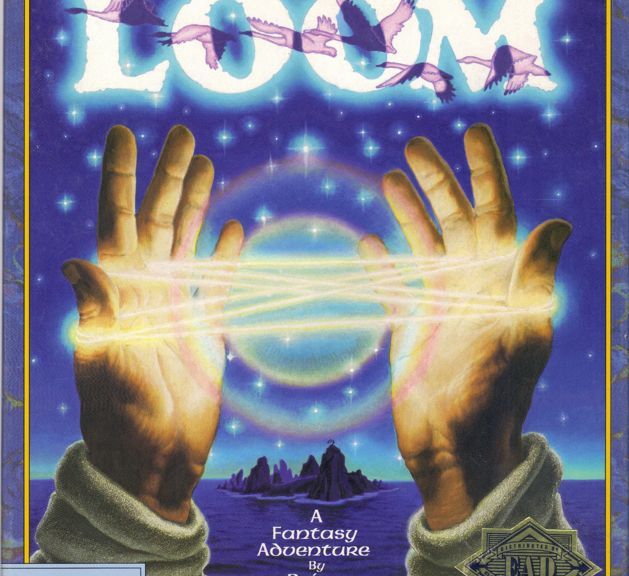
Loom

Publisher: LucasArts
Developer: LucasArts
Year: 1990
Platform: DOS; Windows; Amiga; Atari-ST; CDTV; FM Towns; Macintosh; TurboGrafx CD;

Review: One of the most original adventures ever conceived, Loom largely succeeds at just this, while failing to engage the player in a captivating story or with interesting characters.

As a 17 year-old member of the guild of Weavers, you must guide Bobbin Threadbare through a mystery, trying to learn why you’ve been outcast from the guild, and why the rest of your guild have been transformed into swans. There is no inventory. Progress through the game entails casting spells with your staff by weaving musical notes, with more powerful spells available as things move along. For example, you may learn that the spell for Open is the note sequence C-D-E-D; play this sequence on a particular object and see if it works. On easy difficulty level, you are shown the correct notes for each spell.  On medium, you see the notes played on your staff without the letters. On the expert level, you only hear the notes. Unless you are tone deaf, even the expert level is not too difficult.

While many of the spells are interesting, it is usually obvious which spells are needed where.  And with no other types of puzzles available, progress is incredibly easy. I finished the game in a mere four hours, even on expert level. Unfortunately, the characters (of other guilds) you meet are classic stereotypes with rather banal dialogue. Even Bobbin rarely acts consistently, vacillating between an appropriate meek teenager and a highly philosophical elder. Moreover, there are few surprises in the plot until the ending, which is confusing, alluding to a sequel that never happened.

Thankfully, the music is gorgeous, heavily borrowing from Tchaikovsky. There is a CD-ROM version with 256 color graphics and voice acting. Sadly, to fit the game on the CD, much dialogue was cut (though the acting is generally below average), as were additional scenes that rewarded the player for playing on expert level.

It is easy to see why Loom has a cult following, as therein is a unique experience in gaming. And while I would recommend this to anyone looking for something different, it is too short and underdeveloped to be considered a great game.

Contemporary Rating: Medium.

Cruelty Rating: Merciful.

Police Quest 2: The Vengeance

Publisher: Sierra
Developer: Sierra
Year: 1988
Platform: DOS; Amiga; Atari-ST; PC-98

Rating: 10

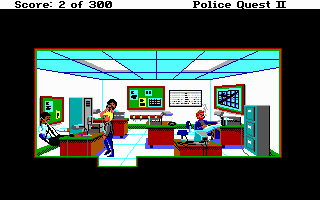
While our family would often play adventure games together when I was young, we would generally pair off given the tight squeeze around the IBM. Police Quest 2 was the exception, with my brother, father, and me huddled around the tiny screen for weeks because we were so invested that we wanted to experience it at the same time. And while that memory no doubt elevates this game for me, I still think it’s damn near a perfect game.

Sonny Bonds is back…with a vengeance! Actually, Jesse Bains, the perp he testified against last game and put in prison, is back with a vengeance. Not only does he escape prison, he also kidnaps your girlfriend Marie to exact revenge upon you. I’d feel bad spoiling the kidnapping–which takes place about halfway into the game–if it wasn’t described on the box with a picture of Bains literally holding Marie hostage. Sierra definitely didn’t want you to realize plots could be uncovered!

The Lytton P.D. has received a major overhaul since the first game, not only of the building but of the staff as well. Lest you worry that you’ll get bored with nobody familiar around, Jim Walls has created several more characters with wonderful personalities. First is Keith Robinson, your partner. Other than taking smoke breaks and making snide remarks, he offers little help, but he provides the comic relief that every cop game needs. In one instance, while on the way to a scene, Keith wagers with you on whether the witness is a dude or a chick. There is no reason for this little scene to be in the game, but given how many intense moments there are, the levity is appreciated.

Then you have Captain Hall, who has a very short temper but a keen taste for pistachio ice cream and is a master at working the telephone. If you dink around too much, he’ll literally suspend you. But he’s also got your back when shit starts hitting the fan. And, as with Police Quest 1, the supporting cast (such as the guys in Narcotics, the street cops, and the gun range supervisor) usually have something funny and interesting to say.

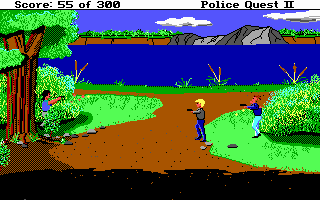
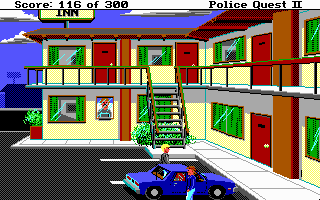
The production values have also taken a leap forward. The pixel-art graphics are generally well-detailed and colorful, and there’s little in the way of pixel-hunting. The sound is a consistent delight, with the music carrying an energetic Miami Vice vibe. Even the sound that tells you that you’ve been awarded points is addictive.

The plot takes a more linear route this time around as Sonny usually knows his next destination. Yet you’re not hand-fed what to do, and the puzzles remain fair and moderately difficult. The day-to-day busywork is toned down considerably (no more checking for flat tires!), but important police procedure still must be followed (such as collecting evidence) in order for Sonny to have a clue as to what’s going on (in addition to nabbing more points!). The design team also made a smart move in eliminating manual driving. Since Sonny drives an unmarked car and never needs to patrol the streets, driving would have become pointless and quite tedious.

The Vengeance has the best story in the series, thanks in large part to its cohesiveness. Your focus is unwaveringly on Bains and saving your girlfriend, giving each decision a gravity that was lacking before. You’ll race around town to follow Bains’s trail, coordinating with airport staff, a scuba diving team, hotel staff, and other police departments. You’ll even explore a sewer system! There is one highly contrived scene in the airplane that has no relation to the main plot, but it can be forgiven considering its entertainment value. And the endgame, which requires you to think quickly to rescue Marie and stay alive, is pitch-perfect.

As close to flawless as an adventure game can get, Police Quest 2 remains my favorite game of all time.

Contemporary Rating: Medium. Good parser, but going to the shooting range multiple times to adjust the sights on your gun would annoy many.

Cruelty Rating: Tough. If your only saved game is a split second before you’re going to die, then yes, you can make the game unwinnable. Otherwise, you should be fine. You can miss a ton of things through your investigation, and this will make the game more difficult (and less enjoyable), but it won’t lock you out.

Portal

Publisher: Valve
Developer: Valve
Year: 2008
Platform: Windows; Macintosh; Playstation 3; Xbox360

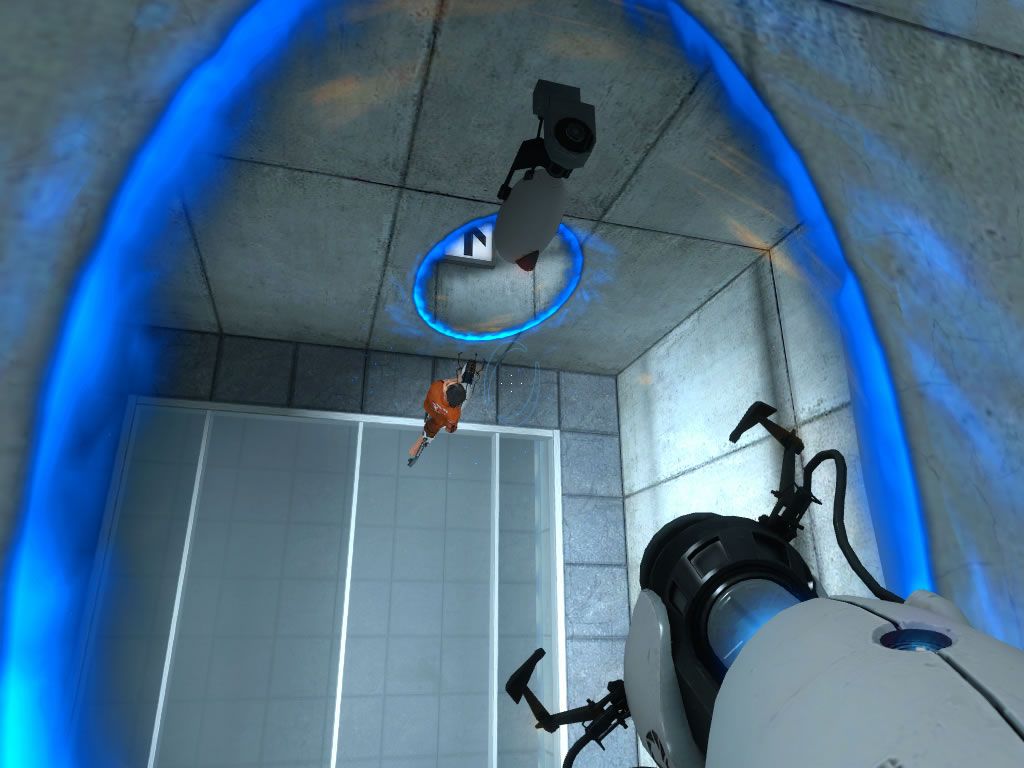
Review: When I first played Portal, I had never played Half-Life, nor been particularly fond of first-person shooters. Basically, I’m more interested in engaging my mind than I am my reflexes. Portal manages to do both at the same time, striking the perfect balance of action and strategy. While using a similar environment as in Half-Life, you control a subject who is trying to advance through test chambers in a research laboratory. What is being tested is a device that fires beams of light that create portals in walls for easy transport or escape. For example, say you need to traverse a pit and you can’t jump across; create a portal on the wall across the pit and one on your side. Walk through and—voila!—you’re on the other side. Valve fleshes this idea out considerably, with several chambers testing your mind, and in some cases, your agility. 

Yes, that’s you you’re looking at

An excellent learning curve is aided by the computer, who explains things to you along the way and gives you some tips early on. Eventually, a plot of sorts develops that is aided by superb voice acting and a chilling atmosphere. At no point did the sounds or colors feel superfluous, the designers proving themselves a model of efficiency.

Speaking of efficiency, the game can be won in a cool four to six hours. For the low price, this is certainly acceptable. And as always, too short trumps too long (at least in gaming). But if you finish and are still thirsting for more as I was, you can play challenge missions or download user-created missions, some of which rival the quality of the original. Or you can go ahead and get the sequel. Despite how one feels about this genre, there is no denying that Portal is one of the best developed games of all-time. This one is definitely staying on the desktop.

Are you still there?

Contemporary Rating: High.

Cruelty Rating: Merciful. There are regular checkpoints that the game sends you back to if you kick the bucket.

Fahrenheit

Publisher: Atari
Developer: Quantic Dream
Year: 2005
Platform: Windows; Playstation 2; Xbox; Xbox 360

Review: Wow.

That was my reaction after completing this adventure. To be honest, that was my reaction about every fifteen minutes while playing. About two or three times a decade I play a game that blows my mind with its innovation and storytelling.  This is one of those games.

The movie-like introduction carries you through New York City to a little diner where you see one man murder another in cold blood, right there in the restroom.  The murderer is you, Lucas Kane. The game takes off from there, and while it’s obvious that Lucas, in a trance, was being controlled by something else during the murder, there isn’t any time to worry about that at the moment. A cop is drinking coffee just outside, and you have to figure out how to get out of there without being caught.

The premise is good enough in its own right, but the way the game treats your predicament is where Fahrenheit really shines. Do you want to bolt out of there and head for the subway tunnel? Or do you want to clean things up, wash your hands, hide the murder weapon, and casually stroll out of the diner? Either way, you only have a few minutes, and nearly every action you take has repercussions later. Bolt out of there frantically, and your mood meter drops (and if it drops too low, Lucas will commit suicide or go insane). Cleaning everything up will improve your mood, but it’ll give you less time to escape the police. And the witnesses will remember everything you did and report it to the police accordingly.

Speaking of the police, you’ll also be playing Carla Valenti and Miles Tyler who are investigating the crime. You can switch between the two officers most any time, and they’ll provide different information based on the way they investigate. You’ll also play as Lucas’ brother Markus, a priest who will struggle between his faith in his Lord and his faith in his brother. Sometimes, the game will have you debating over how hard you should follow a character’s motivations, because you know it’s in direct conflict with another character you control. All four are developed very well, and I cared about all of them to some extent while playing. The performances (including the supporting cast) look as natural as you’ll see in a computer game, and the narration itself blends seamlessly with each scene.

Throughout the game, Lucas will be learning about what happened, trying to gain the trust of his brother and avoiding the police. The police will be doing their best to find Lucas. And while Fahrenheit was not billed as a pure adventure, it really has what I think most adventurers are pining for. People have realistic motivations. Puzzles are in the form of game-related problems; none are inappropriate to the situation at hand. Some require strategic planning, such as distracting guards to make it through an area. There is no inventory, though you will pick up objects at times and use them shortly thereafter. And, bless their hearts, you can actually die in this game. Not only that, puzzles have multiple solutions, with some leaving you better off in the long run. There are even three different endings.

However, the designers added an action element to the game which is going to appeal to some and turn off (if not completely alienate) others. Many scenes require quick reflexes and hand-eye coordination, such as playing a pick-up basketball game, or diving away from police cruisers. The game will flash a “GET READY!” sign before presenting you quick-time events in the form of the game Simon. For example, it will quickly flash a sequence of lights that you must copy in order to successfully complete that action sequence. There are three difficulty levels, and the easier the setting, the less of the sequence you have to perform correctly to move on. In some scenes, you have to perform anywhere from ten to twenty of these sequences in rapid succession, all while trying to watch what’s going on in the background. Furthermore, there are other scenes (such as pulling someone up from the edge of a balcony, or balancing on a high beam), where you must alternately mash two buttons for a predetermined length of time to complete the sequence.

From what I’ve read, these action scenes are very difficult using a keyboard and mouse, so I took the advice of other reviewers and bought myself a dual analog joystick, in my case, the Logitech Rumblepad 2. So yeah, I also got to enjoy the controller vibrating in my hands during intense moments. For me, these parts of the game were exhilarating.  I had the difficulty setting on medium and managed to make it through without ever dying (though I did die in other scenes where button-mashing wasn’t required), but I have excellent hand-eye coordination.  I was also able to enjoy the scenes in the background while still focusing on the button mashing. Many people will have a hard time with this, even on the game’s easy setting. If the sound of this turns you off, or if simple action games like Super Mario Bros. gave you fits, you’ll probably become frustrated with Fahrenheit on the whole and should probably avoid it.

I could nitpick this game all day long (e.g. how can these guys be outside when the weather is 70 degrees below zero and not have their exposed skin freeze instantly?), but the only real quibble I have is with the conversation system. Conversations happen in real time, so there’s no pausing for two minutes to figure out what you want to say.  When a player asks you a question, a list of two to four responses will appear on the screen, and you must select one before the timer runs out. If you don’t select anything, the players will continue to talk on their own. While the game won’t let you miss anything vital to completing the game, you’ll miss out on quite a few helpful details if you don’t participate.  The frustrating aspect is that oftentimes your choice of responses are condensed to single words.  Sometimes their meaning is obvious. I could figure out that Suspect/Bizarre meant “Did you see anything bizarre about the suspect?” But I had no idea that News meant “So is there anything new in your life lately?” It’s hard to make appropriate choices when you’re not sure what your choices even are.

Obviously, the game has a ton of replay value, as there are thousands of ways the game can be played out. Granted, most of the differences are just in the details, as no matter what choices you make, the plot eventually pigeonholes you into just a few different ending sequences. But it is the fine attention to these details that makes Fahrenheit such a delight. And you don’t have to start the game over just to see something you missed. You can replay any chapter you like and experiment with different conversations and actions. Of course, I wanted to check out all of the fun ways to kill Lucas. And trust me, there are plenty of ways to do that! Many have complained about the endgame for its sudden and bizarre plot twist, and I can’t say I disagree. But I did enjoy the final boss battle and all three endings just the same, so it didn’t ruin my enjoyment.

The soundtrack is above average, though at times is just a little cheesy. The graphics are wonderful, with obvious inspiration from The Matrix. Character movement is about as realistic as I’ve seen in an adventure game, with facial details a marked improvement over other engines. Switching camera angles and moving the guys around takes a while to get used to, but is not too clumsy. The game is rated Mature for strong language, violence, adult themes, and sexual situations. To keep that mature rating in America (retitled Indigo Prophecy), they removed some non-gratuitous sex scenes. Apparently, animated nipples are more impressionable than brutal, gory murders.

If you like your games to have a little action and a little tension, but are still primarily told with narrative and dialogue rather than guns, then I can’t recommend Fahrenheit enough.

Contemporary Rating: High.

Cruelty Rating: Merciful. You always get taken back to the beginning of a scene if you die.