Developer: Infamous Adventures Publisher: Infamous Adventures Year: 2006 Platform: Windows
AGDInteractive wasn’t the only group working on a remake of King’s Quest III. Four years earlier, Infamous Adventures took a stab at it. While it doesn’t have the production values of the former (or would that be the latter?), it’s a faithful adaptation of the original game and sure to please those who liked the original just fine.
Publisher: AGDInteractive Developer: AGDInteractive Year: 2011 Platform: Windows; Mac
Presumably the final remake from AGDInteractive, their retelling of King’s Quest III does a great job updating and enhancing the original game by Sierra while still honoring the primary plot and structure. They changed just enough to keep the game fresh and if you liked the original there’s little doubt you’ll enjoy this as well.
Publisher: AGDInteractive Developer: AGDInteractive Year: 2002 Platform: Windows; Mac; Linux
Score: 2
Excuse me while I blush for a while. Not satisfied with simply enhancing the original game, AGDI agreed that the original King’s Quest II was utter trash and essentially created a new game. And they only produced one of the best adventure games in the history of the industry.
Publisher: AGDInteractive Developer: AGDInteractive Year: 2001 Platform: Windows; Mac; Linux
Originally known as Tierra, AGDInteractive decided to remake some classic Sierra adventure games. They started in 2001 with King’s Quest. It was an interesting choice given that Sierra had already re-released their crown jewel in 1990 with updated graphics and sound. And while in their remake they didn’t quite make this a game worth introducing to a new generation, they most certainly improved upon it, if ever so slightly.
Publisher: Sierra Developer: Sierra Year: 1986 Platform: DOS; Amiga, Mac, Atari ST, Apple II
Score: 5
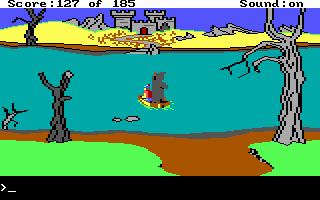
Sierra spent a little more time creating the third installment in the Daventry series and it shows. The increase in more complex puzzles is quite welcome as are a larger map and complex characters. To top it off, there is a plot. A plot that develops.
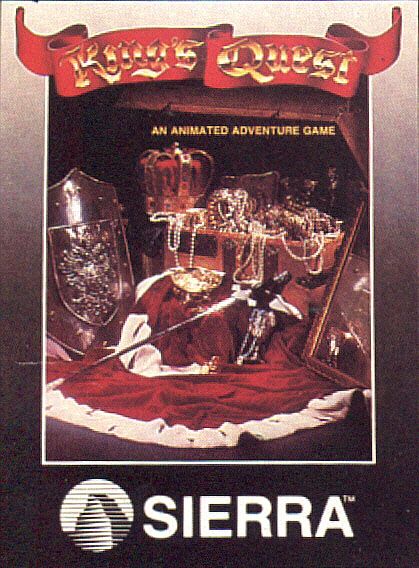
Publisher: Sierra Developer: Sierra Year: 1984 Platform: DOS; Macintosh; Apple II; Amiga; Sega Master System
Score: 3
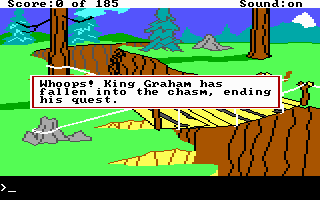
Sierra’s first 3D animated adventure game (thanks to their AGI engine) in its most successful series ever, King’s Quest was a fascinating game when it came out. Unfortunately, it doesn’t hold up too much over time.
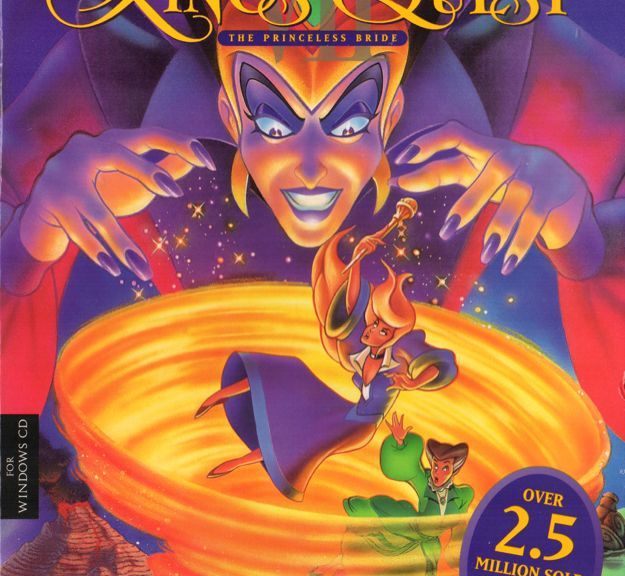
Publisher: Sierra Developer: Sierra Year: 1994 Platform: DOS, Windows, Mac
Rating: 1
Inigo Montoya: Do you hear that Fezzik? That is the sound of ultimate suffering.
Fezzik: From what?
Inigo Montoya: People playing “The Princeless Bride.”
Vizzini: Inconceivable!
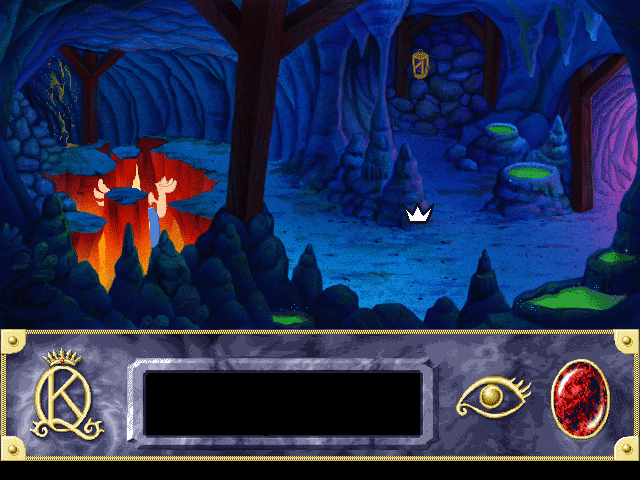
While I adapted to the four-icon point’n’click style of adventure gaming, I longed for a change that was more intuitive while remaining challenging (much like the LucasArts catalogue). Well, once again Roberta Williams ushered in a new style of gaming with the single icon. The fucking thing lights up whenever you run the mouse over something important, removing virtually all the thinking. The entire game is mostly reduced to clicking everything on everything. Since KQ7, some developers have been able to utilize a single icon and hotspot highlighters and still make engrossing, challenging games, either by adding other mechanisms for solving puzzles than simply point and click, or by altering the course of the game if you mindlessly click the wrong thing. Not surprisingly, Roberta Williams failed spectacularly.
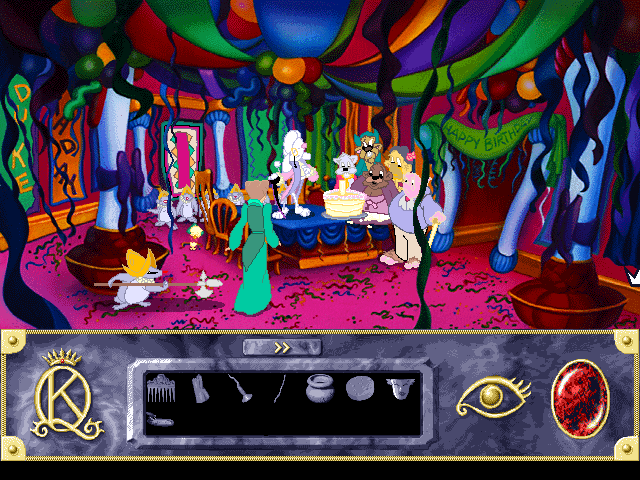
Also, not surprisingly, the story is insipid. Valanice is quite perturbed with her only daughter because Rosella has decided that marrying handsome hunks at the drop of a hat like her mother was so last plot line. Valanice taunts her daughter with stories of blind matronly love (after all, she took in Graham’s love without questioning it), while Rosella covers her ears and yells “Shut up! Shut up! Shut up!” But her mother does not comply, which drives Rosella to dive into an obviously dangerous whirlpool, because she’d literally rather risk death than listen to her mom for one more second. Valanice, determined to bring back her daughter to the sophisticated world, dives in after her. Unfortunately for her, she gets dumped off in a desert, far away from the place. Meanwhile, Rosella winds up bemoaning, over and over and over, her new troll status. Oh yeah, spoiler alert, she becomes a troll.
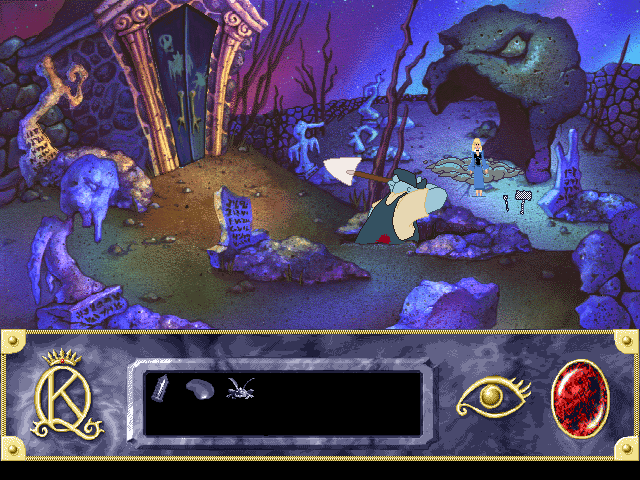
Amazingly, the plot actually develops in this game. Chapter by chapter, the player learns more objectives while maneuvering plot twists. It’s a shame then that the game has no other redeeming qualities. The graphics consist of a poorly defined cartoon world with characters that are generally unpleasant to look at. Everyone feels kind of pasted into the scene from Microsoft Paint, unlike Sam & Max where everyone feels neatly integrated into the scenes. Not only that, every sentient being is caricatured (replete with exaggerated emotions and grating voice-acting) to the point of skin-crawling pain, making the game devoid of the minimum amount of pathos necessary to give a shit about the creative plot twists. Puzzles range from incredibly easy to incredibly nauseating. There are even walking dead scenarios, which is ridiculous in a game that is otherwise insultingly easy. As for the sound, well, nothing memorable.
There are exactly three points during this game where I enjoyed myself:
1) The introduction, where Rosella tells her mother to bugger off. 2) The ending, and not just because the game was over. 3) The raven who spouts countless degrading insults at both Rosella and Valanice. I used some of them myself.
I was grateful the series was over after this game. Yes, there was a 3D action game that came a few years later utilizing the King’s Quest name, but the series’ death was already established.
Publisher: Sierra Developer: Sierra Year: 1985 Platform: DOS, Mac, Apple II, Amiga, Atari ST, PC Booter
Score: 2
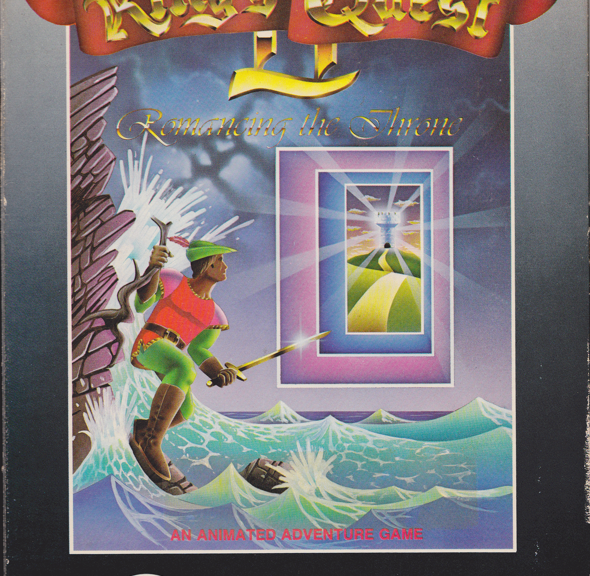
Second verse, same as the first. Only worse. King’s Quest II falls right into the “Hurry up and write a sequel by next Christmas” genre.
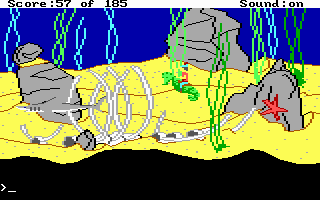
The only technical aspect improved upon from 1984’s King’s Quest is the brighter hues the time’s best 16-color RGB monitors could display. Otherwise, there is nothing particularly fascinating to gaze upon, except those highly accentuated items that no adventurer can resist taking, even if it is private property.
You are King Graham of Daventry, lonely, horny, and in need of a fair maiden to quench the fire in your loins. After many months of turning down every wench not suitable to your fine tastes, you yield to desperation and ask your trusty magic mirror to be your pimp. Thankfully, your mirror succeeds in finding you a delectable young morsel. Alas! She is locked inside of a castle by an obviously inhumane being, likely using her only for selfish, unseemly acts of nature. While Graham begins fantasizing about his future quest, and pondering exactly how in God’s name he shall find this formidable castle, his body goes poof and rematerializes in a faraway land. Now, you may ask, is this the land where the castle is erected? Of course not. Graham has been transported to a land where he must first hone his fine adventuring skills, finding three keys of various colors to unlock the doors necessary to reach the land where he can lay claim to the woman that will surely melt under the charisma bestowed within every member of the royalty of Daventry.
While the plot for Romancing the Throne is a little tighter than that of its predecessor, the ideas therein are rather humdrum. Most puzzles are of the lock and key variety, and are for the most part highly contrived. Several times, one puzzle cannot be completed until another one has, even though they bear no relation to one another. Like the first game, there are points to be won that are not necessary for the game’s completion; however, these extra points generally are rewarded for solving puzzles in a particular order (irrelevant to the game’s plot), or by disposing of enemies that may or may not present themselves depending on random events. And just like the first game in the series, there are more random enemies that make the PC speaker go berserk and test the integrity of your digestive system.
The one merit this game possesses is some sporadic humor. Look out for Batman and a plug for Space Quest. However, when the Easter eggs are more entertaining than the game itself, you have an idea of what you’re getting into. If you enjoyed King’s Quest: Quest for the Crown, you may enjoy the sequel. But Romancing the Throne has nothing to offer for most adventure gamers. Its saving grace is that it is probably the easiest of all the King’s Quest games, and can be won in less than a week by even the average adventurer.
Publisher: Sierra Developer: Sierra Year: 1990 Platform: DOS, Windows, Amiga, Mac, NES, FM Towns, PC-98
Score: 2
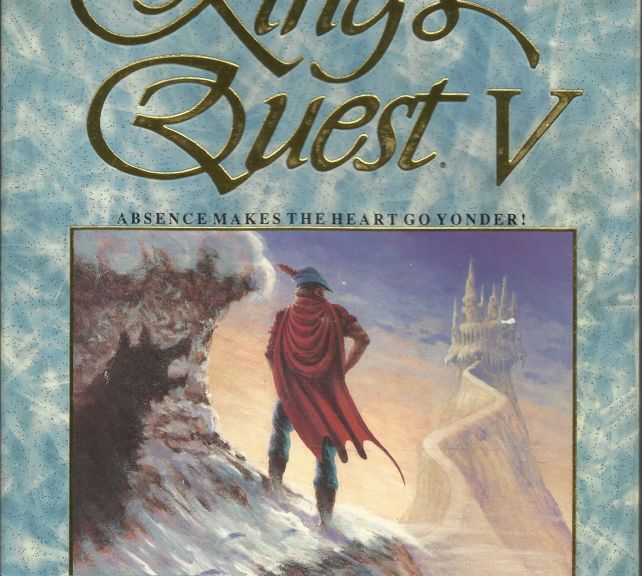
Possibly the first big-name adventure game to be on CD-ROM and completely eschew the need to use the keyboard, King’s Quest V spends way too much time focusing on its shiny new features, leaving the actual game to suffer immensely.
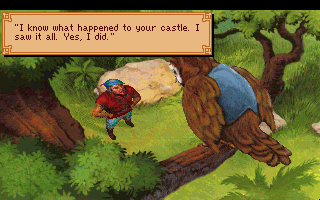
After a leisurely walk through Daventry, Graham returns home just in time to see the castle vanish before his eyes. A nearby owl–a talking one, natch–reinforces Graham’s despair by recounting the details of the tragedy. He then sends the king to go see the local benevolent wizard. A lengthy dialogue ensues where the Good wizard tells Graham that a Bad wizard (who is related to Mannanan from King’s Quest III), is out for revenge against the royal family. The Good wizard gives Graham the wand necessary to destroy the Bad wizard, and more or less leaves Graham to his own adventuring wits, which he will need to get anywhere near the Bad wizard. While the plot does help tie the series together a bit, it is in true Sierra fashion detailed in full before the player even touches the mouse. Seriously, there is virtually no plot development the entire game.
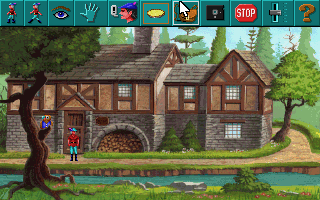
The point-and-click interface that Sierra introduced here substantially changes gameplay to merely finding the correct pixel or combining the right inventory items. While this does relieve the player of parser ignorance, and the dreaded “You can’t do that” messages, many of the puzzles in KQ5 require arbitrary logic (such as needing to navigate a desert very precisely to avoid dying of thirst). The term “pixel-hunting” may have been born out of this game, creating even more “You are a pathetic imbecile” responses than ever. And at some point with all the frustrating clicking and combining you’re bound to solve a puzzle by sheer accident, which isn’t exactly satisfying.
The one thing this game does get right is the implementation of all the pretty features. The graphics are excellent, and were simply amazing in 1990 to those who were used to sixteen-color games. The voice acting is mostly pleasant; however, whose idea it was to create Cedric, Graham’s sidekick owl, should be given a medal by Satan, as I’m sure he uses Cedric to torture the damned. Cedric follows Graham practically everywhere, is rarely helpful, and when he would be helpful, he is nowhere to be found. And if you want an idea as to what he sounds like, think of Jar-Jar Binks, only condescending.
But what really gives the game a black mark is the cruelest walking dead situation in history. While Leisure Suit Larry 2 had several cruel walking dead scenarios, they were aggravatingly funny in an Andy Kaufman sort of way. Not only is the situation here not funny, it is one working channel and there’s a marathon of King of Queens cruel. Either that, or an honest mistake that the shittiest beta-testers in history missed. There’s a spot in the game where a mouse is being chased by a cat. You must save this mouse by throwing a boot at said cat. Then, later in the game, the mouse will save you from an otherwise lethal predicament. But this event ONLY HAPPENS ONCE, and it happens so fast that if you turned away from your computer for a few seconds, you would never know it happened! And if you don’t figure it out then, it isn’t even obvious later that you would need a mouse to save you. I know walking dead situations occur in nearly every adventure game before 1995 (heck, there’s even more in this game), but this one pissed me off more than any other. Having Cedric taunting me probably wasn’t helping.
Take all of the above annoyances and leave the player with a clichéd and suddenly insultingly easy endgame, and you have a game you couldn’t pay me to play again.




You must be logged in to post a comment.