
Publisher: Tsunami
Developer: Tsunami
Year: 1995
Platform: Windows, DVD Players
Category Archives: PC Games
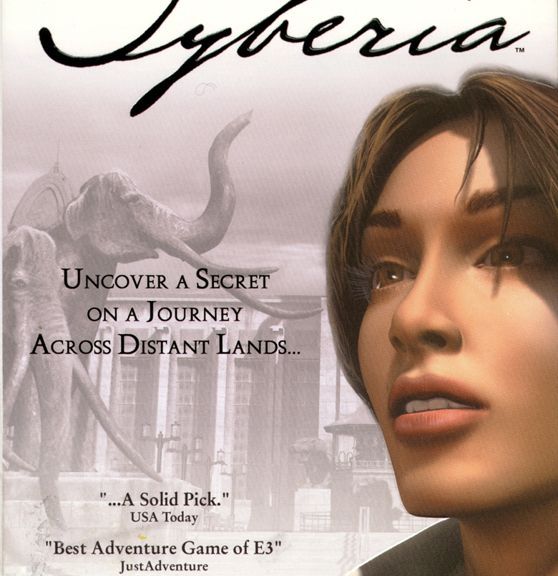
Syberia
Publisher: Microids
Developer: Microids
Year: 2002
Platform: Windows, XBox, Playstation 2, Nintendo DS
Labelled as the adventure game of the year for 2002, many accolades were given to this unique adventure and some have called it the best adventure ever. While I have no strong feelings about that (the list of great adventure games in the early aughts are pretty slim), I fear Syberia has been given legendary status in the gaming community for the wrong reasons.

Cruise For a Corpse
Publisher: Erbe Software
Developer: Delphine Software
Year: 1991
Platform: DOS, Amiga, Atari ST
A decent mystery wrapped up in sloppy game design, the only corpse to be cruised for is the shell of a game that’s been left rotting on the promenade. On board a cruise, invited by the wealthy owner, you’re soon knocked out cold after coming upon the dead owner’s body. When you wake up you have the rest of the day to interview all of the suspects (read: everyone on board) and pin the murderer.
Because there are so few positives, let’s start with those. Delphine Software introduced their vector graphic engine that became popular in the Alone In The Dark series. While it is impressive, it is unnecessary (especially in an adventure), and the more polished sprite-based artwork of the time would have been sufficient. Some cut scenes add good flavor to the story. The dialogue is fairly banal, but it is translated from French so I’m giving it the benefit of the doubt. The plot itself is also fairly deep, with each suspect having a motive. At the end of the game, you have to accuse the perp, with the ending changing based on who you pick (with one ideal ending, of course).

The game itself has a Gabriel Knight time system, with the clock advancing every time you do something important. This is fine, and actually a system that I prefer, as I become frustrated when I miss a clue because I didn’t happen to be in the right place at the right time. However, the logic the game uses to advance the clock is ridiculous beyond compare. For example, you can ask a lady about a topic at 2:00 in the afternoon and nothing happens. But talk to her about the exact same thing a half hour later and the clock advances. Perhaps even worse, every time the clock advances, characters and items get distributed seemingly at random throughout the ship. Check that drawer and 10:00 and there’s nothing in it. Go back to that drawer at 12:30 and you’ll find a key item you need. Why is that item now in the drawer when it wasn’t before? That’s an even greater mystery than the whodunit.
What these failures in logic amount to is tedious and aimless wandering throughout the ship, ruining continuity and interest in the story. Thankfully, you can bring up a map of the ship to warp to any (unlocked) place you like, but that’s little consolation. Even playing with a walkthrough did little to relieve the boredom of this meandering investigation. Unless you have completely run out of games to play, don’t touch this corpse with a ten foot pole.


Runaway: A Road Adventure
Publisher: Dinamic Multimedia
Developer: Pendulo Studios
Year: 2001
Platform: Windows, iOS
I think I am going to write a review now of the game Runaway: A Road Adventure. Yes! That is what I am going to do. I’ll put my fingers on the keys and type out words that describe my feelings about this game! For starters, I will tell you about the plot. Runaway was originally developed in Spain, by guys who obviously like Tim Schafer’s work on Full Throttle. I also liked Tim Schafer’s work on Full Throttle. This game emulates that one in style and graphics. However, what this game has is a stripper! Yes, a real live one, who escapes from the mob after watching her father get killed. However, during her escape, she gets hit by a car driven by Brian, a college student on his way to Berkeley. After helping her escape the hospital, she convinces him to let her tag along and solve a mystery as to why her father was killed. Sounds like fun, don’t ya think?
I really liked the concept of this game to begin with. And I’ll tell you why I liked the concept. There’s a nerdy college student, a stripper, and the mob. Though, I probably already told you that, how could this game not be great with that formula? You control Brian (that’s the main character played by you), and you get to pick up lots of random items and use them to solve puzzles! However, I didn’t like the puzzles. I’ll tell you why I didn’t like the puzzles. There are many objects very hard to find, so you spend a lot of time searching pixels instead of solving anything. Also, sometimes Brian will (realistically) not pick up an item until he has a use for it. But then sometimes, he will just pick up a random item (like a poker) hoping he can use it sometime later. I will tell you one more reason why I didn’t like the puzzles. Brian will often have an item that would easily solve a particular problem he is having, but when he tries to use that item, he is not able to. Not only that, a reason isn’t given! So Brian must find the really bizarre solution to the problem that involves tricks MacGyver wouldn’t even try. Wow, who would think one could write so much about puzzles!

The stripper–by the way her name is Gina–is cute and nice, but unfortunately, I didn’t like the way she is used in the game. I bet you want to know why, too. I didn’t like the way she is used in the game because she never actually does anything except get in trouble or get injured. So what I am trying to say is that she was just eye candy, a plot device to make the game more appealing. And, if I’m being perfectly honest, she didn’t really have that great of a personality. So that is what I think about Gina.
I will tell you one thing I did like about the game, and that is the cut scenes. I really liked the cut scenes because the graphics were nice and the underlying plot was kind of fun. But that’s all I have to say about the cut scenes.

Finally, I should summarize my feelings about Runaway. So, to summarize, I will tell you that an interesting plot is made boring by uneven and mostly uninteresting puzzles along with uneven and mostly poor acting. Those are the feelings I have about this game, so you can probably guess that I will not be rushing out to play the sequel any time soon! Well, that was fun writing that review. I sure hope you enjoyed it too!
Disclaimer: The entire review was written exactly the way Brian talks, which may be the primary reason I loathe this game. Unfortunately, I don’t know whether to blame the original script writers or the translators. Amazingly, I seem to be one of the few people who feels this way, as this game is generally held in high regard.
The Lurking Horror
Publisher: Infocom
Developer: Infocom
Year: 1987
Platform: Every computer ever and now smartphones
Review: One of Infocom’s most overrated titles, The Lurking Horror is essentially the company’s only foray into the horror genre. Unfortunately, it feels more like a Zorkian dungeon crawl then an atmospheric mystery (not surprising given it was written by Zork’s author). While there are some creepy parts to this college campus caper, it is mostly a disjointed puzzlefest with a smattering of Cthulhu mythos. But what really sent my annoyance through the stratosphere was a hunger daemon, illogical walking dead situations, and unrealistic inventory restrictions. Coupling that with NPCs that aren’t fleshed out and a rather abrupt and unsatisfying ending, I can’t really recommend this to those looking for a good fright.

Star Trek: The Next Generation: A Final Unity
Publisher: Spectrum Holobyte
Developer: Spectrum Holobyte
Year: 1995
Platform: DOS; Macintosh
With characters, actors, visuals, and sounds straight from one of my favorite television shows, I figured this game would have a hard time displeasing me. But it missed on all cylinders, and probably needs a new warp drive to boot.
In A Final Unity, you find the Enterprise unwillingly involved in a Garidian civil war and later in a race with the Garidians and Romulans to discover the power behind the mythological Unity Device. Several missions await, and on the way you run into Ferengi, Klingons, Vulcans, and a few new alien species. The plot is dished out slowly and effectively in gameplay and cut scenes, culminating in a satisfying end game reminiscent of Judgement Rites.

Sadly, the plot is the only redeeming quality of the game outside from what the show itself brought to the table. The ship interface is downright maddening. The battle station and engineering are simultaneously slow and confusing, let alone uninteresting. While you can leave the controls up to Worf and La Forge, respectively, I was left yearning for the system in the Interplay games, which says a lot. Navigation is damn near impossible when the game doesn’t automatically set the course and speed for you. You’re given a three-dimensional view of space, and discerning between sectors, neutral zones, and nebulae is a puzzle in itself. Finally, Starfleet gives many vague orders that are misleading at times. Sometimes, the plot advances simply by waiting for an indefinite period of time, with little clue that waiting, is in fact, what advances the game.
If that were all, I could forgive this section of the game. But away team missions are not much better. You can take any member of the crew on your away teams, and who you take matters very little, most of the time. Each crew member is given a ton of generic responses to every possible action and are not always in character. Who you control on the away mission is also usually irrelevant, and more or less is up to whose voice you’d rather hear at that moment. And while there are some conversation trees, there are rarely consequences for saying the wrong things until the end game, where you must control Picard. The puzzles themselves are fine, with some creative and original ideas and some clunkers. Regardless, some of the puzzles simply involve, again, too much waiting.

Yet, all of these faults pale in comparison to the most glaring atrocity in A Final Unity. The series was a veritable joy to watch week in and week out for two reasons. The first one, intelligent and engaging stories, is present. But there was hardly an episode of TNG where I wasn’t laughing out loud on several occasions. There was a sense of humour underlining nearly every story, and sadly, there is absolutely nothing worthy of a laugh, or even a smile, in this game. Riker makes no mention of his exploits with women. Data doesn’t ramble off his thesaurus nor makes any social faux-paus. Worf doesn’t even get to say, “Klingons do not play video games!” In short, the characters, while having the voices of their original actors, had none of the charm or personality. A significant reason for my enjoyment of 25th Anniversary and Judgment Rites was how well the writers embodied the characters and integrated them into the story. The rivalry between Bones and McCoy was there, as well as Scottie’s pleas in vain about the damage to engineering. And William Shatner’s overacting was funny enough on its own accord. I was hoping that perhaps Wesley Crusher could make an appearance so Picard could belt out, “Get the boy off my bridge!” But, alas.
If you are a hard-core fan of Star Trek, you will probably enjoy this game, at least to some degree. But I found this adventure, despite the few positives, an insult to the fans.
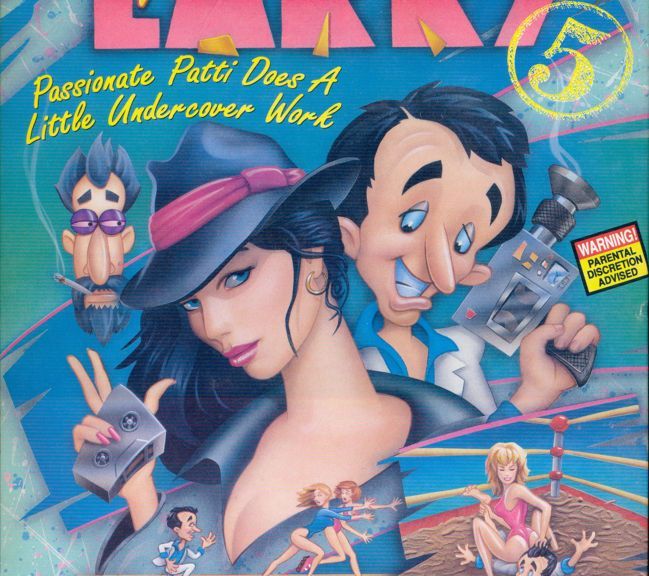
Leisure Suit Larry 5: Passionate Patti Does A Little Undercover Work
Publisher: Sierra
Developer: Sierra
Year: 1991
Designer: Al Lowe
Score: 0
One can sum everything up by stating Larry 4 was by far the superior game.
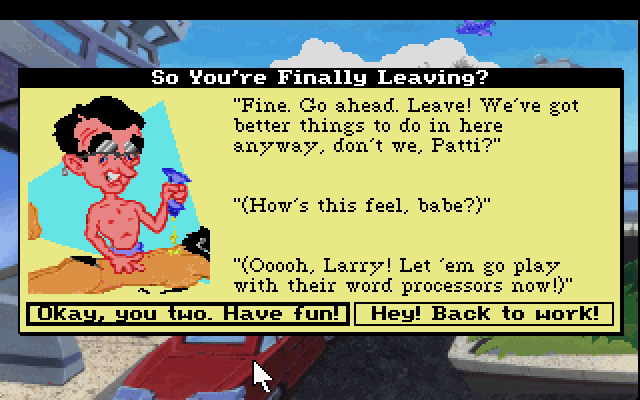
Leisure Suit Larry 5 is the most abominable commercially released computer game ever, though I admit I have not played Leisure Suit Larry: Magna Cum Laude. Al Lowe hated the latter and went out of his way to make sure people knew he had no role in its design. For some reason he hasn’t apologized for this game yet.
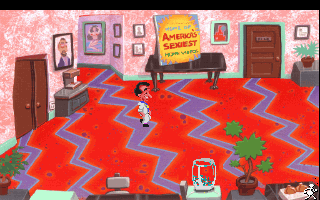
The “new and improved” VGA graphics–hand-drawn and replete with the most cartoonishly bright colors you can imagine–are so wretched that after five minutes you’ll find yourself wishing you were staring directly into the sun. The MIDI music is so uninspired and hash that it will make you want to go listen to a middle-school band performance. The point-and-click interface–heavy emphasis on the clicking–is only there to give you tendinitis. The puzzles are insultingly easy, the worst of them having you get into a wrestling ring where you must grab as many female private parts as you can; it’s like whack-a-mole, only less arousing. The great news is you can skip several of the puzzles if you feel like three hours is too long for an adventure game. The plot, which sees Larry amnestic and somehow signing up for a shady job to be a talent scout for sexy home videos, is more threadbare (and somehow more offensive) than the women Larry meets. Nearly every joke falls flat. There is not one redeeming quality in this entire game.
Play it only to see how low Sierra had sunk in the early 90s.
Space Quest IV: Roger Wilco And The Time Rippers
Publisher: Sierra
Developer: Sierra
Year: 1991
Platform: DOS, Windows, Mac, Amiga, PC-98
Rating: 1
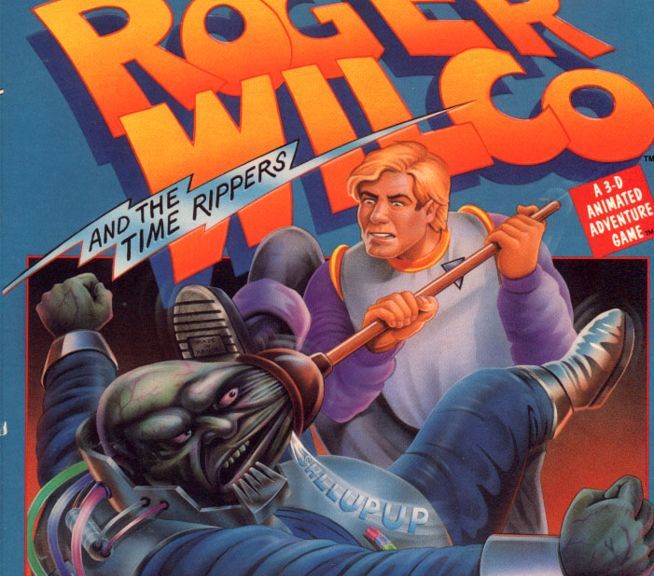
One would think that taking a previously hilarious science fiction character and throwing him into a time travel story would be an easy formula for success, but Space Quest IV is one of the laziest adventure games I have ever played, putting me to sleep even with a walkthrough at hand.
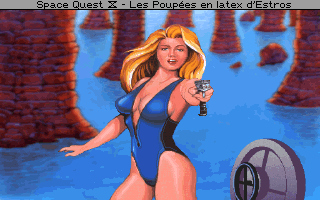
Roger Wilco, per usual, is gloating about his success in the previous Space Quest games when he’s captured by Vohaul’s goons. At the last minute, he’s saved by some mysterious men and zapped headlong into Space Quest XII, where he finds his home planet in ruins. After figuring out where he is, Roger must prevent this catastrophic future from coming to pass, save his own skin, and get back to his own time. Along the way, he’ll travel to other Space Quest games while trying to avoid Vohaul’s police force.
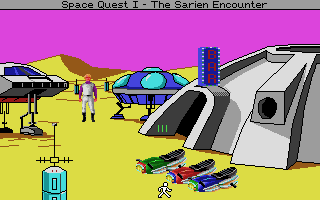
Sadly, most of what happens during the game, including the over-the-top voice-acted narrator , feels more like it belongs to Leisure Suit Larry’s universe than Roger’s. Very few of the game’s puzzles relate to science fiction. Most are tacky (which also describes the graphics), and some being unbelievably boring (and long) arcade sequences, like making burgers! Worse yet, many of the puzzles require extensive backtracking; I think I spent more time walking from one place to another than I did interacting with the game world. The only interesting diversion is a trip to Ulence Flats from Space Quest 1, but this excursion lasts only a few short minutes.
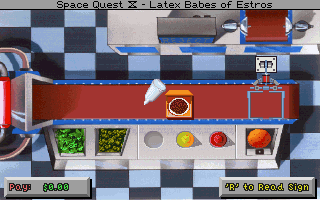
When Sierra updated their engines for point-and-click play, their games in every one of their long-standing series temporarily suffered (even Police Quest 3, which I enjoyed). It was as if the designers and producers spent so much time playing with their new toy that they forgot what made their games great in the first place. Many people consider this their favorite game in the series and one of the best adventure games ever made. Usually when I hate a game, as with Broken Sword or Syberia, I understand why people would love it. With Space Quest IV, I’m left utterly baffled.
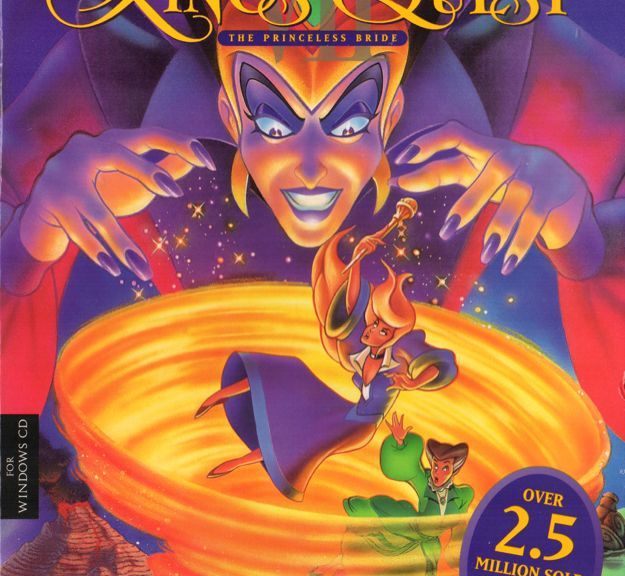
King’s Quest VII: The Princeless Bride
Publisher: Sierra
Developer: Sierra
Year: 1994
Platform: DOS, Windows, Mac
Rating: 1
Inigo Montoya: Do you hear that Fezzik? That is the sound of ultimate suffering.
Fezzik: From what?
Inigo Montoya: People playing “The Princeless Bride.”
Vizzini: Inconceivable!
While I adapted to the four-icon point’n’click style of adventure gaming, I longed for a change that was more intuitive while remaining challenging (much like the LucasArts catalogue). Well, once again Roberta Williams ushered in a new style of gaming with the single icon. The fucking thing lights up whenever you run the mouse over something important, removing virtually all the thinking. The entire game is mostly reduced to clicking everything on everything. Since KQ7, some developers have been able to utilize a single icon and hotspot highlighters and still make engrossing, challenging games, either by adding other mechanisms for solving puzzles than simply point and click, or by altering the course of the game if you mindlessly click the wrong thing. Not surprisingly, Roberta Williams failed spectacularly.
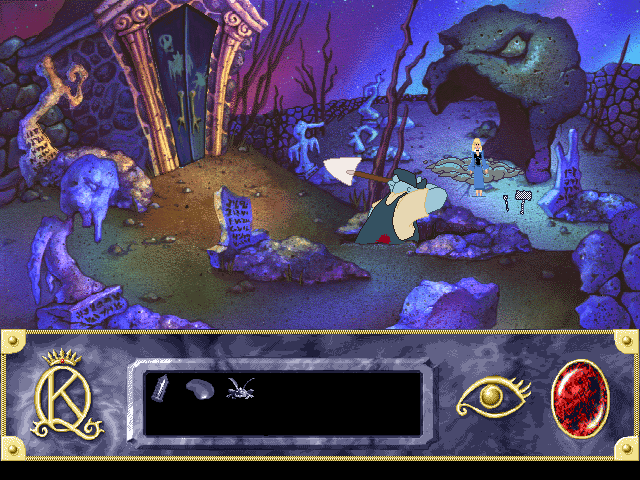
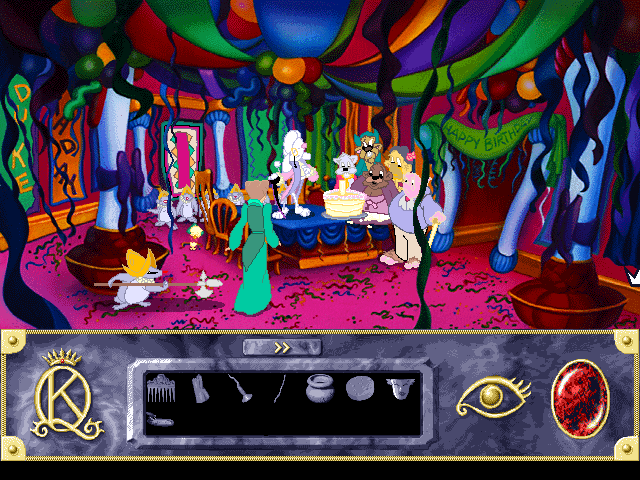
Also, not surprisingly, the story is insipid. Valanice is quite perturbed with her only daughter because Rosella has decided that marrying handsome hunks at the drop of a hat like her mother was so last plot line. Valanice taunts her daughter with stories of blind matronly love (after all, she took in Graham’s love without questioning it), while Rosella covers her ears and yells “Shut up! Shut up! Shut up!” But her mother does not comply, which drives Rosella to dive into an obviously dangerous whirlpool, because she’d literally rather risk death than listen to her mom for one more second. Valanice, determined to bring back her daughter to the sophisticated world, dives in after her. Unfortunately for her, she gets dumped off in a desert, far away from the place. Meanwhile, Rosella winds up bemoaning, over and over and over, her new troll status. Oh yeah, spoiler alert, she becomes a troll.
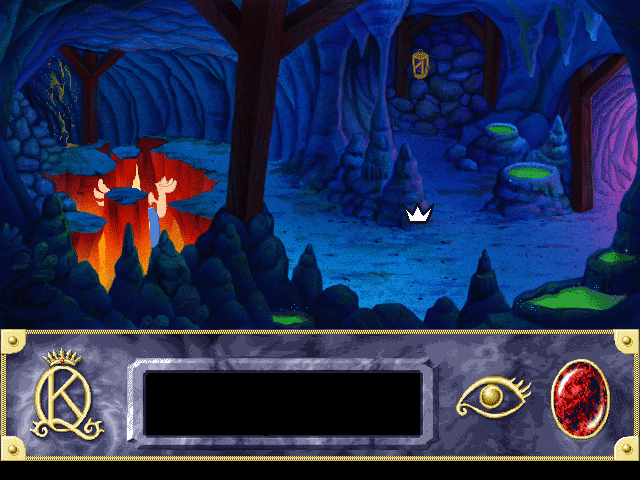
Amazingly, the plot actually develops in this game. Chapter by chapter, the player learns more objectives while maneuvering plot twists. It’s a shame then that the game has no other redeeming qualities. The graphics consist of a poorly defined cartoon world with characters that are generally unpleasant to look at. Everyone feels kind of pasted into the scene from Microsoft Paint, unlike Sam & Max where everyone feels neatly integrated into the scenes. Not only that, every sentient being is caricatured (replete with exaggerated emotions and grating voice-acting) to the point of skin-crawling pain, making the game devoid of the minimum amount of pathos necessary to give a shit about the creative plot twists. Puzzles range from incredibly easy to incredibly nauseating. There are even walking dead scenarios, which is ridiculous in a game that is otherwise insultingly easy. As for the sound, well, nothing memorable.
There are exactly three points during this game where I enjoyed myself:
1) The introduction, where Rosella tells her mother to bugger off.
2) The ending, and not just because the game was over.
3) The raven who spouts countless degrading insults at both Rosella and Valanice. I used some of them myself.
I was grateful the series was over after this game. Yes, there was a 3D action game that came a few years later utilizing the King’s Quest name, but the series’ death was already established.
King’s Quest II: Romancing The Throne
Publisher: Sierra
Developer: Sierra
Year: 1985
Platform: DOS, Mac, Apple II, Amiga, Atari ST, PC Booter
Score: 2
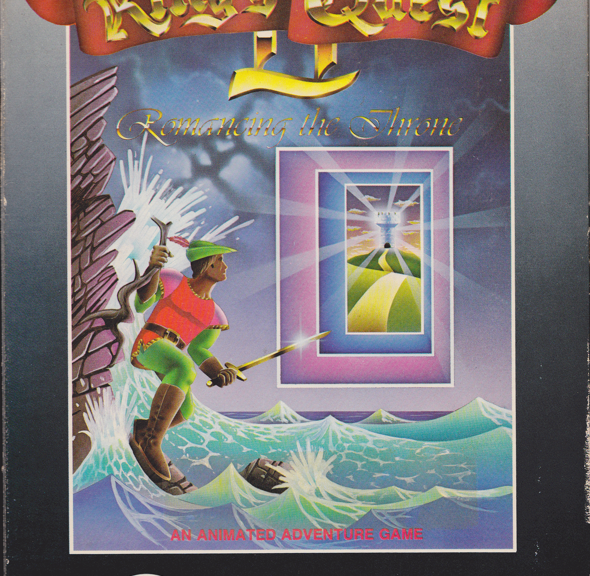
Second verse, same as the first. Only worse. King’s Quest II falls right into the “Hurry up and write a sequel by next Christmas” genre.
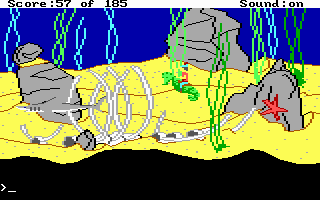
The only technical aspect improved upon from 1984’s King’s Quest is the brighter hues the time’s best 16-color RGB monitors could display. Otherwise, there is nothing particularly fascinating to gaze upon, except those highly accentuated items that no adventurer can resist taking, even if it is private property.
You are King Graham of Daventry, lonely, horny, and in need of a fair maiden to quench the fire in your loins. After many months of turning down every wench not suitable to your fine tastes, you yield to desperation and ask your trusty magic mirror to be your pimp. Thankfully, your mirror succeeds in finding you a delectable young morsel. Alas! She is locked inside of a castle by an obviously inhumane being, likely using her only for selfish, unseemly acts of nature. While Graham begins fantasizing about his future quest, and pondering exactly how in God’s name he shall find this formidable castle, his body goes poof and rematerializes in a faraway land. Now, you may ask, is this the land where the castle is erected? Of course not. Graham has been transported to a land where he must first hone his fine adventuring skills, finding three keys of various colors to unlock the doors necessary to reach the land where he can lay claim to the woman that will surely melt under the charisma bestowed within every member of the royalty of Daventry.
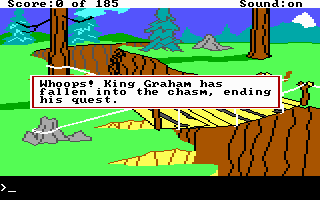
While the plot for Romancing the Throne is a little tighter than that of its predecessor, the ideas therein are rather humdrum. Most puzzles are of the lock and key variety, and are for the most part highly contrived. Several times, one puzzle cannot be completed until another one has, even though they bear no relation to one another. Like the first game, there are points to be won that are not necessary for the game’s completion; however, these extra points generally are rewarded for solving puzzles in a particular order (irrelevant to the game’s plot), or by disposing of enemies that may or may not present themselves depending on random events. And just like the first game in the series, there are more random enemies that make the PC speaker go berserk and test the integrity of your digestive system.
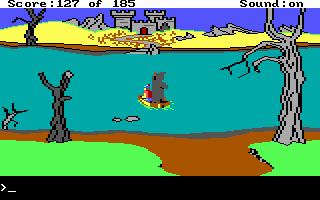
The one merit this game possesses is some sporadic humor. Look out for Batman and a plug for Space Quest. However, when the Easter eggs are more entertaining than the game itself, you have an idea of what you’re getting into. If you enjoyed King’s Quest: Quest for the Crown, you may enjoy the sequel. But Romancing the Throne has nothing to offer for most adventure gamers. Its saving grace is that it is probably the easiest of all the King’s Quest games, and can be won in less than a week by even the average adventurer.


You must be logged in to post a comment.