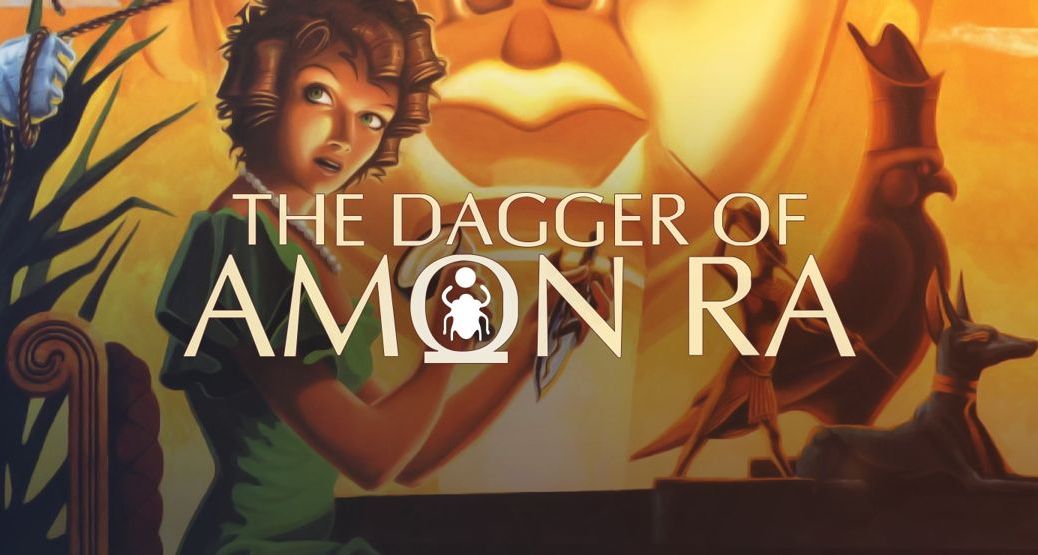
Publisher: Sierra
Developer: Sierra
Year: 1992
Platform: DOS, Windows
Rating: 2
The sequel to The Colonel’s Bequest, The Dagger of Amon Ra tells a more interesting and complex murder mystery about a stolen Egyptian dagger. Despite this, the game manages to be far worse on nearly every other level.
Laura Bow’s father helps her get a job as a journalist in the Big Apple, which has her nervous and excited. After getting robbed blind upon arriving, she arrives at work and is assigned lead on a case about the stolen artifact. Eventually winding up at the local museum with big wigs, socialites, Egyptian dignitaries, museum staff, and the local detective, Laura eavesdrops on their conversations prior to discovering one of the guests murdered. Rather than call for outside help, somebody locks up the museum, leaving everyone trapped together.
Laura’s investigation entails a combination of eavesdropping, interrogation, and crime scene investigation. The eavesdropping portions are probably the most interesting, as nearly everyone has a secret whether it’s related to the murder or not. Clues abound as well, such as notes and journals, revealing planned rendezvous you can catch. To be clear, the Sierra time advance system is in order, with the clock not moving until certain events are triggered. But there are conversations you can miss out on, which while not preventing you from finishing the game, may make it more difficult to pinpoint the culprit.
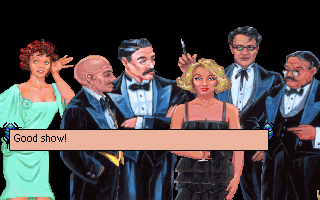
Meanwhile, conversations are an enormous burden. Laura carries a notebook that accumulates topics of interest she can question people on. Everyone has a response to everything, many of them pointless. This would be fine if standard conversation trees were used. Yet here you must question the suspect, access the notebook, flip to the correct page, select the topic, then manually exit the notebook to ask the question. Laura won’t be taking notes for you, either. For anything of note to the investigation you’ll want to keep your own documentation.
Frustratingly, the structure of the investigation is ridiculous. Much like the first game, bodies start dropping like flies, including people you’re probably suspecting. Laura comes to the museum as a reporter to figure out who may have stolen the dagger. But with people continually dying, her goal shifts to surviving the night. And while you can finish the game simply by surviving, you can’t win unless you’ve been taking copious notes and doing calculated investigative work (which, you know, everyone does while they’re fearing for their lives). Since the game never insinuated I would have to solve every single murder (on top of figuring out who stole the dagger), I was unprepared.
On top of that, the atmosphere is laughable. By the end of the game, there are dead bodies EVERYWHERE, and nobody seems to care, including the innocent bystanders. Characters will literally stand next to corpses with no reaction and nothing to say about it. Since they didn’t care, I didn’t either. You can’t even confront witnesses with evidence, which is perhaps the most dramatic part of any investigation.
So at the end of the game, when Laura is asked to pinpoint the culprit and motive for each murder, it is nearly impossible to do without wild deduction. One could argue that the “winning” solution is the most likely, but most of the evidence is circumstantial and you can create a narrative that easily fingers other suspects with no evidence that can contradict it.
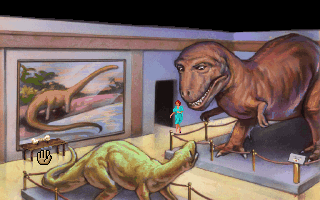
If this were the only problem, I could still have recommended the game. Some of the inventory puzzles are fun and fit seamlessly with the game’s narrative and style. Deciphering hieroglyphs and then using them later to solve a puzzle was a neat idea. The graphics are also decent enough, with bold colors, detailed exhibits (including paintings, sarcophaguses, and dinosaurs), gruesome closeup shots, and solid animations. Laura will die early and often in unique and colorful ways. There’s even a fun chase scene that forces you to solve puzzles on the fly.
But boy is this game riddled with other issues. Of most concern are the frequent racist stereotypes of Chinese and Egyptian people and sexist treatment and portrayals of the female characters. This is compounded by the talkie version of the game, where these problematic stereotypes are exacerbated by ridiculous accents. The acting may be the worst I’ve ever heard in an adventure game, and I was forced to turn it off. The narrator is actually quite pleasant to listen to, but it’s not worth it to hear every cringey line of dialogue.
There are also bugs, of course. Many times I would look at an object only to be given a description of something else across the room. Several times I was not allowed to proceed with interacting with an artifact as the game thought someone else was in the room when they were not. When you’re not running into these issues, there’s also plenty of cruel pixel-hunting to do. In a couple of cases you need to locate a book on an expansive shelf, though there’s no hint that you need to do so. So when you click on the wrong book and the game gives you a response telling you you’re wasting your time doing that, there’s no reason to keep trying every single book on the shelf.
The Dagger of Amon Ra was thankfully the last game in the series. While murder mysteries generally make for entertaining games, and Laura Bow had the potential to be a cool ongoing heroine, Sierra just never could get it to work.

 Death By Troggles