Publisher: Sierra
Developer: Sierra
Year: 1986
Platform: DOS, Apple, Atari ST, Amiga
Rating: 3
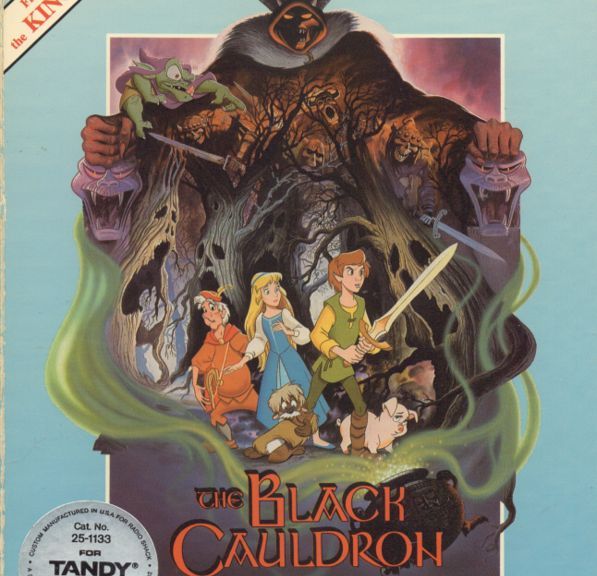
On the heels of King’s Quest II, The Black Cauldron was one of the earlier Sierra titles using their Adventure Game Interpreter. And while it’s a much more richly realized game than the first two in the KQ series, this movie adaptation is oversimplified and suffers from many of the same pitfalls that make it a chore to play.
I have neither read the book nor watched the animated Disney movie the game is based on, but from what I’ve read the movie is followed quite closely. You play as Taran, an assistant pig-keeper, who is sent on a quest to destroy the black cauldron, sought out by The Horned King to upstart his skeleton army. Taran’s pig, Hen Wen, is magical and has visions that the king hopes to use to find the cauldron.
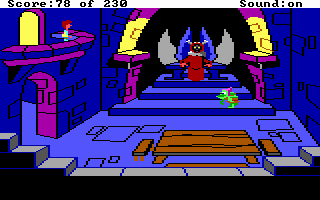
Al Lowe (along with Roberta Williams) made a solid design choice in that there are three paths through the game, only one which directly follows the movie. In the movie, Hen Wen is stolen and requires rescue, which is the path I took. However, there is a more difficult path where you keep your pig safe and yet another that leads to a bad but perfectly legitimate ending to the story. Depending on the path you take, several puzzles have varying solutions,
Another design choice to make the game more accessible to children is the lack of a text parser. Only four function keys are used for the actions of selecting an item from your inventory, using it, a general “do” action, as well as looking. I wish I could say this makes the game easier, but I never quite got the hang of it. It also hampers the game at times. If another character is on the screen while you try to use certain inventory items, the game thinks you’re trying to give it to that character and not for the obvious purpose you were intending. Another issue is that while you can look and get a general description of the area, you can’t look at anything in particular, so in case you happen to be standing right next to the thing you want to look at, you’re out of luck.
Given the simplified interface for children, it’s surprising then that its so incredibly easy to die in the most obnoxious ways possible. They put in a thirst and hunger daemon, something Sierra, despite all their faults, generally didn’t do. Running out of water for your flask is a bit difficult to do given the abundance of fresh water around, but it happened to me once when I was in the Horned King’s castle, where there is no water to be found and I wasn’t adequately prepared. It is very easy to die of hunger as you’re given limited food; there is a bottomless food wallet you can find, but only entirely by luck as its location is not logical and not signposted.
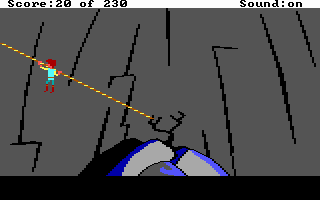
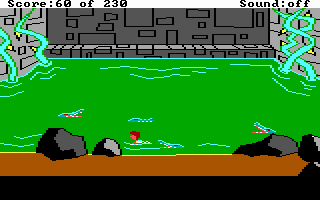
Most deaths occur either by falling into water or falling off cliffs, which no joke happened to me me about fifty times. There are just so many spots where the safe pixel zones are tiny and poorly defined. And saving every three steps is the exact opposite of fun. I had to traverse the cliffs leading to the king’s castle on three separate occasions which I believe accounted for a third of my time playing the game.
The only part of the game I really enjoyed was the castle itself. Almost every puzzle has multiple solutions. There are hidden passageways, leading to most rooms having more than one entrance and exit. There are many spots to hide from the guards. And the path I took where I had to rescue the pig was just delightful; it was the only puzzle I found to be simultaneously intuitive and rewarding.
The production values were fine for 1986, with 16 colors, minimal animations, and occasional music, blips, and bloops from the computer soundboard.
I imagine those who watched the movie will find the game more enjoyable, in part due to knowing the backstory, but mostly due to having a built-in walkthrough for some of the more obscure puzzles. Others will probably find little to enjoy with The Black Cauldron.
 Death By Troggles