Publisher: Annapurna
Developer: Mobius
Year: 2019
Platform: Windows, PS4, PS5, Xbox One
Rating: 8
In general I haven’t had the patience for completely open-world games for various reasons, the most prominent being the narrative often gets derailed either by sidequests or I wind up doing things in an order the writer didn’t intend. Outer Wilds breaks the mold for me, telling a remarkably tight and moving science-fiction story wrapped up in the conceit of a 22-minute time loop.
The game begins as you wake up next to a campfire by the launch site of your spaceship. Looking up, you see the galaxy’s giant green planet in the distance while something orbiting the planet explodes. Getting your bearings, you learn from the spaceship’s architect that it’s ready for launch, and probably won’t explode. He recommends you go into town to get the launch codes and say goodbye to everyone. This is the only part of the game that is linear; once you have the launch codes, it’s free-sailing.

You play the nameless protagonist (from a blue, four-eyed humanoid race) on the planet Hearth, a brand new cadet joining a team of five explorers in your village’s relatively new space program. Three of your colleagues are hanging out on other planets in the solar system, and one is missing. In addition to grabbing the launch codes, exploring your village helps you learn the ropes of everything you will be doing in space. There’s a cave where you can practice moving around in a zero-G environment, including doing ship repair. You can play with a model spaceship to get used to the controls. You can practice using a scout device you will need regularly on your travels. But most importantly, you should check out the space museum to learn about the extinct Nomai race.
Your species has learned from its local and space excavations that the Nomai were an incredibly advanced species that traveled to your galaxy a long time ago, back when the Hearthians were at the very beginning stages of their evolution. Scientists have decoded their written language while also collecting some artifacts, including anti-grav crystals. Additionally, the museum has collected a quantum rock that disappears when nobody is looking at it.

After launching your ship, you have full discretion on where to go. Maneuvering the ship is kind of a pain at first, and it took me a long-ass time to get comfortable with the controls. Not that the controls are bad; it’s just the game uses Newtonian physics and you have to direct the ship to where the destination planet WILL be, not where you currently see it. Thankfully, there’s an autopilot function to help out. It’s not flawless; the autopilot doesn’t care if something else in the way, so it might send you straight into the fucking sun. But you can disable it anytime. Even once I got used to the controls, I still used it often, especially since you have only 22 minutes at your disposal.
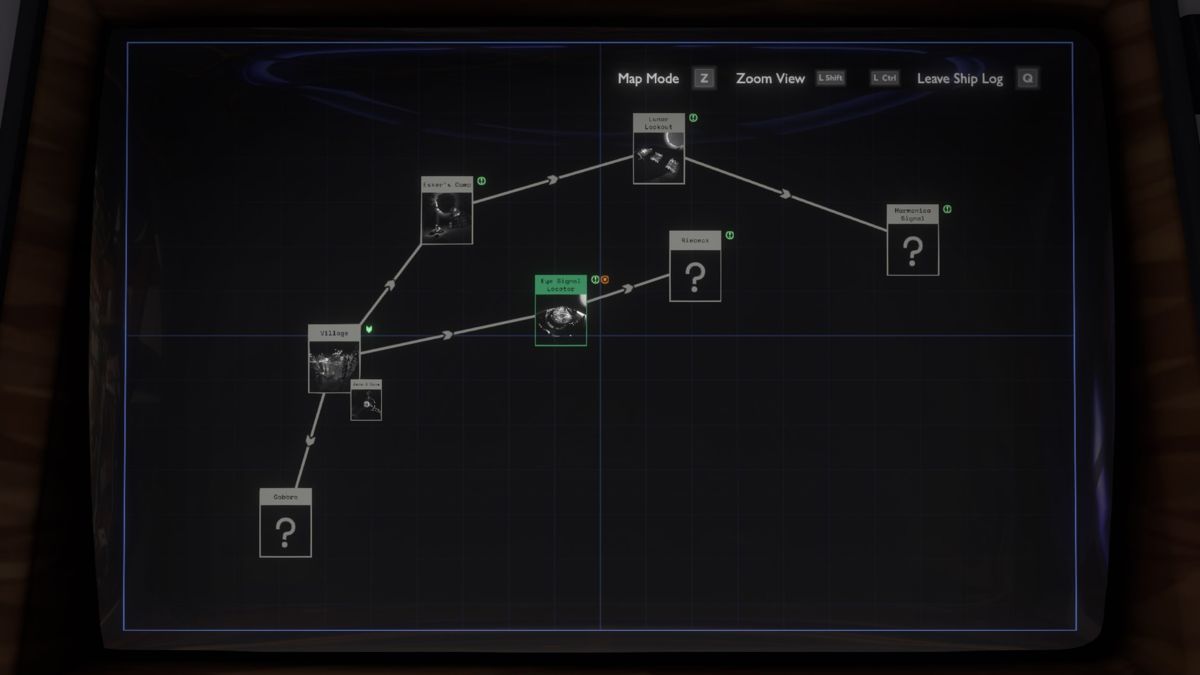
Yeah, exactly 22 minutes after you wake up, the sun goes supernova, destroying the entire galaxy. You then are hurtled back in time to the campsite, waking up to once again see something explode over the green giant. You’re the only one who realizes time has restarted, and everything you’ve done has reset itself. The one exception is the game’s saving grace; on board your ship you have a computer that keeps track of information you’ve learned through each loop. This information is sorted into two places; you can either look at all the info you’ve gathered planet by planet or in a flow chart the game creates to link different puzzles to each other. While taking your own notes can be helpful in remembering certain details, the computer keeps track of everything super important. Not only that, when your computer updates with information you’ve gathered, there’s a rush of satisfaction seeing the chart get filled out.
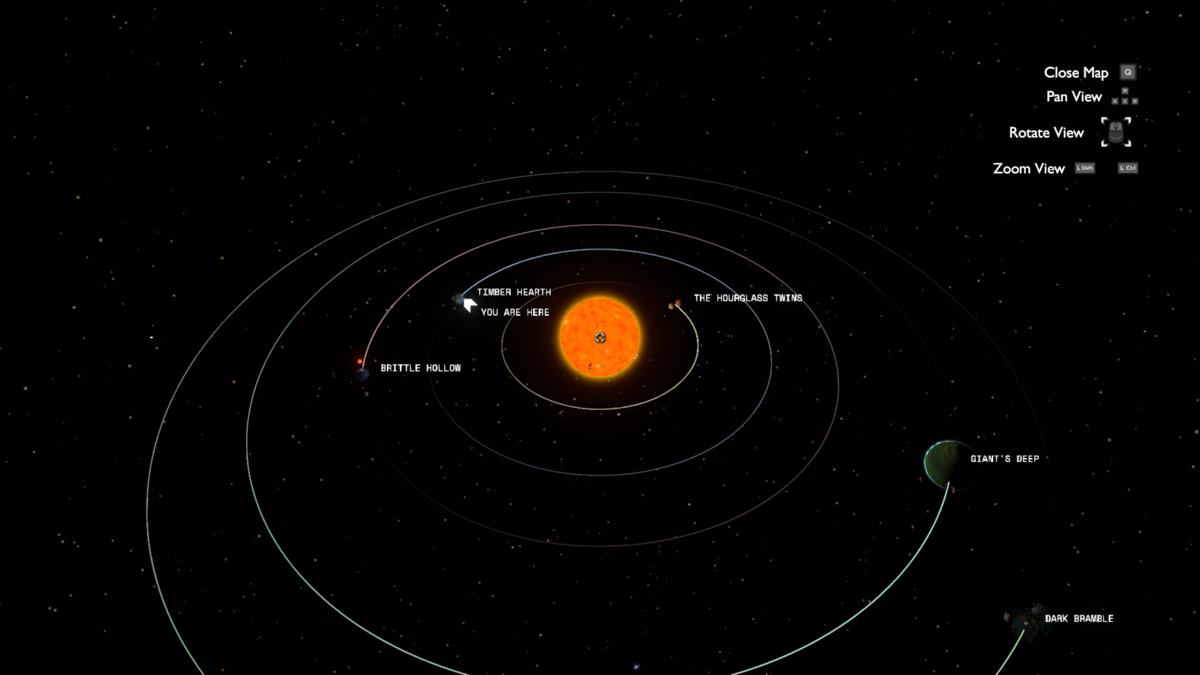
The galaxy is a curious one. Firstly, all of the solar system’s planets can be seen with the naked eye; either the Hearthians have incredible vision, or the gravity in this system is something else. Moreover, the planets are all a wonder of their own. For example, the Hourglass Twins are dual rotating planets, whose gravitational force with each other is so strong that all of the sand on one planet will fall to the other within a twenty minute span (and then the process will reverse itself). Brittle Hollow has a black hole inside of it, with its gravity somehow only affecting the planet itself. Giant’s Deep is almost entirely covered by ocean and tornadoes. There’s even a comet hurtling toward the sun. Each planet has its own unique challenges (and gravity), and the great thing is if you get stuck or frustrated, you can switch to another one on the next loop.
One frustration I wish didn’t exist is your extremely limited oxygen and fuel supplies. An oxygen tank that doesn’t even last 22 minutes is obnoxious. One could argue that 22 minutes is just how the player perceives things, and everything in game time takes place over a much longer span. Regardless, planning trips around your tanks is a stressor I don’t find particularly rewarding. There are ways to refill it, including returning to the ship, finding discarded tanks from your comrades, or just finding a grove of trees (for the oxygen). Most of the time it isn’t an issue, either because you die long before you run out, or there is oxygen conveniently located during the middle of puzzles. Still, I could have done without it.
You can also injure yourself, either by falling from a great distance or running into spiky plants (that get in the way of several doors). You can use the first aid kit in your ship, or simply be more careful. Your fuel tank serves as a mini rocket booster to help you float or slow your fall (assuming you’re not in high gravity). There are no puzzles that require you get injured to progress, and usually if you die it’s because you did something stupid or got fell by running into a pocket of ghost matter, a mysterious substance that is deadly to all life, but contained in a small area and detectable by your scout.
There are so many unique puzzles and ways to explore each planet that it’s impossible to cover them all. But to break it down as simple as possible, the goal is to discover Nomai technology, relics, and writings to help learn more about them and their understanding of the universe, hoping to find information that can help you save your galaxy. And its this exploration of the Nomai where the game earns its emotional weight. Yes, you will come across corpses of long-lost Nomai, but reading their writings is where things pack the biggest punch. You will experience their sense of wonder, excitement, joy, logic, and dread, almost as if you’re a live documentarian of their species. Building pathos for an ancient civilization is an impressive feat.
The puzzles mostly involve learning how to use what’s left of their technology and applying their knowledge of quantum physics. I got stuck a couple of times, but only needed gentle nudges to push me in the right direction. Once you’ve put together enough of the puzzle pieces, you can go ahead and solve the game, a feat that took me about 18 minutes or so. It would be impossible to accidentally stumble across the final answer (or even most of the smaller answers to be honest), a testament to complex design. There are certainly a few puzzles you don’t have to finish to win the game, but the joy in The Outer Wilds comes from the exploration and learning.
The atmosphere is remarkable. Music is sparse, and when it does play it’s generally a simple acoustic tune in the background that doesn’t try to emphasize danger or heighten tension. Most of what you hear is your breathing, footfalls, and various noises of the planets, such as water rushing or rocks falling. The void of space itself is dead silent, which is creepy enough by itself.

There is no voice acting and there didn’t need to be. There’s not a lot of dialogue anyway; most interactions with your fellow Hearthians are short and not where the bulk of anything interesting happens. And most of what you learn about the Nomai is through writings; adding voices to the smattering of audio-files would have run the risk of ruining the mood had the acting not been pitch perfect. Given it’s another species and running through a translator, having it written out is most practical and just as exciting or chilling as any voice over could be.
Outside of the fuel and oxygen tanks, my only other frustration with the game is its repetitive nature. Every time you wake up, you have to launch the ship and travel to the planets again and again. While this fun when you’re starting out and getting to know the various planets, it can feel like a chore when you’re trying to solve the same puzzle on the same planet repeatedly. There are times when you’re 17 minutes into a puzzle, about to solve it, when you make an error and need to redo everything step for step. There are also puzzles where you literally have to sit around and wait for something to occur in the loop. I’m not entirely sure there’s a way around this, as being allowed to spam-save would take away a lot of the tension, and creating restore checkpoints could easily do the same. One feature that does help a bit is (eventually) learning how to meditate to essentially fast-forward to the supernova. Before you learn how, if you want to restart the loop you either have to intentionally kill yourself, wait out the 22 minutes, or quit the game and come back.
The expansive ending certainly does its best to reward the player for a job well done. It didn’t hit me like it does some, but all in all it was still a satisfying conclusion to a wonderful story. I would have liked to learn more about Hearth and my comrades; as it stands the game is almost exclusively an exploration of the Nomai. Still, Outer Wilds is an easy game to recommend for anyone looking to enjoy an intelligent and unique science fiction tale.

 Death By Troggles