
Publisher: Wales Interactive
Developer: Little Jade; Good Gate; Wales Interactive
Year: 2020
Platform: Windows, Mac, PS4, XBox One, Switch, iOS, Android
Rating: 4
I’m not entirely sure what it would take to make an interactive movie truly great. Pure camp could work, and Black Mirror’s Bandersnatch has its moments. But a dramatic piece can easily suffer from discontinuity or the randomness of a choose your own adventure. The Complex is no different.
The movie begins in the middle of a war zone in the fictional Asian country of Kindar. You play Dr. Amelia Tennant, who has two patients in her tent, apparently dying from some kind of nerve agent. You have one dose of an experimental drug that uses (vaguely described) nano cell technology to heal life-threatening injuries. Your first choice is whether or not to save the young aspiring footballer or the pregnant woman. Not being a monster, I saved the woman before jumping to present day.

During a meeting with investors for her potentially world-saving technology, Dr. Tennant gets called out to investigate a woman who fell ill on public transportation, with signs similar to those who have been given too high a dose of the cells. As it turns out, the victim is one of the Kindarian interns at the complex you work at. You get her back to the lab under quarantine, tasked with saving her life and figuring out what went wrong. Joining you is Dr. Wakefield, your former coworker–and love interest–during the war, who abandoned his post and the project (of which Dr. Tennant is still bitter) but is still considered an expert with this problem. Meanwhile, the head of the complex and her assistant occasionally check in via internal comms from the safety of their office.
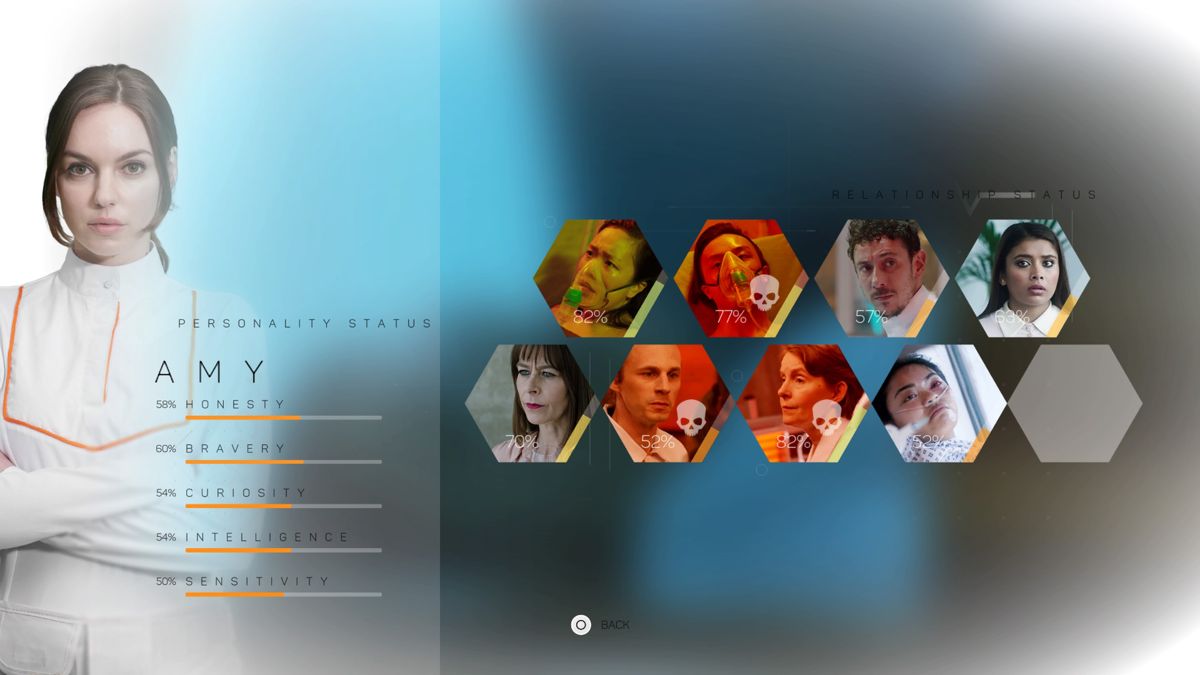
The first playthrough takes a couple of hours and involves around thirty decisions that can lead you to one of nine endings. Most decisions, especially early, are less about directly impacting the game’s events but rather improving or harming your relationship with both Dr. Wakefield and your patient Clare. After each decision you can access a menu that tells you what percentage your relationship is at, with the default being fifty percent. Each decision only last a few seconds but can thankfully be paused so you can think of your preferred response.
While it’s nice to see the immediate impact of your decisions, the system is a bit wonky. While the direction your relationships move always make sense, the percentages seem random. There appears no way to move your relationship with someone to 100 percent or 0 percent, even though your actions can directly save people’s lives or kill them. Indeed, the only thing that matters as far as plot branches go is whether you’re over 50% or below it. Several other relationships are tracked as well, but they never change the course of events and only matter for a couple of achievements. And, annoyingly, a couple of the relationship percentages are hard to read as they’re displayed in a white font on a light background.
Wonkiness aside, the real issue with the game is simply the story. While the acting is fine enough, the shallow dialogue doesn’t make us feel for any of these characters or their fates, and several high dramatic moments wind up a bit tepid. The paint-by-numbers sci-fi plot also doesn’t do the game any favors, as every plot point and twist is easily predictable.
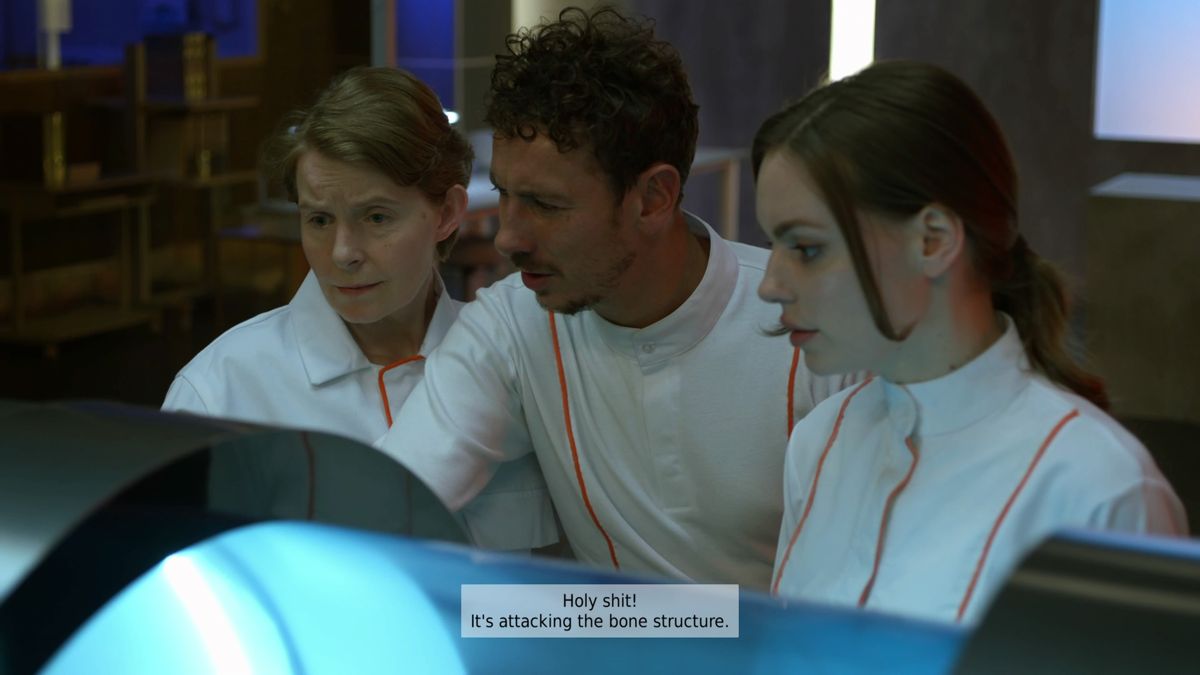
It’s a shame, too, as the sets and cinematography are above average for this type of game. While it’s clearly low-budget, it did feel like I was inside a high-tech facility complex with futuristic touch screens and quarantine pods. The directing is competent, if uninspiring. Due to the nature of the game, it’s usually obvious when a scene you’re watching based on a decision transitions to a scene universal to all playthroughs, and the cuts in conversation are occasionally awkward.
As mentioned above, there are also a couple of continuity issues, where certain events only occur on certain playthroughs for no reason other than it seemed cool. To be fair, these surprise events were a highlight to distract myself from the otherwise humdrum plot.
Blissfully, each subsequent playthrough allows you to quickly skip any scenes you’ve already witnessed, significantly shortening the time it takes to find other endings. Not so blissfully, all nine endings pretty much suck. While the “bad” endings (which assume you care about any of the characters) are somewhat entertaining, none of the “good” endings are particularly positive, with denouements so short and vague that they could hardly be considered rewarding.
If you just love interactive movies of all kinds, then The Complex is certainly pleasant and inoffensive enough to kill some time. But even my low bar for this medium was not met with this completely unmemorable story.

