
Publisher: Devolver
Developer: Croteam
Year: 2014
Platform: Windows, Mac, Linux, iOS, Android
Rating: 6
Can an android become sentient? Bet you’ve never experienced that kind of story before. But in case you have, The Talos Principle does a decent job of engaging in this discussion while sending you through about a hundred or so environmental puzzles. Clearly inspired by the Portal series, The Talos Principle is significantly more difficult and significantly more serious. And while I found it to be repetitive at times and the story not as engrossing as I was hoping for, I still had a blast working my way through it.
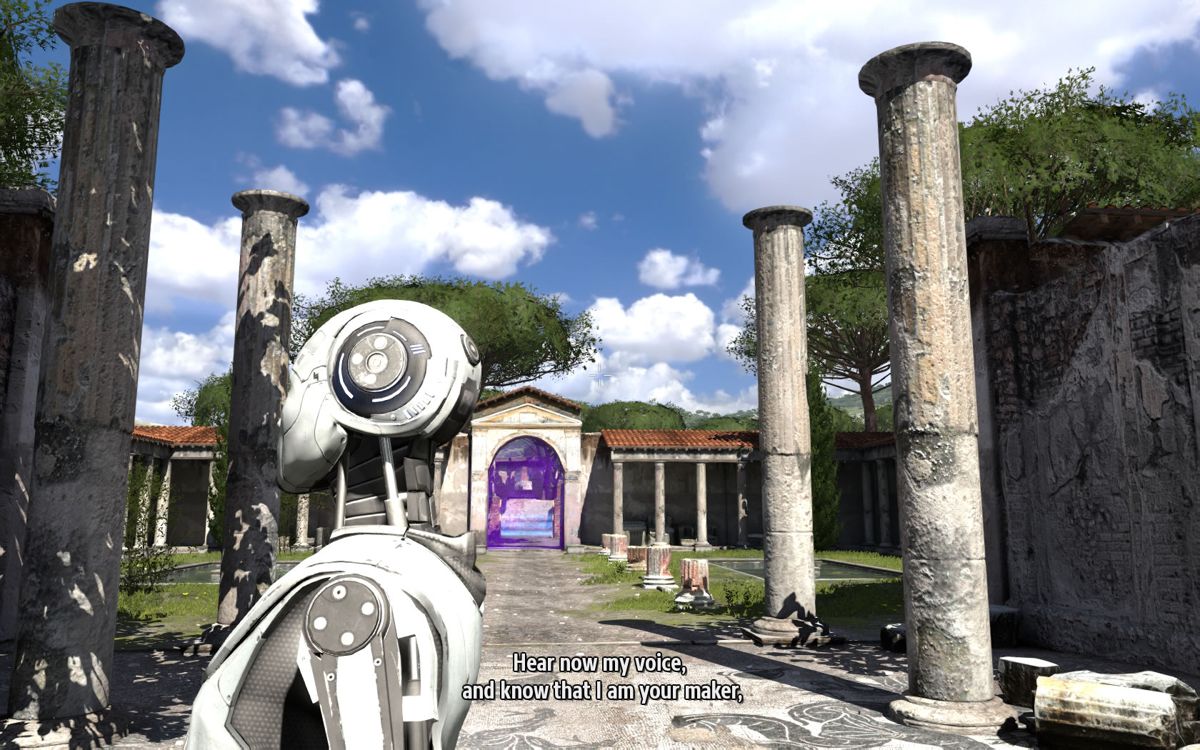
As the game begins, you find yourself in a fully 3-D environment, moving around in first person. You quickly learn you are an android, and a booming voice who identifies himself as Elohim (literally “god” in the Hebrew language) tells you that you are one of its children and he’s so excited for you to explore his world, solve his puzzles, and be granted eternal life.
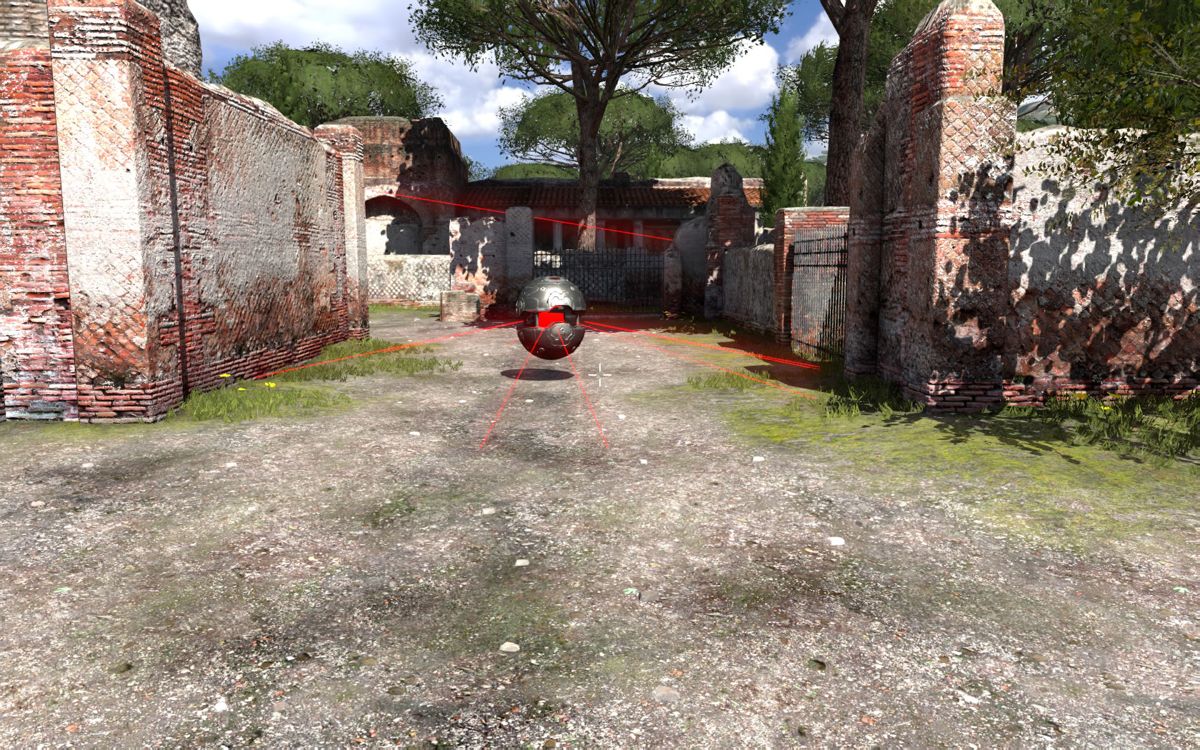
You are then introduced to the game’s most basic puzzle elements. There’s an item called a jammer that you can place on the ground and aim it at a force field, a roving mine, or a remote laser gun to disable it. The roving mines are floating orbs that operate like sentries with a predictable pattern, and the remote laser guns are installed high on walls and destroy anything that crosses its path. A series of simple puzzles help you get used to the strategies involved with sidestepping these obstacles. While you can jump a very short distance, there is no significant platforming involved and most of the puzzles are intellectual in nature, with only some mild dexterity needed to move somewhat quickly to avoid the mines.
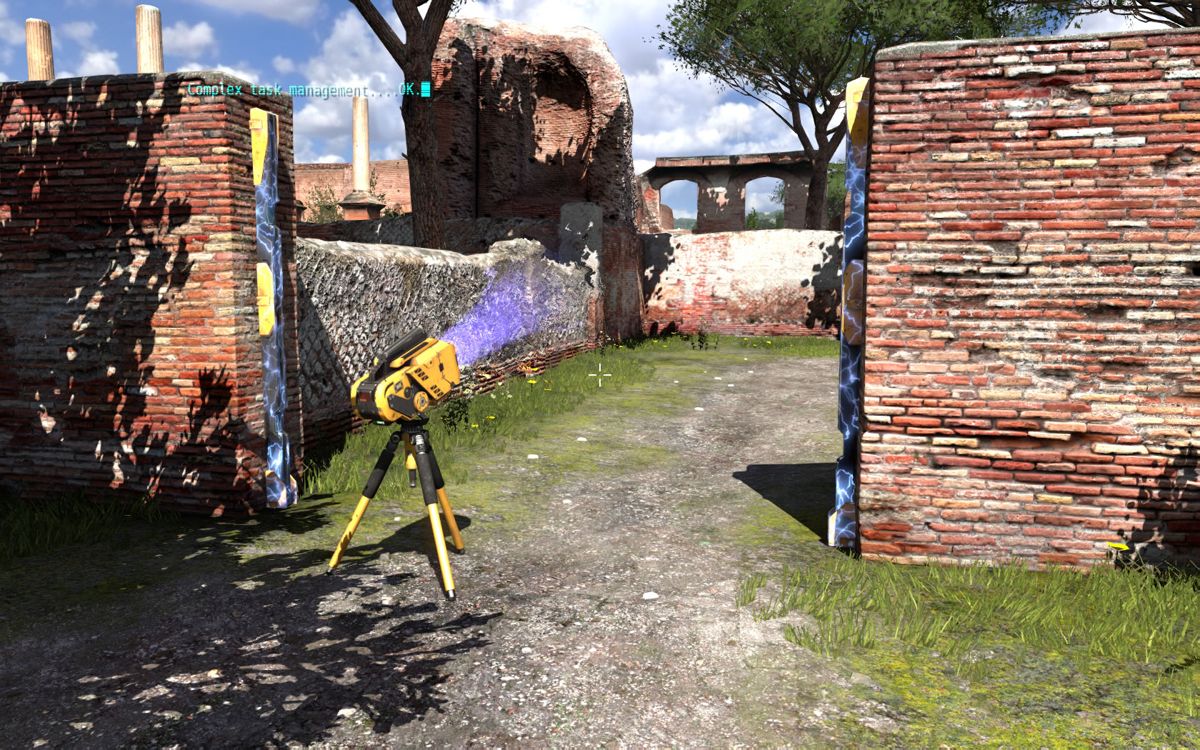
You then get introduced to the concept of sigils, which are your reward for completing any particular puzzle. Each sigil is kept behind a force field and is basically a floating tetromino. And it should be noted each puzzle is self-contained. In general, you cannot remove items from any one puzzle area, though thankfully there’s often many puzzles available at any one time so you can move around if you get stuck.
Collect enough sigils and it will give you access to gates that either lead to additional areas of the game, or give you access to tools you’ll need to solve future puzzles. Annoyingly, just collecting the sigils is not enough. On each gate, you are given a surface area and must perfectly align the sigils so that they fill the space evenly. There’s no reason stated for this game to exist, and they become progressively more difficult and obnoxious the further in the game you get.
In addition to Elohim frequently interrupting to give you advice or praise, there is at least one computer terminal located in every new section you arrive at. Accessing the data on each terminal is as simple as pressing a button and selecting from menu options. The files on these computer slowly hint at what the world was like when the humans were still around, and how the humans created this current world your navigating and why. Interspersed with articles about ancient religions and artificial intelligence theories are e-mails and journal entries by the scientists working on the Talos project. While I found a good number of these to be rather mundane, one fascinating character emerges in that of project leader Alexandra Drennan.
In addition to reading her personal thoughts and internal communications, spread throughout the world are visible auditory echoes she recorded that you can activate just by walking through them. Erin Fitzgerald does an incredible job voicing Alexandra, her general optimistic musings about the project and humanity in general providing the heart and soul this otherwise dry story desperately needs.
Another character also emerges–Milton–a program within the terminals that truly despises Elohim and tries to use philosophy and logic to bring you over to its side. Elohim is aware of Milton as well and will occasionally reassure you that his side is the proper one. The game’s constant push and pull between faith and science could have definitely been more enlightening; as it stands, most of what you hear and read feels very surface-level and I found little of it moving or intellectually challenging.
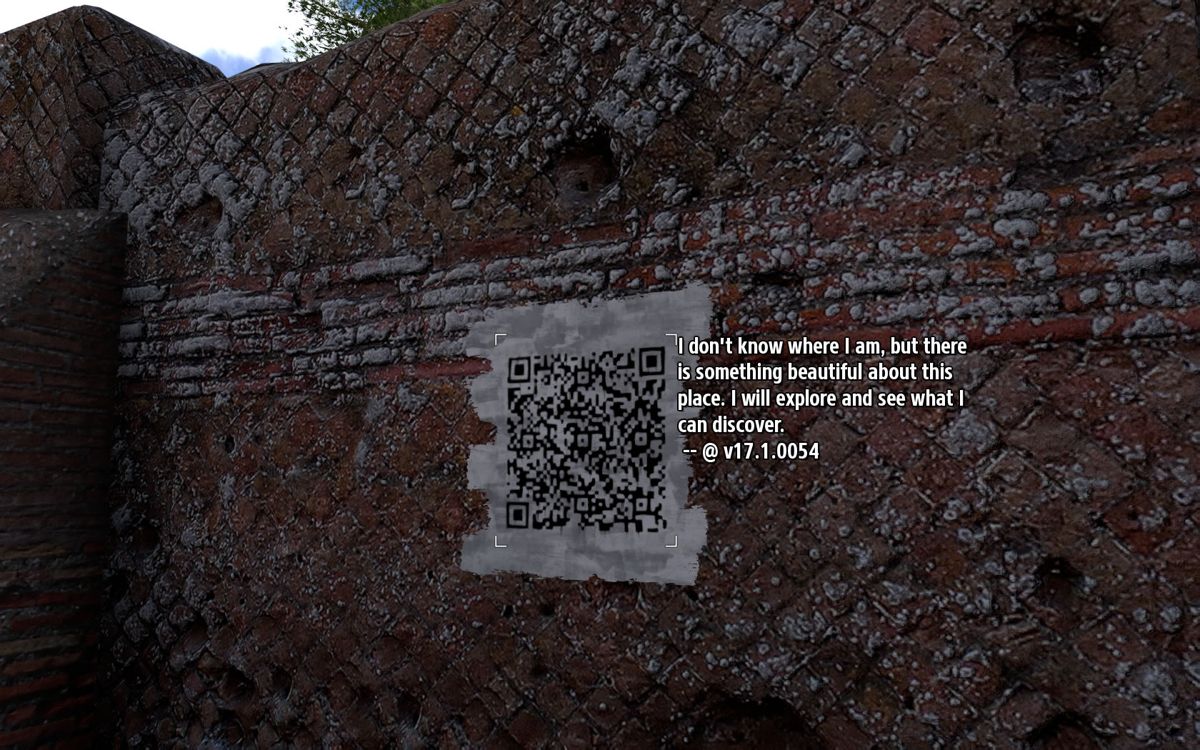
You will find many QR codes that “previous” androids have painted on walls with a message, and they run the gamut from debating the legitimacy of Elohim and Milton’s claims, doubting their will to keep going, or simply sharing frustration over how hard the puzzles are. It’s a nice touch that makes the experience feel a little less lonely.
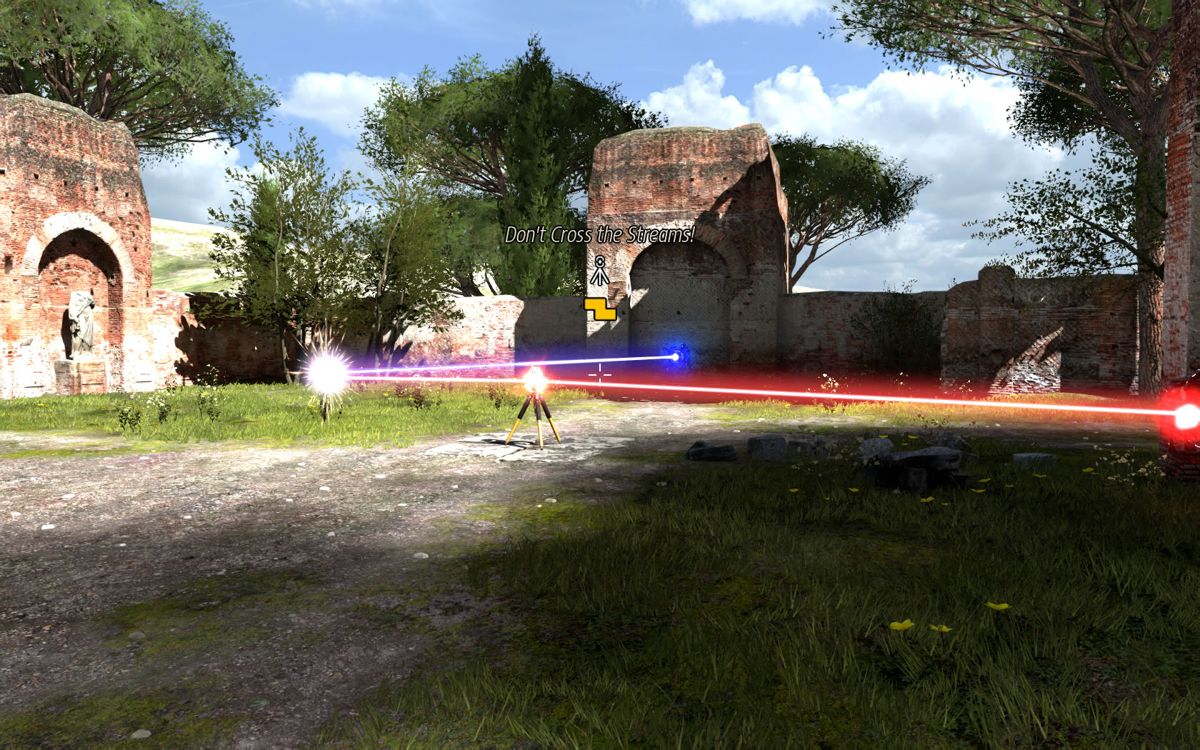
Back to the puzzles, additional elements beyond the jammers make things more interesting. The most fun are connectors, which are tripods holding a crystal that can redirect red or blue lasers to power receivers that open gates or disable force fields. You will often find yourself using a combination of several connectors to redirect lasers around a maze of stone and brick walls, also being mindful that the red and blue lasers can never cross. Things get more complex from there with cubes, fans, and activation plates. The other significant puzzle design involves you activating a terminal to create a holographic copy of yourself performing actions, that you can then play and work along side to solve puzzles. I found these brainteasers especially frustrating as my mind had difficulty projecting what I needed my hologram to do.
That said, I managed to solve all 99 main story puzzles without any help from the internet, even if some took me several days and dozens of tries to master. I did use the three in-game hints you’re allotted (which you can obtain fairly easily), but only one of them helped me figure out the answer. When you collect a sigil, you’re rewarded with a triumphant ringing tone, though I never felt quite the dopamine rush I was looking for.
Each primary section of the game has its own background music, and while they’re generally unobtrusive tracks, I found them generally unpleasant at the beginning, improving significantly by the game’s end. I also found the graphics to be underwhelming. Everything is clearly drawn and perfectly functional, but it never stopped feeling like I was inside a simulation; perhaps that was partly the point given the game’s subject matter, but I found my eyes glazing over at the repetitive visuals after 99 puzzles.
This all changes, though, during the final section. For the game’s entirety, Elohim warns you to not climb the tower. If you do, you are defying his wishes and will not be granted eternal life. Of course, for one of the endings (and I would say the best one), you must climb the tower, and it’s the most rewarding section of the game on so many levels. The music is more majestic, the puzzle rooms are a refreshing change of pace, and the story line coalesces into a somewhat emotional and satisfying ending. There is an ending for those who want eternal life instead, which is amusing in its own right. And there’s a third ending for those looking for the challenge of collecting an additional 30 bonus sigils, which are hidden in various levels and are quite difficult to obtain. I didn’t have the patience to find them all.
While I’m not sure I have the desire to ever play this again due to the utter exhaustion I felt by the time it was over, I’m glad I played The Talos Principle. The story is just fun and endearing enough to keep you going, and the puzzles, even if occasionally repetitive, are of world-class design.
 Death By Troggles