Tag Archives: King’s Quest

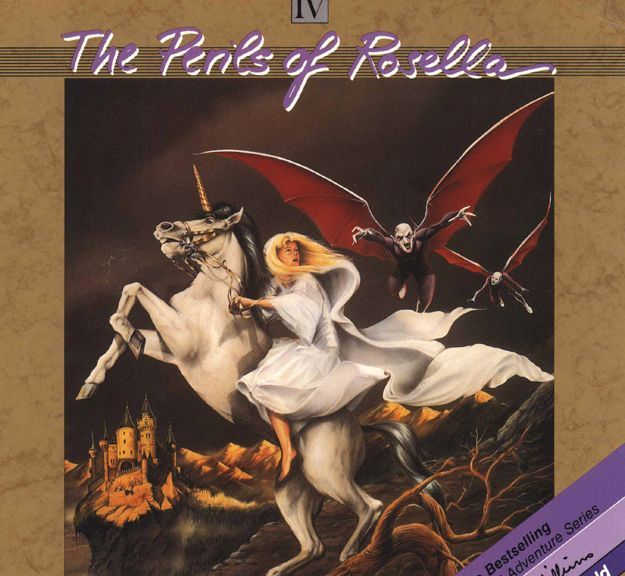
King’s Quest IV: The Perils of Rosella

Publisher: Sierra
Developer: Sierra
Year: 1988
Platform: DOS; Amiga; Apple II; Atari ST

Review: 1988 and 1989 were Sierra’s truly great years, and it all began with The Perils of Rosella. With the series’ fourth installment, Sierra revolutionized the gaming industry with professionally composed music, their new SCI game engine, the best parser they ever created, and an adventure worthy of the moniker.

King Graham is planning on passing his adventurer’s hat to the next of kin, but before Alexander and Rosella can fight over the rights to star in the next sequel, Graham lets everyone down and has a heart attack. While Graham is on his deathbed, Rosella runs out of the room in emotional anguish, only to have the magic mirror come to the rescue once more. Genessa, a good fairy from a faraway land, informs the hopeful Rosella that a magical fruit within her realm can save her father much like drinking water from the Holy Grail. Rosella says “Okay.” Genessa informs Rosella that because the producers needed to flesh out the game, she has been struck ill and does not have enough magic power remaining for a round trip; rather, there’s just enough left for a one stop shop. Rosella says, “Screw that!” Genessa informs Rosella that the evil fairy Lollotte has stolen her talisman, and if Rosella would be so kind enough to destroy the evil Lollotte and bring back her talisman, she just may continue to live, and would thus be able to send Rosella back home. Rosella says nothing. Genessa reminds Rosella of the incredible guilt she’d feel if she didn’t at least try. Rosella says, “Bloody hell!  I’m in!”

Okay, so maybe the introduction isn’t quite like that. I make light of it because Roberta Williams must let the player know the entire plot before the first chapter even begins, as she did in nearly every game she ever made.  At least it’s the only significant mistake she made here. In fact, the plot does veer slightly at various junctures. Rosella ends up needing to complete more quests than the one already outlined during the introduction. While the various plot lines are not connected very well, they do stand up on their own merits, and because the ride is fun you can forgive everything else. The characters (human and otherwise) you meet have good development considering you rarely interact with any of them for more than a couple minutes. The game has humor; I fondly remember reading all of the epitaphs in the cemetery. There are multiple endings, and creative ways you can die. To top it off, halfway through the game day turns into night, fleshing out more characters and allowing for more exploration, not to mention adding a few spooks.

Like the last game, time is a factor, as you must retrieve the talisman within 24 game hours. While that may seem like a short time, the game can be won much quicker than that if you know what to do. There’s a chance you may have to restart if you do enough aimless wandering, but if you make good use of the “save” and “restore” commands you shouldn’t have to worry too much. Some puzzles are difficult without being unfair. Mythology is used quite heavily but knowledge of the stories is neither required nor all that useful. There is one terrifyingly awful puzzle involving a whale’s tongue(!). Thankfully, it is not terribly difficult, although it’s a mite frustrating. At least Sierra was able to poke fun at this very puzzle in Leisure Suit Larry 3.

If you only play one game in the King’s Quest series, and you are not allergic to typing, make it The Perils of Rosella.

Contemporary RatingLow. The pointless time limit and some cheap falling deaths were annoying twenty years ago.

Cruelty RatingCruel. Not as cruel as other Sierra titles, but there is one way to lock yourself out of the good ending without realizing it. You might realize you did something wrong, but the game gives little indication.
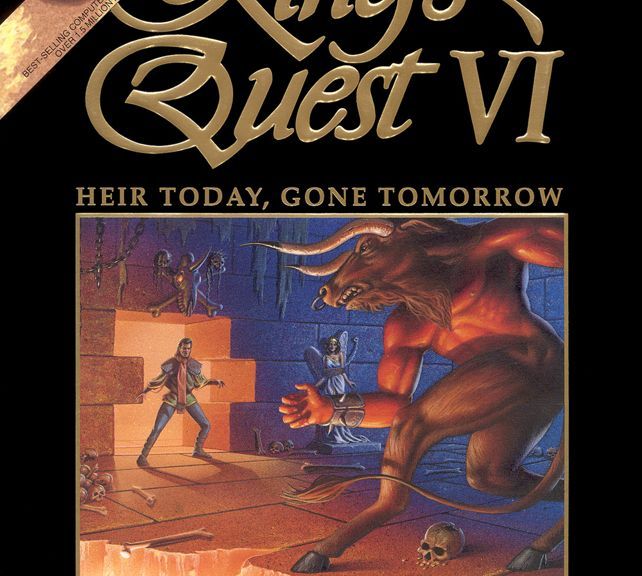
King’s Quest VI: Heir Today, Gone Tomorrow!

Publisher: Sierra
Developer: Sierra
Year: 1992
Platform: DOS, Windows, Amiga, Macintosh

Review: While a vast improvement over the previous installment, with a much longer, integrated plot and a much better use of mythology, the sixth installment still lacks in many basic areas that plague the King’s Quest series.  Thankfully, there’s enough that’s awesome here to make it worth playing.

Alexander, a very bored prince, is sulking in the throne room, something he learned quite well from his father. Roberta Williams digs into the plot device bag and pulls out the ol’ reliable Magic Mirror to get things started. And whadya know, Cassima, the lass King Graham helped save on his last adventure, appears in the mirror. She is trapped inside of a castle and expresses her longing for a man (a la Juliet).  While she never mentions him by name, Alexander assumes she is talking about himself. So, without asking his father’s permission or telling so much as his fairy godmother of his plans, Alexander takes off for the Land of the Green Isles, where Cassima is being held in solitude.

Wait a second. This sounds eerily familiar. Perhaps…yes, perhaps it’s because this is the exact same plot lifted from King’s Quest II: Romancing the Throne. Thankfully, Mrs. Williams must have realized her abysmal failure the first time around and decided to give it another shot.

The opening animation sequence is beautifully done. It also manages to be quite long without giving away the game’s plot in its entirety. The plot does move along during play, though barely, and during cut scenes like in King’s Quest IV: The Perils of Rosella. While not original, the King’s Quest series was never known for its plot. Rather, environment, mysticism, and puzzles (well, sometimes) helped sell the series. For the most part, they’re all here.

Yet I have a love/hate relationship with this game. I would have enjoyed it more with a typing interface. Then, some of the neat puzzles might have been hard. Unfortunately, many are very easy. Too many of the puzzles require “triggers” to activate them (breaking mimesis), and there is one very not obvious way to become walking dead for a very long time. If you don’t converse with a particular character at the beginning of the game, you will put the game in an unwinnable situation depending on which plot branch you take. Worse yet, you will not know you have done as such until the game is almost over. There is no excuse for such sloppy game design. Also, an extensive part of the game involving the Cliffs of Logic and the Catacombs is one huge copyright protection. The only way to solve the puzzles is to have the “Guidebook” that comes with the game. Instead of creating fun and intuitive puzzles, the designers simply became lazy.

On the bright side, most of the characters are developed well. The shopkeepers of the pawn shoppe and the library have captivating voices and wonderful personalities. In fact, everyone human that you meet is fun to interact with. However, many of the mythological and cartoon characters become rather annoying and have little pleasantness about them (except Hole in the Wall!). The main characters are so stereotypical that one wonders if Disney had a role in character development. Alexander will never do anything that is improper or not fit for a prince, unless of course he needs to do so to advance in his quest. And Cassima’s undying love for Alexander is groundless, but it does fit her undynamic personality. At least the corniness is good for a few chuckles.

The graphics are nothing spectacular and not much of an improvement over the last game in the series. Everything is very colorful, but much of it is too cartoonish. The sound effects are pretty good, however, and the end game song is a treat.

Most of the game is pleasant, and the advent of five unique islands to explore, a plot branch, and two endings with one giving you more points than the other (and a much longer, satisfying game) are great ideas and I applaud Sierra. Also, magic is used almost as extensively as it was in King’s Quest III: To Heir Is Human, an idea this series should have implemented more often.

Heir Today, Gone Tomorrow is a relatively easy adventure with poor plot development and some annoying puzzles.  So why do I like it so much? Perhaps it’s sentiment.  Perhaps because it’s predecessor was abominable.  Or perhaps it’s all of the charm.  And the things this game does well, it does really well.

Contemporary RatingMedium. Highly intuitive gameplay, but making an hour’s worth of puzzles a copyright protection is unforgivable.

Cruelty Rating:  Cruel. You can die frequently, and it’s not always obvious.  Only one walking dead situation, but it’s still very cruel.