Tag Archives: Sierra

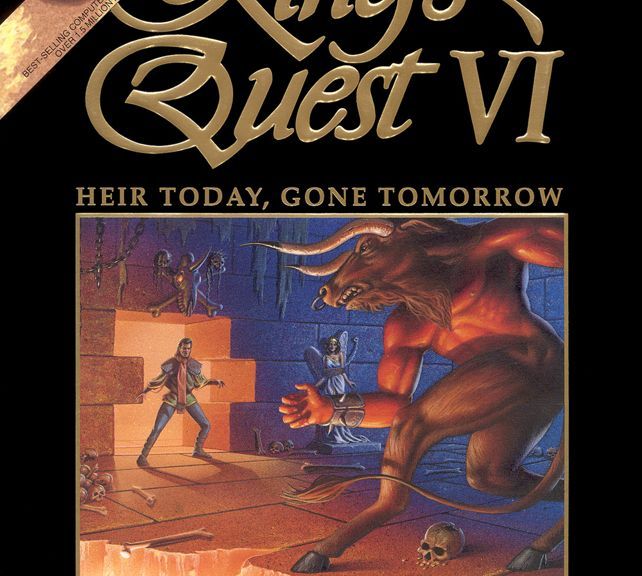
King’s Quest VI: Heir Today, Gone Tomorrow!

Publisher: Sierra
Developer: Sierra
Year: 1992
Platform: DOS, Windows, Amiga, Macintosh

Review: While a vast improvement over the previous installment, with a much longer, integrated plot and a much better use of mythology, the sixth installment still lacks in many basic areas that plague the King’s Quest series.  Thankfully, there’s enough that’s awesome here to make it worth playing.

Alexander, a very bored prince, is sulking in the throne room, something he learned quite well from his father. Roberta Williams digs into the plot device bag and pulls out the ol’ reliable Magic Mirror to get things started. And whadya know, Cassima, the lass King Graham helped save on his last adventure, appears in the mirror. She is trapped inside of a castle and expresses her longing for a man (a la Juliet).  While she never mentions him by name, Alexander assumes she is talking about himself. So, without asking his father’s permission or telling so much as his fairy godmother of his plans, Alexander takes off for the Land of the Green Isles, where Cassima is being held in solitude.

Wait a second. This sounds eerily familiar. Perhaps…yes, perhaps it’s because this is the exact same plot lifted from King’s Quest II: Romancing the Throne. Thankfully, Mrs. Williams must have realized her abysmal failure the first time around and decided to give it another shot.

The opening animation sequence is beautifully done. It also manages to be quite long without giving away the game’s plot in its entirety. The plot does move along during play, though barely, and during cut scenes like in King’s Quest IV: The Perils of Rosella. While not original, the King’s Quest series was never known for its plot. Rather, environment, mysticism, and puzzles (well, sometimes) helped sell the series. For the most part, they’re all here.

Yet I have a love/hate relationship with this game. I would have enjoyed it more with a typing interface. Then, some of the neat puzzles might have been hard. Unfortunately, many are very easy. Too many of the puzzles require “triggers” to activate them (breaking mimesis), and there is one very not obvious way to become walking dead for a very long time. If you don’t converse with a particular character at the beginning of the game, you will put the game in an unwinnable situation depending on which plot branch you take. Worse yet, you will not know you have done as such until the game is almost over. There is no excuse for such sloppy game design. Also, an extensive part of the game involving the Cliffs of Logic and the Catacombs is one huge copyright protection. The only way to solve the puzzles is to have the “Guidebook” that comes with the game. Instead of creating fun and intuitive puzzles, the designers simply became lazy.

On the bright side, most of the characters are developed well. The shopkeepers of the pawn shoppe and the library have captivating voices and wonderful personalities. In fact, everyone human that you meet is fun to interact with. However, many of the mythological and cartoon characters become rather annoying and have little pleasantness about them (except Hole in the Wall!). The main characters are so stereotypical that one wonders if Disney had a role in character development. Alexander will never do anything that is improper or not fit for a prince, unless of course he needs to do so to advance in his quest. And Cassima’s undying love for Alexander is groundless, but it does fit her undynamic personality. At least the corniness is good for a few chuckles.

The graphics are nothing spectacular and not much of an improvement over the last game in the series. Everything is very colorful, but much of it is too cartoonish. The sound effects are pretty good, however, and the end game song is a treat.

Most of the game is pleasant, and the advent of five unique islands to explore, a plot branch, and two endings with one giving you more points than the other (and a much longer, satisfying game) are great ideas and I applaud Sierra. Also, magic is used almost as extensively as it was in King’s Quest III: To Heir Is Human, an idea this series should have implemented more often.

Heir Today, Gone Tomorrow is a relatively easy adventure with poor plot development and some annoying puzzles.  So why do I like it so much? Perhaps it’s sentiment.  Perhaps because it’s predecessor was abominable.  Or perhaps it’s all of the charm.  And the things this game does well, it does really well.

Contemporary RatingMedium. Highly intuitive gameplay, but making an hour’s worth of puzzles a copyright protection is unforgivable.

Cruelty Rating:  Cruel. You can die frequently, and it’s not always obvious.  Only one walking dead situation, but it’s still very cruel.

Phantasmagoria: A Puzzle of Flesh

Publisher: Sierra
Developer: Sierra
Year: 1996
Platform: DOS, Windows

Review: About the only thing that the second installment of this “series” has in common with the original is full motion video.. Otherwise, near everything else, including the writer, director, actors, and genre have changed.

Exit Roberta Williams, enter Lorelei Shannon. Both were involved directly in the making of King’s Quest 7, one of the worst adventure games of all time. I have forgiven Lorelei after doing this project.

Unlike the first game, this is not horror. Shannon’s script has some tense moments, and there’s plenty of gore, but Puzzle of Flesh is more of a sci-fi thriller. And the tense moments that exist become so predictable that they could hardly cause a fright. What this script does have that its predecessor does not is an original plot and character development. During the game the player gets a good feel for nearly a dozen characters.

Curtis Craig, played by Paul Morgan Stetler, is the protagonist, an attractive single introvert who works in a cubicle for a pharmaceutical company as an editor. He’s at the low end of the totem-pole but appears content with his simple life. He’s dating one of his co-workers, but his true love is his pet rat Blob. No one really knows much about him; in fact, Curtis doesn’t know that much about himself either. Of course, some really bizarre, seemingly supernatural things begin happening to Curtis and those around him and he spends the entire game trying to figure out who, or what, is behind these events. Flashbacks are used extensively, giving Craig and the player information, little by little, about what might be going on.

Stetler is fantastic. He rarely overacts, and his non-verbal reactions are often right on target. His gay friend Trevor, played by Paul Mitri, is also very good. He makes a good contrast to Stetler’s character, and his acting appears very natural when he’s being funny (and junior high-like when he’s asked to do drama). Monique Parent, Cinemax soft-porn star, has a similar role here and does well enough for that role. Most of the supporting actors are sufficient, especially Michael Taylor Donovan as Stetler’s supervisor.

The real standout is Ragna Sigrun, who spends most of the game trying to seduce Stetler. Her range is evident throughout, and like Stetler, I found myself unwillingly attracted to her immediately.

The game’s main faults lie within the nature of the beast of FMV games. Continuity is very difficult to achieve, as the switch from still screens to video sequences tends to break atmosphere. Also, characters oftentimes seem to react inappropriately in situations because the player decided to do things in a slightly different order than the author had intended. Ultimately, though, there is very little freedom, as the days do not progress unless the character triggers certain events. Mimesis is broken quite often.

And the plot does have several holes. However, they are minor enough that they will probably not be annoying if you find the script material interesting. I did, so I turned my brain off at times to enjoy the ride. My main gripe is with the end sequence, as it is overlong and requires the player to figure out a puzzle, seemingly for puzzle’s sake. All remnants of pace and tension are wiped out, and as the game ended, I was glad. The last thing I want in a game is to be glad it’s over.  However, I did appreciate the multiple endings.

This game is not for kids. It may not even be suitable for teenagers. Even with the censors on, the heavy adult themes present may be too much for some to handle. A significant portion of the game revolves around S&M, gender identity issues, and child abuse.  Throw on top of that murder, several sex scenes, and lots of blood, and you got something the whole family can enjoy!

Like the first game, it is very short and pretty easy. It took me two days, but I enjoyed myself most of the time. A game like this should probably be short, as the emphasis is on the interactive movie experience and not puzzles. Just put yourself in a dark room and escape from reality for a few hours, much like a good movie.

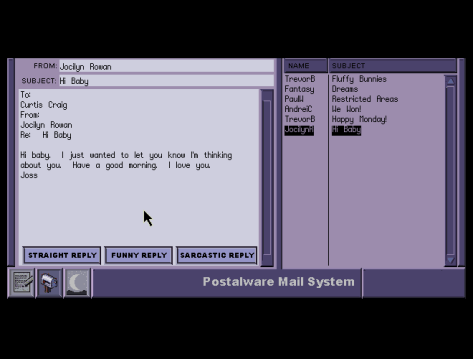
3230304-phantasmagoria-a-puzzle-of-flesh-windows-replying-to-emails-is-a

Contemporary RatingMedium. A little too much tedium at times, the story not advancing until you click everything that can be clicked.

Cruelty Rating:  Polite. A few points where you can die, but you’ll be saving regularly anyway.

The Beast Within: A Gabriel Knight Mystery

Publisher: Sierra
Developer: Sierra
Year: 1995
Platform: DOS, Windows, Macintosh

Review: Sierra took a risk by taking a successful game (Gabriel Knight: Sins of the Fathers) and completely changing the interface for its sequel. The second game in the Gabriel Knight series is strictly full-motion video, with real actors attempting to bring the story to life. Compared to other FMV games, The Beast Within is a rip-roaring success; but the nature of the beast unnecessarily hurts the series.

This time, the game takes place entirely in Germany. The local town is need of Gabriel’s “powers” to help rid themselves of what they believe are werewolves. As he is once again experiencing writer’s block (after his successful book based on the last game!), Gabriel reluctantly agrees. What follows is a six-chapter series that slowly dishes out an engaging plot, only a little more predictably than before. This time around, the player alternates between playing Gabriel and Grace (his employee from the first game), as they both must research the problem and risk their lives to fulfill their destinies.

The game is fairly easy, with a faithful dose of hotspot clicking to advance the plot. However, there are still many inventory puzzles, and quite a few are entertaining to solve, including one that involves splicing tape recordings. What really holds the game back is the same problem with its predecessor, multiplied threefold. At more than one occasion, Grace must nail every hotspot in a handful of rooms, merely for information gathering, with no indication that it is necessary.

The other disappointment, frankly, is the acting, especially that of the two main characters. In Sins Of The Fathers, Gabriel was a hunk and a cocky sonofabitch, with layers of depth and sensitivity buried underneath the tough exterior. Here, he is pretty much a wuss, and not at all attractive. Grace is not any better, overreacting to nearly every situation while being passive-aggressive with everyone she meets (again, unlike the previous game, where Grace is cool, with a cutting wit). Thankfully, the supporting cast puts in top-notch performances, especially Peter LucasWolf Muser, and Fredrich Solms.

While the writing at times leaves a bit to be desired (including humor, which is almost non-existent), the story and characters are enough to draw the player in through to the end, which like the previous game, is well-developed and thoroughly intense. The only major beef I had with the plot was that even though I discovered who the antagonist was well before game’s end, I couldn’t do anything about it because Gabriel didn’t know (and he should have). Instead of simply implementing mutliple endings and/or plot branches, I was squeezed through a painfully linear endgame.  Thankfully, the final puzzle is pretty damn good, leading to a satisfying ending.

Overall, this game was a success, widely considered the adventure game of the year. It is a worthy play, but probably only to fans of the series.

Contemporary Rating: Medium. Very easy to play, but the insane amount of pixel-hunting at times would drive modern gamers batty.

Cruelty Rating:  Polite. There are a couple of situations where you can die and must save before hand just in case, but the situations are very obvious.

Space Quest I: The Sarien Encounter

Publisher: Sierra
Developer: Sierra
Year: 1986
Platform: DOS, Amiga, Apple II, Apple IIgs, Atari ST, Macintosh

Review: When I was young, my selection of adventure games was, for the most part, limited to shareware (mostly junk) and Sierra games. But while my parents invested in King’s QuestPolice QuestLeisure Suit Larry, and ManhunterSpace Quest was left off the shopping lists. And even though I knew about this series and was intrigued, I never put it on my Christmas list either. So approximately sixteen years after this adventure was first released, I got my hands on a copy. It was well worth the wait.

The premise behind the game is about as sophisticated as your typical plot on the original Battlestar Gallactica. Possibly, this could be the point. You play Roger Wilco, a space janitor with no skills, or work ethic for that matter. When your ship is raided by the Sariens, you must escape and foil their plans to use the Star Generator for their own universe domination. What follows is less of a story but a piecing together of slapstick humor, crafty puzzles, and enough untimely deaths to make Wile E. Coyote blush.

It baffles me that so many adventurers hate dying. This never bothered me when I was a kid, and still doesn’t phase me. In fact, one of the primary reasons I get frustrated with current adventures is that there is usually no way to screw up. When you never have to worry about making a mistake or (gasp!) death, you can go head first into every task without so much as lifting a neuron. For me, that removes the innate challenge that a real puzzle presents. Not every problem in reality is guess-and-check. Sometimes you just have to guess and hope.

220439-space-quest-chapter-i-the-sarien-encounter-dos-the-beginning

With that said, Space Quest does such a marvelous job of finding creative, unexpected ways for Roger to die that I simply had to discover them all. Lucky for me, I found a document on the web that detailed every death, so instant gratification was ever-ready. And with the ‘save’ and ‘restore’ functions one keystroke away, I never became frustrated.  However, I was lucky.  There are two distinct ways to put the game in an unwinnable situation.  One I experienced only made me have to restore back about ten minutes or so.  The other, which I avoided, requires one to start the game over.  It’s unlikely that you’ll encounter it if you’re thorough, but it’s still there.

Other than that the game was very well designed. Not only are most puzzles logical and clever, there are often multiple solutions.  This offers a good deal of replay value and a way for different breeds of adventurers to hack away. The production values are adequate, though the parser is fairly poor when compared to its peers.

But what it all comes down to is comedy. The deluge of punchlines and silly antics never stops, so if your sense of humor is in line with the writers’, then you’ll like The Sarien Encounter.  If after fifteen minutes you don’t find yourself amused, then you’ll be hard pressed to enjoy the rest of the game.  Or the rest of the series, for that matter.

Contemporary Rating: Low.  The parser doesn’t always understand some reasonable commands, which would frustrate new players.

Cruelty Rating:  Cruel.  Having to play the entire game over again by missing something near the beginning is the main reason this scale exists.

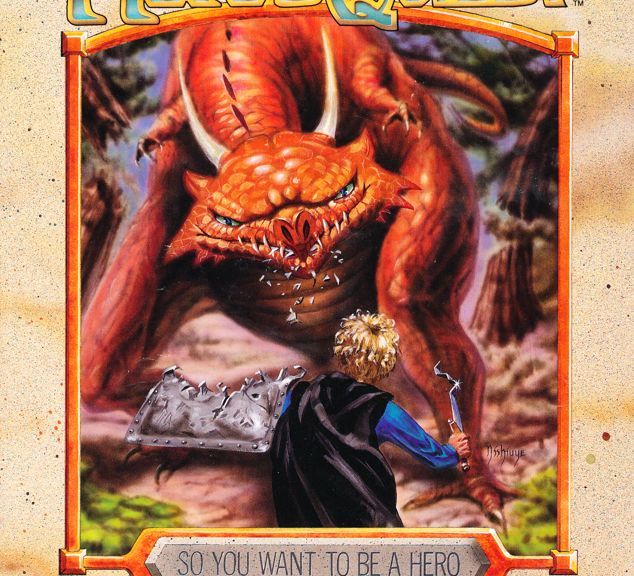
Hero’s Quest: So You Want To Be A Hero

Publisher: Sierra
Developer: Sierra
Year: 1989
Platform: DOS, Amiga, Atari ST, PC-98

Review: Due to copyright conflicts with Milton Bradley, Sierra changed the series to Quest For Glory. They later remade this game as Quest For Glory 1.

Definitely one of Sierra’s finest concepts, Hero’s Quest combines the adventure and RPG genres to create a game that not only appeals to both fans, but has great replay value as well. You can select from a hero, magic user, or thief to complete your quest.  While the paths are virtually the same, most puzzles are solved differently based on your skill set, and you are treated differently by your peers.

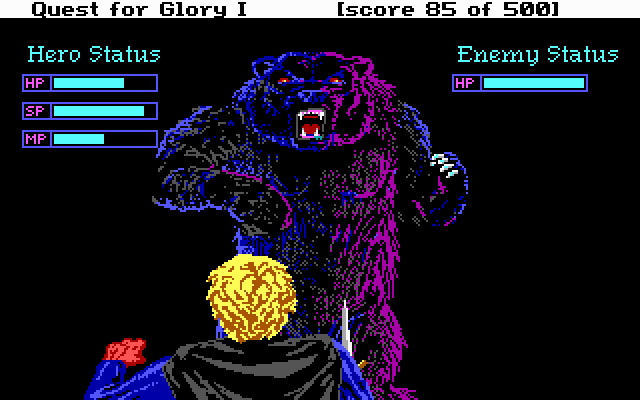
I love the game’s premise, and it is one of the funnier offerings Sierra has on the shelf, but the battle system left me shuddering. I prefer turn-based combat rather than hand-to-hand, but I can enjoy the latter if it’s implemented well. Unfortunately, this system is not intuitive and hardly engaging. I found fighting to be more of a chore than an opportunity.

However, I seem to be in the minority, as this game is lauded by nearly all. Computer Gaming World awarded it the best adventure game of 1990. I genuinely like it myself, and would recommend it to fans of 80’s adventures, but the RPG elements here more or less ruin it for me.  I have not played any of the game’s four sequels and probably will never do so.  From what I’ve read, the second installment is even better than the first, with the series gradually getting worse from there on out.

Contemporary RatingLow.  The parser responds pretty well to commands, but I can’t imagine why anyone would put up with the outdated battle system today.

Cruelty Rating:  Tough.  You can die from hunger or exhaustion, and there is at least one way to die by not having an item with you at a certain time.  All of these situations are obvious and fairly easy to prevent, but you can still get stuck if you’re not careful and will have to restore back to an earlier point.

Manhunter 2: San Francisco

Publisher: Sierra
Developer: Evryware
Year: 1989
Platform: DOS, Amiga, Atari ST, Macintosh

Review: The Manhunter series is easily the most original idea that Sierra published.  The first game, Manhunter: New York, is not nearly as good as the sequel.  Unfortunately, you pretty much have to play it to understand anything that is going on in this game.

Aliens landed in 2002, setting up shop in New York (and then later, San Francisco). It took them less than three days to destroy the city, and less than a year to end the human resistance. Or so they thought. You have been assigned by the alien “orbs” to be a man hunter. Since some of the aliens’ technology is not as compatible with human beings as they thought it would be, you (along with many others) need to help them. You have no choice. You must investigate humans who are not obedient and report them to the aliens.

You are given a tracking device in which you can watch the perpetrator commit the crime. They are then tagged, and you can continue to watch where they go until the signal is lost (usually when they go under ground or die). You can also manually tag other humans near the perpetrator, and watch where they go, as they may be linked with the crime. You can then travel wherever they did and do some research.

Of course, you must help the resistance while you are supposed to be helping the aliens. Since the resistance cannot be overt, you must pick up clues and look for symbolism which will give you tips on what you need to do. Other man hunters will help, if they trust you. But gaining their trust takes effort.

Most of the game is merely going to places, picking up items, and manipulating them (which is fairly easy). There are also several arcade sequences. Some are easy, some are ridiculous, but only a couple add excitement to the game.  There is almost no typing needed and no mouse support.  You more or less move the cursor with the arrow keys until you land on something important. What makes this game challenging is the keen eye one must have to catch all of the symbolism and apply it to the situation at hand, or one further down the road. Definitely not a game for those who like to rush. The puzzles are long, difficult, and extremely satisfying to complete.

For the time, the music is scary enough and the graphics are well done, occasionally ribald and quite gory. Creepy for sure! Definitely not for the faint of heart. The atmosphere doesn’t quite approach scary, but there are definitely some tense moments.  One of the game’s charms is that real locations in San Francisco are used, such as Alcatraz, the Transamerica Building, Coit Tower, and the Bank of Canton.

While I can’t really recommend this game today to anyone but the hardcore adventure gamer (or those who love gory games), it holds a special place in my memory. And frankly, so does this guy.

Contemporary RatingLow.  Controls were confusing, even in 1989, and requires playing the original (which I don’t recommend!).

Cruelty Rating:  Polite.  You can die and lose your progress, but dangerous situations are apparent. Saving your game at regular intervals prevents frustration.