
Publisher: Sierra
Developer: Sierra
Year: 1986
Platform: DOS; Amiga, Mac, Atari ST, Apple II
Score: 5
Sierra spent a little more time creating the third installment in the Daventry series and it shows. The increase in more complex puzzles is quite welcome as are a larger map and complex characters. To top it off, there is a plot. A plot that develops.
You are Gwydion, a slave of the evil wizard Mannanan. He orders you around the house completing chores, and if you do not comply, he may zap you into a pile of ashes. Even if you do comply, he will eventually dispose of you anyway. Mannanan cannot risk you becoming a fine adventurer, capable of thwarting his carefree lifestyle. While finding ways to get Gwydion killed is quite entertaining, only by thwarting your master’s lifestyle can you advance the plot.
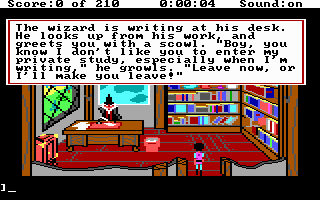
The game’s parser is considerably more extensive than in the previous two installments, and the graphics are a step up as well, giving the atmosphere a little more…atmosphere. Useful items are finally not heavily accentuated, and some of the more colorful surroundings cannot be manipulated at all. The pointless random enemies have finally been banished from Sierra’s playbook. Better yet, the soundboard is used more appropriately, and while not a joy to listen to, is no longer grating.
Some mythology is used, but not as heavily as in the first two games. Hence, the puzzles are not as simple. Moreover, for the first time in the King’s Quest series, magic is used extensively, a welcome sight given that Daventry is presented as a mystical land, quite unlike our Earth.
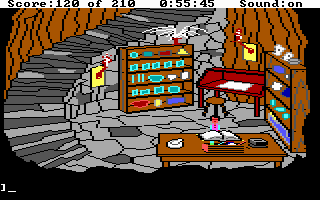
Not to let us down, however, Gwydion’s quest does contain some flaws. There are many walking dead situations (and that’s not including the stupidly twisty path down the mountain) that come about simply by not finding certain spell ingredients at the right time. In at least one case, you can get close to the end of the game before realizing you have to practically restart. Frustrating!. The game also contains the ever so infamous Sierra copyright protection puzzles, which are only possible to complete if one has not lost the manual and can also read archaic handwriting. And finally, once Mannanan has been thwarted, the rest of the plot comes at you at warp speed, dousing you in exposition without the reward of uncovering it yourself.
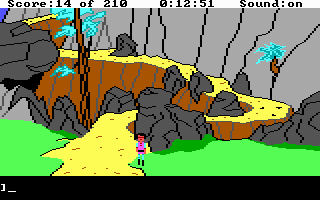
Overall, To Heir is Human is an improvement over the two previous games, and quite a joy to play when one is not tackling the aforementioned frustrating elements. However, it is quite difficult, so the more lackadaisical adventurer may want to carry a walkthrough.

