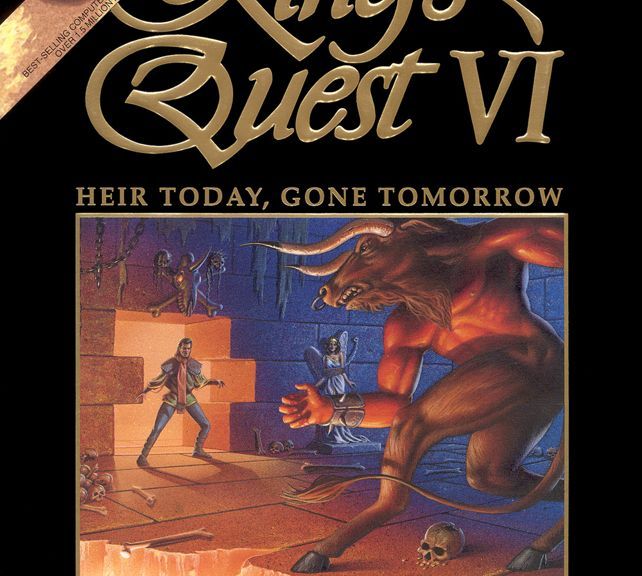
Publisher: Sierra
Developer: Sierra
Year: 1992
Platform: DOS, Windows, Amiga, Macintosh
Review: While a vast improvement over the previous installment, with a much longer, integrated plot and a much better use of mythology, the sixth installment still lacks in many basic areas that plague the King’s Quest series. Thankfully, there’s enough that’s awesome here to make it worth playing.
Alexander, a very bored prince, is sulking in the throne room, something he learned quite well from his father. Roberta Williams digs into the plot device bag and pulls out the ol’ reliable Magic Mirror to get things started. And whadya know, Cassima, the lass King Graham helped save on his last adventure, appears in the mirror. She is trapped inside of a castle and expresses her longing for a man (a la Juliet). While she never mentions him by name, Alexander assumes she is talking about himself. So, without asking his father’s permission or telling so much as his fairy godmother of his plans, Alexander takes off for the Land of the Green Isles, where Cassima is being held in solitude.
Wait a second. This sounds eerily familiar. Perhaps…yes, perhaps it’s because this is the exact same plot lifted from King’s Quest II: Romancing the Throne. Thankfully, Mrs. Williams must have realized her abysmal failure the first time around and decided to give it another shot.

The opening animation sequence is beautifully done. It also manages to be quite long without giving away the game’s plot in its entirety. The plot does move along during play, though barely, and during cut scenes like in King’s Quest IV: The Perils of Rosella. While not original, the King’s Quest series was never known for its plot. Rather, environment, mysticism, and puzzles (well, sometimes) helped sell the series. For the most part, they’re all here.
Yet I have a love/hate relationship with this game. I would have enjoyed it more with a typing interface. Then, some of the neat puzzles might have been hard. Unfortunately, many are very easy. Too many of the puzzles require “triggers” to activate them (breaking mimesis), and there is one very not obvious way to become walking dead for a very long time. If you don’t converse with a particular character at the beginning of the game, you will put the game in an unwinnable situation depending on which plot branch you take. Worse yet, you will not know you have done as such until the game is almost over. There is no excuse for such sloppy game design. Also, an extensive part of the game involving the Cliffs of Logic and the Catacombs is one huge copyright protection. The only way to solve the puzzles is to have the “Guidebook” that comes with the game. Instead of creating fun and intuitive puzzles, the designers simply became lazy.

On the bright side, most of the characters are developed well. The shopkeepers of the pawn shoppe and the library have captivating voices and wonderful personalities. In fact, everyone human that you meet is fun to interact with. However, many of the mythological and cartoon characters become rather annoying and have little pleasantness about them (except Hole in the Wall!). The main characters are so stereotypical that one wonders if Disney had a role in character development. Alexander will never do anything that is improper or not fit for a prince, unless of course he needs to do so to advance in his quest. And Cassima’s undying love for Alexander is groundless, but it does fit her undynamic personality. At least the corniness is good for a few chuckles.
The graphics are nothing spectacular and not much of an improvement over the last game in the series. Everything is very colorful, but much of it is too cartoonish. The sound effects are pretty good, however, and the end game song is a treat.
Most of the game is pleasant, and the advent of five unique islands to explore, a plot branch, and two endings with one giving you more points than the other (and a much longer, satisfying game) are great ideas and I applaud Sierra. Also, magic is used almost as extensively as it was in King’s Quest III: To Heir Is Human, an idea this series should have implemented more often.
Heir Today, Gone Tomorrow is a relatively easy adventure with poor plot development and some annoying puzzles. So why do I like it so much? Perhaps it’s sentiment. Perhaps because it’s predecessor was abominable. Or perhaps it’s all of the charm. And the things this game does well, it does really well.

Contemporary Rating: Medium. Highly intuitive gameplay, but making an hour’s worth of puzzles a copyright protection is unforgivable.
Cruelty Rating: Cruel. You can die frequently, and it’s not always obvious. Only one walking dead situation, but it’s still very cruel.










 Death By Troggles
You must be logged in to post a comment.