Tag Archives: Legend

Gateway II: Homeworld

Publisher: Legend
Developer: Legend
Year: 1993
Platform: DOS

Rating: 6

A direct sequel to Gateway, I was psyched to finally sit down and play one of the more heralded games by Legend about Frederick Pohl’s Heechee Saga. While it’s a well built game and has several high moments, I was overall disappointed, only because it failed to be as excellent as its predecessor.

Continue reading Gateway II: Homeworld

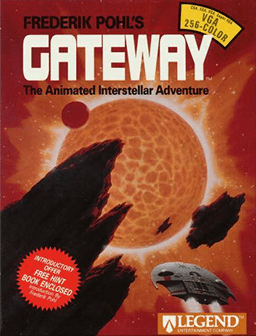
Gateway

Publisher: Legend
Developer: Legend
Year: 1992
Platform: DOS, Windows

Rating: 7

Science fiction is at its best when it is used as a tool to explore the human condition. Science fiction games have an extra hurdle of not alienating players by making the sci-fi overly complex; to do so can disengage the player from the story. Frederick Pohl’s Gateway mostly succeeds at both before faltering in the final act.

Continue reading Gateway

Shannara

Shannara DOS Front Cover

Publisher: Legend
Developer: Legend
Year: 1995
Platform: DOS

Around 1993, Legend Entertainment decided to mostly stop developing their own ideas and started pounding out adventure titles based on best-selling novels. Shannara was probably the most high-profile of them all. I was hesitant at first as neither the genre nor Terry Brooks’s style appeals to me, but I found Shannara to be a mostly pleasant, if very simple, adventure.

Continue reading Shannara

Spellcasting 101: Sorcerers Get All The Girls

Publisher: Legend
Developer: Legend
Year: 1990
Platform: DOS

When Infocom disbanded, Steve Meretzky was hired by up-and-coming Legend Entertainment to continue text adventures and compete with Sierra in the adventure game industry. While Legend’s first offering wasn’t entirely polished, and did not have very good sound support, Meretzky certainly did his job to jump start the company and this series.

Continue reading Spellcasting 101: Sorcerers Get All The Girls

Quandaries

Publisher: Freeware
Developer: Legend
Year: 1998
Platform: DOS

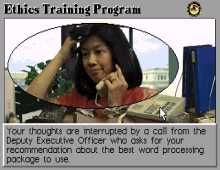
I’m stretching this by calling it an adventure game, as it is more of an edutainment title.  But it was developed by Legend Entertainment and written by Bob Bates, so I’m going with it. This game is actually an ethics training program designed by the U.S. Government and used as an ethical training tool for its employees. As it was fully funded by the government, the game is freeware, and worth a play by anyone who is interested in ethics.

Continue reading Quandaries

The Blackstone Chronicles

Publisher: Red Orb
Developer: Legend
Year: 1998
Platform: Windows

The last adventure game developed by Legend Entertainment was their first attempt at horror, done so with help from one of the best suspense writers in the business, John Saul. The Blackstone Chronicles is a paperback series of six stories, detailing the hell that Oliver Metcalf endures trying to piece together the mysteries of the Blackstone Asylum, last run by Oliver’s father. The game begins where the series ends, the asylum turned into a museum. Naturally, spirits of those who lived and worked in the asylum haunt Oliver. His father, Malcom, pissed that the asylum is being desecrated, and further pissed that Oliver hasn’t done anything to protect his father’s legacy, kidnaps Oliver’s son and threatens terror unless he learns his lesson and obeys orders.

Continue reading The Blackstone Chronicles

Death Gate

Publisher: Legend
Developer: Legend
Year: 1994
Platform: DOS

Review: The first Legend game to eschew typing and implement strictly the point’n’click interface, Death Gate succeeds admirably in creating a captivating and moderately difficult fantasy adventure that almost anyone can enjoy. Based on the Death Gate Cycle short stories by Margaret Weis and Tracy Hickman, the game designers managed to take many elements from those stories and use them to create a foundation for their adventure. Never does the game feel like a translation, and you certainly do not need to read the stories to enjoy the game. Following is the summary from Moby Games:

Two thousand years ago, the Sartan split the world into five realms. The mensch races – the humans, dwarves, and elves – were split between four of those worlds named for the four elements, and your race, the Patryn, was banished to the deadly Labrynth. After those two thousand years, some of the Patryn have found their way through the Labrynth’s exit. It is your job to sail through the Death Gate into each of the other worlds to find each world’s seal piece, so that your race may reconstruct the planet and have revenge on the Sartan.

The story is one of revenge and reunification and there are many plot twists (though mostly obvious) along the way. Magic is used extensively and often in very clever fashions never seen before in adventure gaming. Most puzzles range from easy to fairly challenging, though none are unfair and are usually interesting in their own right, and fit within the context. Rarely do puzzles feel contrived or pointless. While no puzzles have multiple solutions, you are often given appropriate feedback as to why your solution is not the correct one, with a pat on the back from the designers for your thoughtful try. I never felt insulted by the game’s interface, which is very easy to use but often requires critical thinking. One puzzle near the end of the game that involves conquering your own double had me absolutely giddy when I solved it, and is one of my favorites of all-time.

The graphics are mostly well-drawn still frames, though there are some decent movies. The voice acting is superb; however, the dialogue gets stale in many places and sometimes goes on forever. Despite the simple writing, the story behind it is consistently engaging, more than making up for its faults. The ending is a little weak, but on the spectrum of adventure game endings, is not all that bad.

You do not need to be a fan of fantasy novels to enjoy Death Gate, and any adventure game connoisseur should have this one in their library.

You get to play as a dog, too!

Contemporary RatingHigh. The game tries really hard to be accommodating to all players.  It was obviously beta-tested really well.

Cruelty RatingPolite.

25: Eric the Unready

Publisher: Legend
Developer: Legend
Year: 1993
Platform: DOS

Review: Rated by many the best adventure game of 1993 and it’s pretty obvious to see why. You are the infamous Eric the Unready. You have been assigned to save the princess from her evil stepmother. Unbeknownst to you, you were assigned because you are the most ill-equipped knight in the land.

As with the early Legend games that used a text parser, you can play the game with or without graphics.  The graphics are gorgeous for the time, and being a comedy they do well to serve the humor.  The music is pleasant if too repetitive.

It’s more of a parody than a game. To the skilled adventurer, this should take less than a couple of weeks to win. The puzzles are not all that well-developed, and can even be annoying at times. But it is without a doubt the funniest game I have ever played. Bob Bates spoofs everything from Star Trek to Saturday Night Live to Zork and has a grand ole time with medieval culture. There is something here for everyone.  I haven’t played the game since 2000, however, so it’s possible the jokes have become dated.

Contemporary RatingMedium. Some of the puzzles seemed there just for busy-work.

Cruelty Rating: Tough. Like many text games, you can get rid of objects that you need later, but you never really need to.

Mission Critical

Publisher: Legend
Developer: Legend
Year: 1995
Platform: DOS, Windows

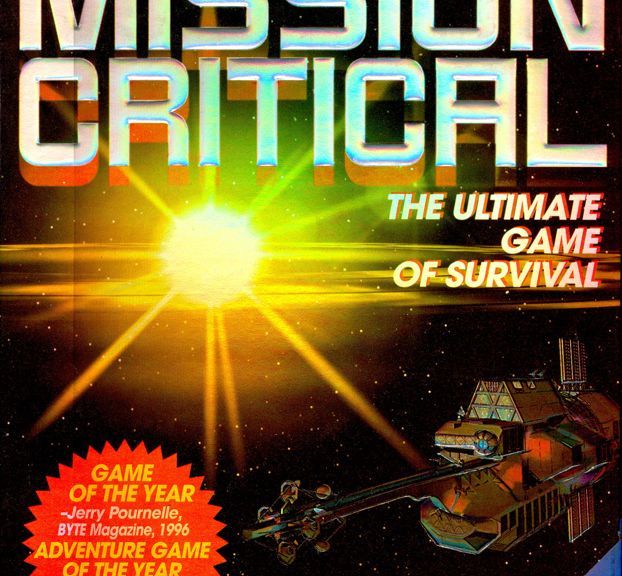
Review: An easy, plot-driven space-faring adventure by Legend Entertainment, Mission Critical tells the story of a lone surviving crewman of a terrible battle. An incredibly long FMV opening sequence depicts this battle where the Alliance (composed mostly of survivors of North America) loses to the United Nations at a key turning point in the war. However, the captain (played by Michael Dorn), decides to destroy his own crew to save the ship (and its secrets) by taking the enemy with him. As you were left unconscious and were the only person kept aboard, the U.N. ignored your presence, allowing the kamikaze plan to work. Now awake, you must quickly make repairs to the ship, figure out what’s really going on in this war, and try to complete your ship’s mission.

As with all Legend games, you play from the first-person perspective. Puzzles are mostly inventory based but are creative and perfectly logical. Never does one feel contrived or thrown in just to make the game longer. Sadly, many are too easy, ramping down the satisfaction level taken from completing them. The ship’s computer will also help guide you nearly to the answer for many problems. But the puzzles do their job, which is provide the necessary pacing to make this extensive story work. Information is revealed slowly, with regards to suspense and intrigue. It is also possible to die, either violently or due to running out of time (though the time limit is very liberal), which adds to the realism. And thankfully, it is impossible to put the game in an unwinnable state.

One aspect that does hurt the pacing is a battle simulator, where you must practice several missions before fighting a few real ones. While the simulation is well-done and the difficulty level can be adjusted to please any gamer, it seems out of place, especially with the type of adventurer the writers had in mind.

The graphics and sound are above-average, and the FMV sequences are beautifully done. Being dead, Michael Dorn’s character doesn’t make a lot of appearances  but it was fun seeing him without the Klingon makeup on. The other actors are up to the task as well, except perhaps the protagonist, who sometimes makes it a little too obvious he’s reading from a script.

While nothing about Mission Critical strikes me as fantastic, it is very solid throughout until the end, where the story comes hurtling at the player with seemingly endless exposition. Thankfully, the game rescues itself a bit with the final puzzle, which is clever and satisfying enough. I would recommend this game to any adventure fan who’s looking for a sci-fi story that plays more like an episode of Star Trek than a puzzlefest.

Contemporary RatingMedium. Intuitive, but the battle simulator definitely doesn’t stand the test of time.

Cruelty Rating:  Polite. You must save the game regularly, but you don’t have to obsess about it.