Tag Archives: PC Adventure Games

Star Trek: The Next Generation: A Final Unity

Publisher: Spectrum Holobyte
Developer: Spectrum Holobyte
Year: 1995
Platform: DOS; Macintosh

With characters, actors, visuals, and sounds straight from one of my favorite television shows, I figured this game would have a hard time displeasing me. But it missed on all cylinders, and probably needs a new warp drive to boot.

In A Final Unity, you find the Enterprise unwillingly involved in a Garidian civil war and later in a race with the Garidians and Romulans to discover the power behind the mythological Unity Device. Several missions await, and on the way you run into Ferengi, Klingons, Vulcans, and a few new alien species. The plot is dished out slowly and effectively in gameplay and cut scenes, culminating in a satisfying end game reminiscent of Judgement Rites.

Star Trek: The Next Generation - A Final Unity DOS A zoological society governed by females.

Sadly, the plot is the only redeeming quality of the game outside from what the show itself brought to the table. The ship interface is downright maddening. The battle station and engineering are simultaneously slow and confusing, let alone uninteresting. While you can leave the controls up to Worf and La Forge, respectively, I was left yearning for the system in the Interplay games, which says a lot. Navigation is damn near impossible when the game doesn’t automatically set the course and speed for you.  You’re given a three-dimensional view of space, and discerning between sectors, neutral zones, and nebulae is a puzzle in itself. Finally, Starfleet gives many vague orders that are misleading at times. Sometimes, the plot advances simply by waiting for an indefinite period of time, with little clue that waiting, is in fact, what advances the game.

If that were all, I could forgive this section of the game. But away team missions are not much better. You can take any member of the crew on your away teams, and who you take matters very little, most of the time. Each crew member is given a ton of generic responses to every possible action and are not always in character. Who you control on the away mission is also usually irrelevant, and more or less is up to whose voice you’d rather hear at that moment. And while there are some conversation trees, there are rarely consequences for saying the wrong things until the end game, where you must control Picard. The puzzles themselves are fine, with some creative and original ideas and some clunkers. Regardless, some of the puzzles simply involve, again, too much waiting.

Star Trek: The Next Generation - A Final Unity DOS Romulan Warbirds closing in.

Yet, all of these faults pale in comparison to the most glaring atrocity in A Final Unity. The series was a veritable joy to watch week in and week out for two reasons.  The first one, intelligent and engaging stories, is present. But there was hardly an episode of TNG where I wasn’t laughing out loud on several occasions. There was a sense of humour underlining nearly every story, and sadly, there is absolutely nothing worthy of a laugh, or even a smile, in this game. Riker makes no mention of his exploits with women.  Data doesn’t ramble off his thesaurus nor makes any social faux-paus. Worf doesn’t even get to say, “Klingons do not play video games!” In short, the characters, while having the voices of their original actors, had none of the charm or personality. A significant reason for my enjoyment of 25th Anniversary and Judgment Rites was how well the writers embodied the characters and integrated them into the story. The rivalry between Bones and McCoy was there, as well as Scottie’s pleas in vain about the damage to engineering. And William Shatner’s overacting was funny enough on its own accord. I was hoping that perhaps Wesley Crusher could make an appearance so Picard could belt out, “Get the boy off my bridge!”  But, alas.

If you are a hard-core fan of Star Trek, you will probably enjoy this game, at least to some degree. But I found this adventure, despite the few positives, an insult to the fans.

Leisure Suit Larry 5: Passionate Patti Does A Little Undercover Work

Year: 1991
Designer: Al Lowe

One can sum everything up by stating Larry 4 was by far the superior game.

Leisure Suit Larry 5 is the most abominable commercialized computer game ever, though I admit I have not played Leisure Suit Larry: Magna Cum Laude. Al Lowe hated the latter and went out of his way to make sure people knew he had no role in its design. For some reason he hasn’t apologized for this game yet.

The “new and improved” graphics are so wretched that after five minutes you’ll find yourself wishing you were staring directly into the sun. The music will make you want to go listen to a middle-school band performance. The point-and-click interface is only there to give you tendinitis. The puzzles are insultingly easy, the worst of them having you get into a wrestling ring where you must grab as many female private parts as you can; it’s like whack-a-mole, only less arousing. The great news is you can skip several of the puzzles if you feel like three hours is too long for an adventure game. The plot is more thread-bare than the women Larry meets. Nearly every joke falls flat. There is not one redeeming quality in this entire game.

Play it only to see how low Sierra sunk in the early 90’s.

Space Quest IV: Roger Wilco And The Time Rippers

Publisher: Sierra
Developer: Sierra
Year: 1991
Platform: DOS, Windows, Mac, Amiga, PC-98

Rating: 1

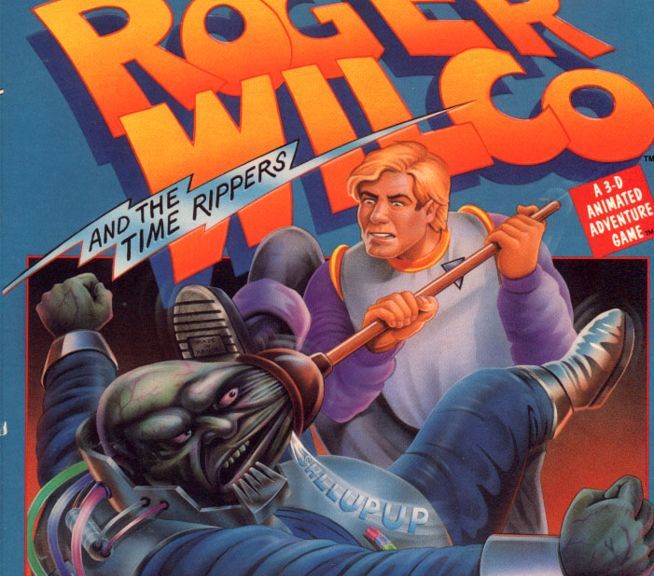
One one would think that taking a previously hilarious science fiction character and throwing him into a time travel story would be the easiest formula for success, but Space Quest IV is one of the laziest adventure games I have ever played, putting me to sleep even with a walkthrough at hand.

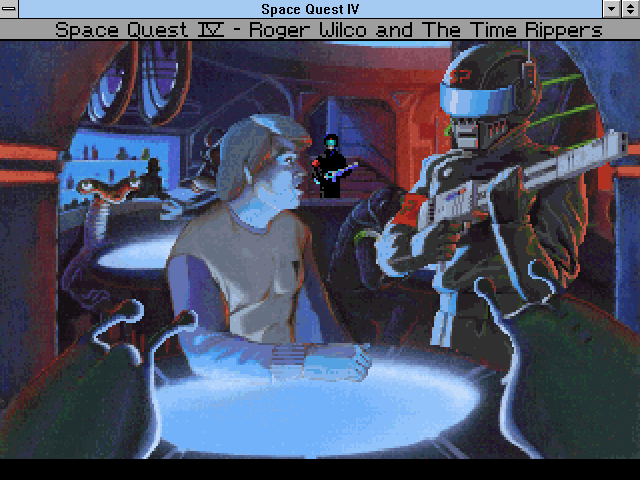
Roger Wilco, per usual, is gloating about his success in the previous Space Quest games when he’s captured by Vohaul’s goons. At the last minute, he’s saved by some mysterious men and zapped headlong into Space Quest XII, in the middle of his now desolate home planet. After figuring out where he is, Roger must thwart events happening in the future (a la Marty and Doc), save his own skin, and get back to his own time. All along, he’ll be traveling to other Space Quest games to do so, trying to avoid Vohaul’s police force.

6833462-space-quest-iv-roger-wilco-and-the-time-rippers-windows-3x-intro

Sadly, most of what happens during the game feels more like it belongs to Leisure Suit Larry’s universe than Roger’s (including an over the top narrator). Very few of the game’s puzzles relate to science fiction, and are often tacky and obtuse (which also describes the graphics), including some unbelievably boring arcade games (e.g. making burgers!). Worse yet, many of the puzzles require extensive backtracking; I think I spent more time walking from one place to another than I did interacting with the game world. The only interesting diversion is a trip to Ulence Flats from Space Quest 1, but this excursion lasts only a few short minutes.

When Sierra updated their engines for point’n’click play, their games in every one of their long-standing series temporarily suffered (even Police Quest 3, which I enjoyed). It was as if the designers and producers spent so much time playing with their new toy that they forgot what made their games great in the first place.  Many people consider this their favorite game in the series and one of the best adventure games ever made. Usually when I hate a game, like with Broken Sword or Syberia, I understand why people would love it. With Space Quest IV, I’m left utterly baffled.  

King’s Quest VII: The Princeless Bride

Publisher: Sierra
Developer: Sierra
Year: 1994
Platform: DOS, Windows, Mac

Rating: 1

Inigo Montoya: Do you hear that Fezzik? That is the sound of ultimate suffering.

Fezzik: From what?

Inigo Montoya: People playing “The Princeless Bride.”

Vizzini: Inconceivable!

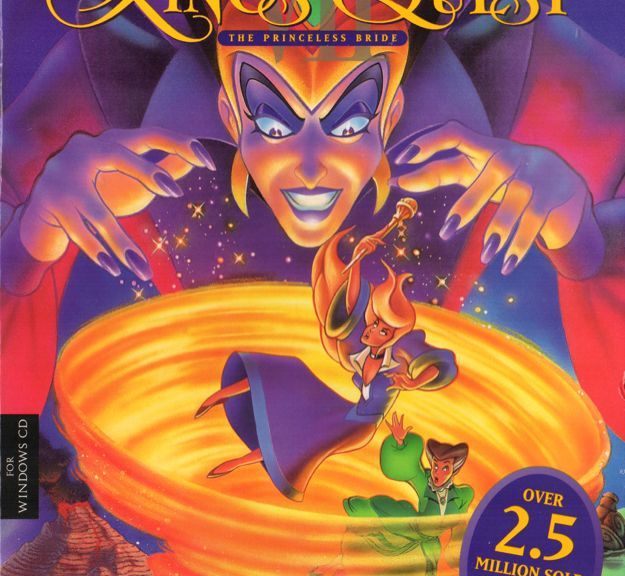
While I adapted to the four-icon point’n’click style of adventure gaming, I longed for a change that was more intuitive while remaining challenging (much like the LucasArts catalogue). Well, once again Roberta Williams ushered in a new style of gaming with the single icon. The fucking thing lights up whenever you run the mouse over something important, removing virtually all the challenge and turning the game into an interactive movie. Since KQ7, some developers have been able to utilize a single icon and still make engrossing, challenging games. Not surprisingly, Roberta Williams failed spectacularly. Not surprisingly, the story is insipid.

Valanice is quite perturbed with her only daughter because Rosella has decided that marrying handsome hunks on the drop of a hat like her mother was so last plot line. Valanice taunts her daughter with stories of blind matronly love, while Rosella covers her ears and yells “Shut up! Shut up! Shut up!” But her mother does not comply, which drives Rosella to dive into an obviously dangerous whirlpool, most likely to commit suicide. Valanice, determined to bring back her daughter to the sophisticated world, dives in after her. Unfortunately for her, she gets dumped off in a desert, far away from the place Rosella winds up bemoaning, over and over and over, her new troll status.

Amazingly, the plot actually develops in this game.  Chapter by chapter, the player learns more objectives while maneuvering plot twists. It’s a shame that the material therein is a conglomeration of all the crap that’s ever been put into a computer game. The graphics consist of a poorly defined cartoon world with characters that are generally unpleasant to look at. Not only that, every sentient being is caricaturized to the point of skin-crawling pain, making the game devoid of the minimum amount of pathos necessary to give a shit. Puzzles range from incredibly easy to incredibly nauseating. There are even walking dead scenarios, which is ridiculous in a game that is otherwise insultingly easy. As for the sound, well, nothing memorable.

There are exactly three points during this game where I enjoyed myself:

1) The introduction, where Rosella tells her mother to bugger off.
2) The ending, and not just because the game was over.
3) The raven who spouts countless degrading insults at both Rosella and Valanice. I used some of them myself.

I was grateful the series was over after this game. Yes, there was a 3D action game that came a few years later utilizing the King’s Quest name, but the series death was already established.

King’s Quest V: Absence Makes The Heart Go Yonder!

Publisher: Sierra
Developer:
Sierra
Year:
1990
Platform: 
DOS, Windows, Amiga, Mac, NES, FM Towns, PC-98

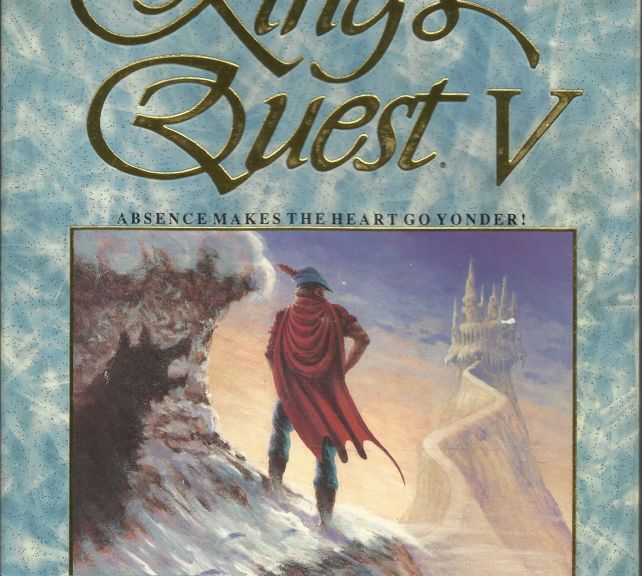
Possibly the first big-name adventure game to be on CD-ROM and completely eschew the need to use the keyboard, King’s Quest V spends way too much time focusing on its shiny new features, leaving the actual game to suffer immensely.

After a leisurely walk through Daventry, Graham returns home just in time to see the castle vanish before his eyes. A nearby owl–a talking one, natch–reinforces Graham’s despair by recounting the details of the tragedy. He then sends the king to go see the local benevolent wizard. A lengthy dialogue ensues where the Good wizard tells Graham that a Bad wizard (who is related to Mannanan from King’s Quest III), is out for revenge against the royal family. The Good wizard gives Graham the wand necessary to destroy the Bad wizard, and more or less leaves Graham to his own adventuring wits, which he will need to get anywhere near the Bad wizard. While the plot does help tie the series together a bit, it is in true Sierra fashion detailed in full before the player even touches the mouse. Seriously, there is virtually no plot development the entire game.

The point-and-click interface dumbs down play to merely finding the correct pixel or combining the right inventory items together. While this does relieve the player of parser ignorance, and the dreaded “You can’t do that” messages, many of the puzzles in KQ5 require inane logic, forcing the player to randomly click until the solution is found. Pixel-hunting creates even more “You are a pathetic imbecile” responses than ever, and solving puzzles by accident isn’t exactly satisfying.

The one thing this game does get right is the implementation of all the pretty features. The graphics are excellent, and were simply amazing in 1990 to those who were used to sixteen color games. The voice acting is mostly pleasant; however, whoever’s idea it was to create Cedric, Graham’s sidekick owl, should be given a medal by Satan, as I’m sure he uses Cedric to torture the damned.   Cedric follows Graham practically everywhere, is rarely helpful, and when he would be helpful, he is nowhere to be found. And if you want an idea as to what he sounds like, think of Jar-Jar Binks, only condescending.

But what really gives the game a black mark is the cruelest walking dead situation in history. While Leisure Suit Larry 2 had several cruel walking dead scenarios, they were aggravatingly funny in an Andy Kaufman sort of way. Not only is the situation here not funny, it is one working channel and there’s a marathon of King of Queens cruel. Either that, or an honest mistake that the shittiest beta-testers in history missed. There’s a spot in the game where a mouse is being chased by a cat. You must save this mouse by throwing a boot at said cat. Then, later in the game, the mouse will save you from an otherwise lethal predicament. But this event ONLY HAPPENS ONCE, and it happens so fast that if you turned away from the your computer for a few seconds, you would never know it happened! And if you don’t figure it out then, it isn’t even obvious later that you would need a mouse to save you. I know walking dead situations occur in nearly every adventure game before 1995 (heck, there’s even more in this game), but this one pissed me off more than any other. Having Cedric taunting me probably wasn’t helping.

Take all of the above annoyances and leave the player with a cliched and suddenly insultingly easy endgame, and you have a game you couldn’t pay me to play again.

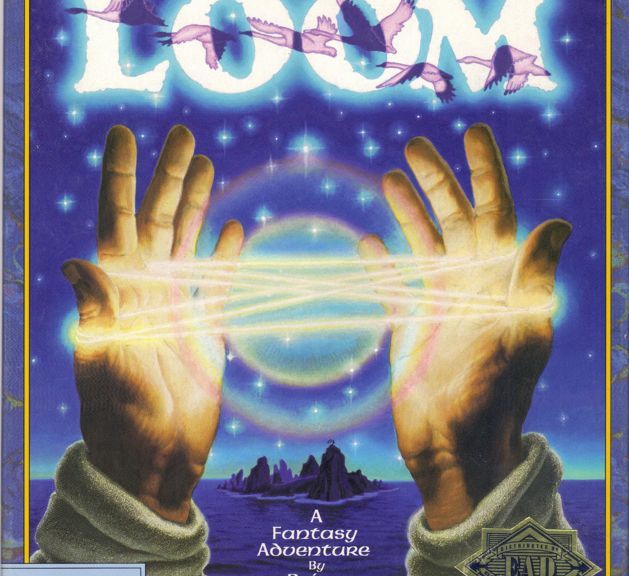
Loom

Publisher: LucasArts
Developer: LucasArts
Year: 1990
Platform: DOS; Windows; Amiga; Atari-ST; CDTV; FM Towns; Macintosh; TurboGrafx CD;

Review: One of the most original adventures ever conceived, Loom largely succeeds at just this, while failing to engage the player in a captivating story or with interesting characters.

As a 17 year-old member of the guild of Weavers, you must guide Bobbin Threadbare through a mystery, trying to learn why you’ve been outcast from the guild, and why the rest of your guild have been transformed into swans. There is no inventory. Progress through the game entails casting spells with your staff by weaving musical notes, with more powerful spells available as things move along. For example, you may learn that the spell for Open is the note sequence C-D-E-D; play this sequence on a particular object and see if it works. On easy difficulty level, you are shown the correct notes for each spell.  On medium, you see the notes played on your staff without the letters. On the expert level, you only hear the notes. Unless you are tone deaf, even the expert level is not too difficult.

While many of the spells are interesting, it is usually obvious which spells are needed where.  And with no other types of puzzles available, progress is incredibly easy. I finished the game in a mere four hours, even on expert level. Unfortunately, the characters (of other guilds) you meet are classic stereotypes with rather banal dialogue. Even Bobbin rarely acts consistently, vacillating between an appropriate meek teenager and a highly philosophical elder. Moreover, there are few surprises in the plot until the ending, which is confusing, alluding to a sequel that never happened.

Thankfully, the music is gorgeous, heavily borrowing from Tchaikovsky. There is a CD-ROM version with 256 color graphics and voice acting. Sadly, to fit the game on the CD, much dialogue was cut (though the acting is generally below average), as were additional scenes that rewarded the player for playing on expert level.

It is easy to see why Loom has a cult following, as therein is a unique experience in gaming. And while I would recommend this to anyone looking for something different, it is too short and underdeveloped to be considered a great game.

Contemporary RatingMedium.

Cruelty RatingMerciful.

Portal

Publisher: Valve
Developer: Valve
Year: 2008
Platform: Windows; Macintosh; Playstation 3; Xbox360

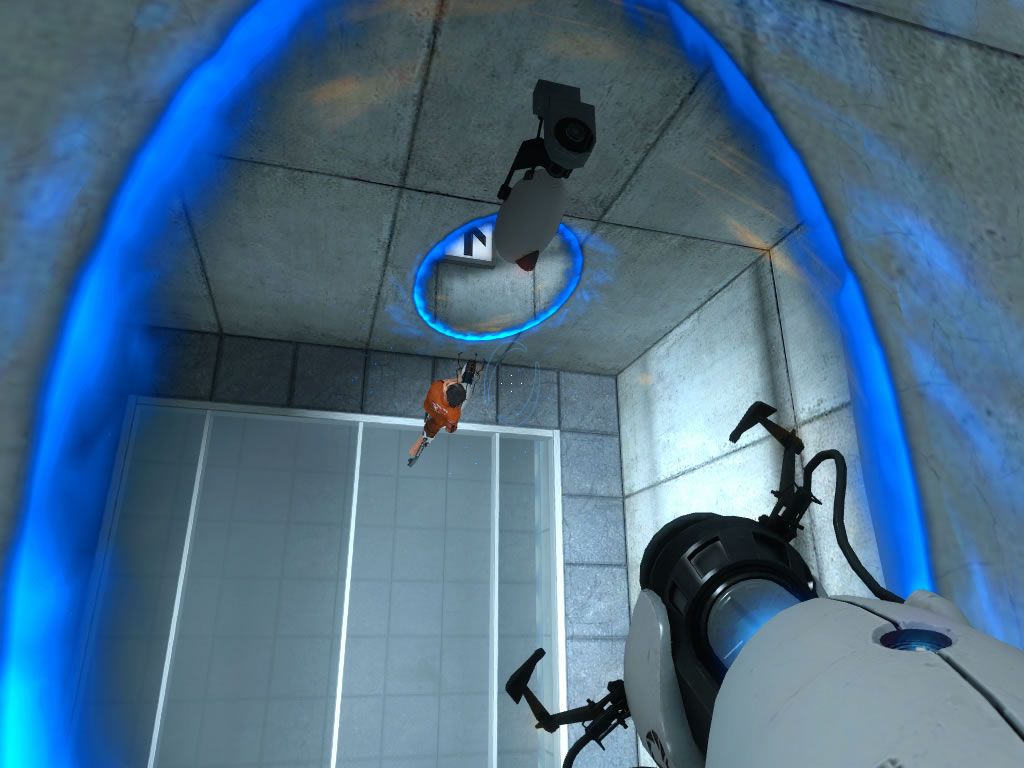
Review: When I first played Portal, I had never played Half-Life, nor been particularly fond of first-person shooters. Basically, I’m more interested in engaging my mind than I am my reflexes. Portal manages to do both at the same time, striking the perfect balance of action and strategy. While using a similar environment as in Half-Life, you control a subject who is trying to advance through test chambers in a research laboratory. What is being tested is a device that fires beams of light that create portals in walls for easy transport or escape. For example, say you need to traverse a pit and you can’t jump across; create a portal on the wall across the pit and one on your side. Walk through and—voila!—you’re on the other side. Valve fleshes this idea out considerably, with several chambers testing your mind, and in some cases, your agility. 

Yes, that’s you you’re looking at

An excellent learning curve is aided by the computer, who explains things to you along the way and gives you some tips early on. Eventually, a plot of sorts develops that is aided by superb voice acting and a chilling atmosphere. At no point did the sounds or colors feel superfluous, the designers proving themselves a model of efficiency.

Speaking of efficiency, the game can be won in a cool four to six hours. For the low price, this is certainly acceptable. And as always, too short trumps too long (at least in gaming). But if you finish and are still thirsting for more as I was, you can play challenge missions or download user-created missions, some of which rival the quality of the original. Or you can go ahead and get the sequel. Despite how one feels about this genre, there is no denying that Portal is one of the best developed games of all-time. This one is definitely staying on the desktop.

Are you still there?

Contemporary RatingHigh.

Cruelty RatingMerciful. There are regular checkpoints that the game sends you back to if you kick the bucket.

Fahrenheit

Publisher: Atari
Developer: Quantic Dream
Year: 2005
Platform: Windows; Playstation 2; Xbox; Xbox 360

ReviewWow.

That was my reaction after completing this adventure. To be honest, that was my reaction about every fifteen minutes while playing. About two or three times a decade I play a game that blows my mind with its innovation and storytelling.  This is one of those games.

The movie-like introduction carries you through New York City to a little diner where you see one man murder another in cold blood, right there in the restroom.  The murderer is you, Lucas Kane. The game takes off from there, and while it’s obvious that Lucas, in a trance, was being controlled by something else during the murder, there isn’t any time to worry about that at the moment. A cop is drinking coffee just outside, and you have to figure out how to get out of there without being caught.

The premise is good enough in its own right, but the way the game treats your predicament is where Fahrenheit really shines. Do you want to bolt out of there and head for the subway tunnel? Or do you want to clean things up, wash your hands, hide the murder weapon, and casually stroll out of the diner? Either way, you only have a few minutes, and nearly every action you take has repercussions later. Bolt out of there frantically, and your mood meter drops (and if it drops too low, Lucas will commit suicide or go insane). Cleaning everything up will improve your mood, but it’ll give you less time to escape the police. And the witnesses will remember everything you did and report it to the police accordingly.

Speaking of the police, you’ll also be playing Carla Valenti and Miles Tyler who are investigating the crime. You can switch between the two officers most any time, and they’ll provide different information based on the way they investigate. You’ll also play as Lucas’ brother Markus, a priest who will struggle between his faith in his Lord and his faith in his brother. Sometimes, the game will have you debating over how hard you should follow a character’s motivations, because you know it’s in direct conflict with another character you control. All four are developed very well, and I cared about all of them to some extent while playing. The performances (including the supporting cast) look as natural as you’ll see in a computer game, and the narration itself blends seamlessly with each scene.

Throughout the game, Lucas will be learning about what happened, trying to gain the trust of his brother and avoiding the police. The police will be doing their best to find Lucas. And while Fahrenheit was not billed as a pure adventure, it really has what I think most adventurers are pining for. People have realistic motivations. Puzzles are in the form of game-related problems; none are inappropriate to the situation at hand. Some require strategic planning, such as distracting guards to make it through an area. There is no inventory, though you will pick up objects at times and use them shortly thereafter. And, bless their hearts, you can actually die in this game. Not only that, puzzles have multiple solutions, with some leaving you better off in the long run. There are even three different endings.

However, the designers added an action element to the game which is going to appeal to some and turn off (if not completely alienate) others. Many scenes require quick reflexes and hand-eye coordination, such as playing a pick-up basketball game, or diving away from police cruisers. The game will flash a “GET READY!” sign before presenting you quick-time events in the form of the game Simon. For example, it will quickly flash a sequence of lights that you must copy in order to successfully complete that action sequence. There are three difficulty levels, and the easier the setting, the less of the sequence you have to perform correctly to move on. In some scenes, you have to perform anywhere from ten to twenty of these sequences in rapid succession, all while trying to watch what’s going on in the background. Furthermore, there are other scenes (such as pulling someone up from the edge of a balcony, or balancing on a high beam), where you must alternately mash two buttons for a predetermined length of time to complete the sequence.

From what I’ve read, these action scenes are very difficult using a keyboard and mouse, so I took the advice of other reviewers and bought myself a dual analog joystick, in my case, the Logitech Rumblepad 2. So yeah, I also got to enjoy the controller vibrating in my hands during intense moments. For me, these parts of the game were exhilarating.  I had the difficulty setting on medium and managed to make it through without ever dying (though I did die in other scenes where button-mashing wasn’t required), but I have excellent hand-eye coordination.  I was also able to enjoy the scenes in the background while still focusing on the button mashing. Many people will have a hard time with this, even on the game’s easy setting. If the sound of this turns you off, or if simple action games like Super Mario Bros. gave you fits, you’ll probably become frustrated with Fahrenheit on the whole and should probably avoid it.

I could nitpick this game all day long (e.g. how can these guys be outside when the weather is 70 degrees below zero and not have their exposed skin freeze instantly?), but the only real quibble I have is with the conversation system. Conversations happen in real time, so there’s no pausing for two minutes to figure out what you want to say.  When a player asks you a question, a list of two to four responses will appear on the screen, and you must select one before the timer runs out. If you don’t select anything, the players will continue to talk on their own. While the game won’t let you miss anything vital to completing the game, you’ll miss out on quite a few helpful details if you don’t participate.  The frustrating aspect is that oftentimes your choice of responses are condensed to single words.  Sometimes their meaning is obvious. I could figure out that Suspect/Bizarre meant “Did you see anything bizarre about the suspect?” But I had no idea that News meant “So is there anything new in your life lately?” It’s hard to make appropriate choices when you’re not sure what your choices even are.

Obviously, the game has a ton of replay value, as there are thousands of ways the game can be played out. Granted, most of the differences are just in the details, as no matter what choices you make, the plot eventually pigeonholes you into just a few different ending sequences. But it is the fine attention to these details that makes Fahrenheit such a delight. And you don’t have to start the game over just to see something you missed. You can replay any chapter you like and experiment with different conversations and actions. Of course, I wanted to check out all of the fun ways to kill Lucas. And trust me, there are plenty of ways to do that! Many have complained about the endgame for its sudden and bizarre plot twist, and I can’t say I disagree. But I did enjoy the final boss battle and all three endings just the same, so it didn’t ruin my enjoyment.

The soundtrack is above average, though at times is just a little cheesy. The graphics are wonderful, with obvious inspiration from The Matrix. Character movement is about as realistic as I’ve seen in an adventure game, with facial details a marked improvement over other engines. Switching camera angles and moving the guys around takes a while to get used to, but is not too clumsy. The game is rated Mature for strong language, violence, adult themes, and sexual situations. To keep that mature rating in America (retitled Indigo Prophecy), they removed some non-gratuitous sex scenes. Apparently, animated nipples are more impressionable than brutal, gory murders.

If you like your games to have a little action and a little tension, but are still primarily told with narrative and dialogue rather than guns, then I can’t recommend Fahrenheit enough.

Contemporary RatingHigh.

Cruelty RatingMerciful. You always get taken back to the beginning of a scene if you die.

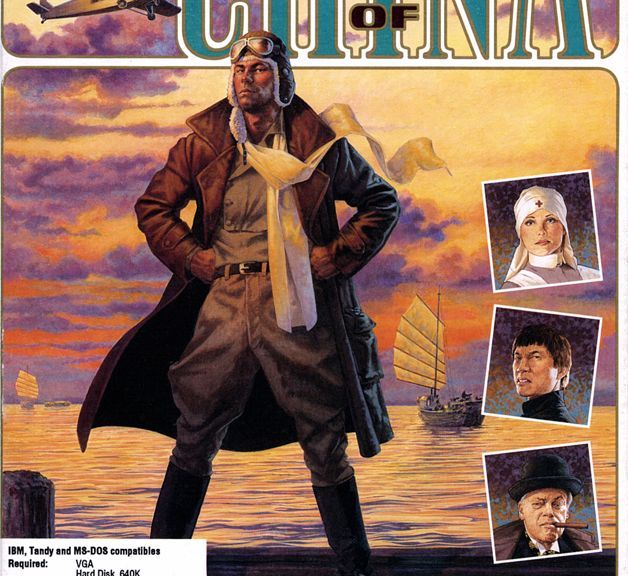
Heart of China

Publisher: Sierra
Developer: Dynamix
Year: 1991
Platform: DOS; Amiga; Macintosh

Review: Dynamix took everything great about Rise of the Dragon and nearly perfected it for their second adventure game. You play pilot Jake Masters (though Indiana Jones would fit as well) of a touring company in the Far East. The only blemish Mr. Masters has on his record is an acquiring debt with his creditor E.A. Lomax, a ruthless businessman out of New York and currently stationed in Honk Kong. Lomax gives Masters an ultimatum: save his daughter Kate who is in the hands of the Chinese in Chengdu and his debt will be cleared. Refuse Lomax’s offer, and well, let’s just say Masters can’t refuse the offer.

In Honk Kong, Masters finds Zhao Chi, a masterful ninja who offers to help Masters. Of course, Masters knows he needs no help, but lets him tag along anyway. Saving Kate in China is just the beginning of the adventure as you travel to several different cities, trying to get back to Paris where Mr. Lomax will be waiting for you.

Heart of China is a captivating game. Every character is fully developed, making the player feel for the heroes and hate the villains (and sometimes vice versa). Conversation is realistic. As in the game’s predecessor, what you say can come back to help or haunt you later. A romantic story develops with believable sexual tension and humour. The graphics are superb, and the sound is appropriate and lively most of the time.

Even the plot develops as the game progresses, which is a rare treat in the adventure genre. You can play all three main characters at various times, and discover plot branches that give you a completely alternate path to proceed through that part of the game. Along with three distinct endings based upon the relationships you develop (or destroy) throughout, the replay value is high.

My only major gripe about this game is the same one I had with Dynamix’s first offering.  The arcade sequences simply do not fit.  While the first one is marginally enjoyable, the second one (which literally ends the game)  is a clunky mess that ruins the tempo of the ending. Blissfully, you are given an opportunity to skip them if you fail a certain number of times, but that’s certainly anticlimactic.

Despite the arcade debacle, Heart of China is easily one of my favorite games and is one that I have gone back to on more than one occasion. If you love Indiana Jones, then this game should be on your must-play list.

Contemporary RatingLow. The arcade sequences along with some occasional confusion manipulating inventory items would likely irritate some.

Cruelty Rating: Nasty. There are a few times you can make the game unwinnable, sometimes obviously, sometimes not.  However, the game never allows you to become walking dead for long, as it becomes obvious pretty quickly you’ve goofed.  Regular saving should allow you to explore and enjoy various paths and dead ends without getting frustrated.

Portal 2

Publisher: Valve
Developer: Valve
Year: 2011
Platform: Windows; Macintosh; Playstation 3; Xbox 360

For those not indoctrinated on the Portal world, it is a first-person platformer that is more or less a bunch of physics-based puzzles involving opening portals in multiple walls and jumping through them to transport. I review it because the game is immersed in a deep plot and because it’s adventure-gamer friendly. I also review it because it’s amazing.

While Portal was a short game that spent most of the time easing the player into the game mechanics, Portal 2 assumes you know what you’re doing and plunges you in right away. The continuity with the first game is a bit muddled, but easy to forgive, especially since the plot is engrossing from the get go. Also, instead of simply going through each level while being condescended to by the computer, you get a friend this time to tag along with you. After rescuing Wheatley, he guides you through the game all the while making you laugh at his mannerisms.

Wheatley

Portal 2 is also deeper, with a few plot twists and additional game mechanics to learn as you are inundated with the entire history of the portal gun. While the added game mechanics (mostly involving different liquids that change the properties of walls and floors) are welcomed, it is precisely the last half of the game where these are introduced that makes the game less than perfect. This section goes on and on, and then goes on some more. There were times when I was so mentally exhausted I wanted to stop playing, which didn’t happen with the first game. Yes, it’s longer, but it also got just a wee bit tedious near the end.

That said, I still give it a perfect 10 rating. What saves Portal 2 from a score of 9 are a pretty fantastic endgame and a separate 2-player game where you team up with a friend and play through a different, near indomitable course, learning even more game mechanics along the way.

Playing with a partner

If you liked Portal, there is no reason not to play the sequel. If you haven’t played either, and are interested, you must play the first game first.

Contemporary RatingHigh.

Cruelty RatingMerciful. There are regular checkpoints that the game sends you back to if you kick the bucket.