Category Archives: PC Games

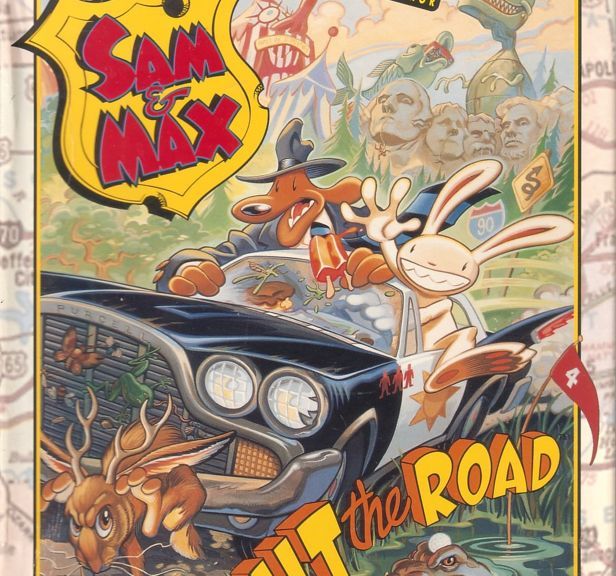
Sam & Max Hit the Road

Publisher: LucasArts
Developer: LucasArts
Year: 1993
Platform: DOS, Windows, Macintosh

Review: A couple of the more popular heroes in the history of adventure games, Sam & Max, freelance police, spawned many rabid fans and eventually their own morning cartoon (that won an award, no less). Sam is a well-dressed, sarcastic canine that was pulled straight out of 40’s noir. Max is crude, narcissistic, and a self-proclaimed violent lagomorph. And they’re both dedicated to solving their client’s plights, as long as there is substantial monetary gain to be made.

The premise is yet another bulls-eye for LucasArts, and is apparent from the opening sequence, where Sam and Max rescue a damsel in distress from a mad scientist, by the simplest method available, a thorough butt-kicking. Shortly after, they make the following discovery:

Max: He’s not a real guy, Sam! Can I keep his head for a souvenir? Why do you suppose its ticking?
Sam: That’s no head, Max! It’s one damned ugly time bomb! Let’s leave this criminal cesspool pronto!
Max: Good idea, Sam. Maybe we can ditch the head somewhere while the credits are running. Mind if I drive?
Sam: Not if you don’t mind me clawing at the dash and shrieking like a cheerleader.

The exchange would be funny enough in an episode of Police Squad, but is classic coming from these furry creatures. Further, after the credits sequence finishes:

Sam: Well, that was a pleasantly understated credits sequence.
Max: I enjoyed the cheesy retro ambiance.
Sam: What the hell are you talking about, Max?

This self-awareness remains throughout the adventure, with Sam and Max making comments to the player and to the game designers. In fact, how you feel about the game will rely heavily on your taste in humor, as you will be barraged with one joke after another, some subtle, some crass, and some intentionally lame.

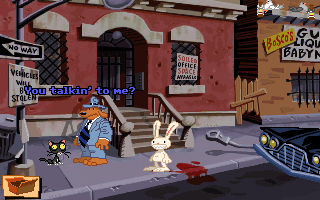
As for the game itself, the plot is quite bizarre. Your case directs you to find a missing “Bigfoot” and a giraffe-necked girl that were kidnapped from a carnival by country-western star Conroy Bumpus. You’ll visit several quirky tourist traps, some based on real places, like the World’s Largest Ball of Twine in Minnesota, with exaggerated effect. The characters you meet are mostly human caricatures intended to dig at pop culture, country music, and Western civilization in general. The interface itself is point-and-click and very intuitive. The graphics are sharply detailed, and the soundtrack is adequate. There are no dead ends, timed puzzles, or other such annoyances for the beginning gamer. And the voice actors for Sam and Max are excellent, with the supporting case up to the task, including a Bigfoot who has seen too many James Stewart flicks.

9526361-sam-max-hit-the-road-dos-outside-of-the-office-anything-can-happ

The puzzles are inventory-based, and few are of the lock and key variety. While you play the game as Sam, Max tags along causing trouble over the screen, but you can use him as an inventory item to solve any number of puzzles!  They usually involve gratuitously disgusting or violent acts, but not always. While nearly all of the puzzles are unique, they unfortunately require leaps of logic from the player on more than one occasion. They aren’t terrible, but slowed down the pace of the game considerably for me, which is the last thing I want in a comedy.

As typical for LucasArts, there are several amusing mini-games to play(including an entertaining variation of Battleship), Lucas films are spoofed (with a hilarious puzzle from Raiders Of The Lost Ark), and a few Easter eggs are present. I enjoyed many parts of Sam and Max, but was not satisfied on the whole. The characters seem more suited for a PG-13 or an R-rated audience, but their humour is necessarily toned down for the PG audience it was also aimed at. And while I laughed out loud a good half-dozen times, I feel as though their potential was never realized.

Thankfully, Sam & Max’s adventures didn’t end here.  They have three whole new adventures thanks to Telltale Games.  If I finished those, I am sure all three would hit the top fifty.  But despite enjoying them immensely, I sadly haven’t found the time to finish any of them.

9526325-sam-max-hit-the-road-dos-max-can-be-very-eloquent-sometimes-and-

Contemporary RatingHigh. While some of the puzzles are unfairly difficult, a quick trip to an on-line walk-through should eliminate most of the frustration.

Cruelty Rating:  Merciful. Like with most LucasArts games, you can’t even die, let alone get stuck.

The Beast Within: A Gabriel Knight Mystery

Publisher: Sierra
Developer: Sierra
Year: 1995
Platform: DOS, Windows, Macintosh

Review: Sierra took a risk by taking a successful game (Gabriel Knight: Sins of the Fathers) and completely changing the interface for its sequel. The second game in the Gabriel Knight series is strictly full-motion video, with real actors attempting to bring the story to life. Compared to other FMV games, The Beast Within is a rip-roaring success; but the nature of the beast unnecessarily hurts the series.

This time, the game takes place entirely in Germany. The local town is need of Gabriel’s “powers” to help rid themselves of what they believe are werewolves. As he is once again experiencing writer’s block (after his successful book based on the last game!), Gabriel reluctantly agrees. What follows is a six-chapter series that slowly dishes out an engaging plot, only a little more predictably than before. This time around, the player alternates between playing Gabriel and Grace (his employee from the first game), as they both must research the problem and risk their lives to fulfill their destinies.

The game is fairly easy, with a faithful dose of hotspot clicking to advance the plot. However, there are still many inventory puzzles, and quite a few are entertaining to solve, including one that involves splicing tape recordings. What really holds the game back is the same problem with its predecessor, multiplied threefold. At more than one occasion, Grace must nail every hotspot in a handful of rooms, merely for information gathering, with no indication that it is necessary.

The other disappointment, frankly, is the acting, especially that of the two main characters. In Sins Of The Fathers, Gabriel was a hunk and a cocky sonofabitch, with layers of depth and sensitivity buried underneath the tough exterior. Here, he is pretty much a wuss, and not at all attractive. Grace is not any better, overreacting to nearly every situation while being passive-aggressive with everyone she meets (again, unlike the previous game, where Grace is cool, with a cutting wit). Thankfully, the supporting cast puts in top-notch performances, especially Peter LucasWolf Muser, and Fredrich Solms.

While the writing at times leaves a bit to be desired (including humor, which is almost non-existent), the story and characters are enough to draw the player in through to the end, which like the previous game, is well-developed and thoroughly intense. The only major beef I had with the plot was that even though I discovered who the antagonist was well before game’s end, I couldn’t do anything about it because Gabriel didn’t know (and he should have). Instead of simply implementing mutliple endings and/or plot branches, I was squeezed through a painfully linear endgame.  Thankfully, the final puzzle is pretty damn good, leading to a satisfying ending.

Overall, this game was a success, widely considered the adventure game of the year. It is a worthy play, but probably only to fans of the series.

Contemporary Rating: Medium. Very easy to play, but the insane amount of pixel-hunting at times would drive modern gamers batty.

Cruelty Rating:  Polite. There are a couple of situations where you can die and must save before hand just in case, but the situations are very obvious.

Rise of the Dragon

Publisher: Sierra
Developer: Dynamix
Year: 1990
Platform: DOS, Amiga, Macintosh, SEGA CD

Review: Dynamix introduced their first game in the adventure genre in 1990, and while it suffered a little from the inexperience of the game designers, it still soared high and above most of its competition.

You play Blade, a former cop who didn’t work within the system and is now a private dick. The mayor’s daughter, an addict, has been killed by a mysterious drug. The mayor has hired you to not only investigate her murder, but the organization that is behind everything. The setting is in Los Angeles in the near bleak future, and most of the game revolves in and around Chinatown; however, there are very few locations to visit in the game.

The locations therein are well realized and the digitized graphics are sufficient if not a tad bit grainy. The sound does a superb job of staying in the background, hardly noticeable but still reflecting the appropriate mood. The icon interface is very intuitive, with most commands executable with one click of the mouse, while not being too insulting. Items can be dragged to and from the inventory and combined with ease. There are enough subtle hints, background imagery, and red herrings in the game to make the point’n’clickin’ meaningful.

Where Rise of the Dragon really stands out is the pacing of the game. Though it doesn’t get mentioned often, the pace of a game can easily make or break the player’s enjoyment. Blade lives in real-time. The world moves on with or without him.  More importantly, characters respond appropriately to Blade’s actions and remember them as well. Piss off an informant?  Forget about getting anywhere on that lead. Apologize to your girl?  She’ll remember your sincerity later. Talking with characters prompts conversation trees that can wind out to several different outcomes. While the game can never be put in an unwinnable state, the more you screw up, the less likely you’ll be able to deduce what’s going on around you.

apologizing to your girl

Though there is a time limit, in the game and in some sequences, it is not too constricting.  You are allowed extensive exploration as well as the “restore” command to beat the clock. One of the game’s treats is the numerous ways you can creatively kill yourself. After I won the game, I spent a good amount of time searching for all of the possible death scenes and the four alternate endings.

Ultimately, the game’s biggest disappointment is its brevity. Perhaps I’ve just played too many games, but I was able to complete this one in about three hours. The puzzles are none too difficult, and there simply isn’t extensive enough character or plot development. There are also two arcade sequences involving using your weapon of choice. The first one is implemented seamlessly and is simple enough, while the second is very clunky and abruptly ruins the flow of the game near the end. While you can skip them if you so choose, continuity is sacrificed.

Despite it faults, Rise of the Dragon should please most adventure gamers as it does a wonderful job of creating a realistic, non-linear environment without ever forcing the player to read the authors’ minds by solving obtuse puzzles. Certainly worth an afternoon.

Contemporary RatingMedium.  The game’s time limit combined with the pointless arcade sequences could scare some people off.  However, if the game intrigues you it shouldn’t be too much a barrier.

Cruelty Rating:  Polite.  You need to save the game regularly, but you can’t get stuck and dangerous situations are apparent.

The Dark Eye

Publisher: Expert Software
Developer: Inscape
Year: 1995
Platform: Windows, Macintosh

Review: If I scored games on originality, The Dark Eye would probably have the highest score. One of the few adventures that has no inventory, the player weaves through three Edgar Allen Poe stories, as well as one original, haunting tale in true Poe fashion.

The game begins with you arriving at your eccentric uncle’s mansion, simply on a trip to visit him, your brother, and your cousin. You learn quickly that your uncle disapproves of the relationship between your brother and cousin and a plot begins to develop, growing darker at every turn. However, to advance the plot you must enter the world of Poe’s stories.  The three works you explore are The Tell-Tale HeartThe Cask Of Amontillado, and Berenice. You get to complete each story playing both the victim, and the victimizer, unable to change the course of the original story. The farther you advance, the more of the plot you see, until the last story is finished where the game’s end is revealed.

The characters are strictly claymation, in both the real world and in Poe’s stories. At first this may seem like a turn-off, but the brilliant acting (especially by William Burroughs) combined with the dark, ominous setting draws the player into their world. The only drawback in this department is character movement, which is very blocky and poorly rendered (perhaps intentionally, but not to my taste).

However, despite being an interactive story without puzzles, the gameplay mangles some of the tension. To trigger advancement in the story, one must click on various objects on the screen, which will trigger events or, at times, memories or voices. Many times this whittles down to a monotonous exercise in guess-and-check, creating more frustration than tension. Additionally, it is often difficult to discern what direction you are heading. There is at least one time during the game where I kept turning around in circles, pleading for an exit before I was felled by carpal tunnel.

Though the game can be played without having read any of Poe’s stories, I’ll guess that it is more enjoyable if one knows the material heading in. The story and the motivations of each character should make a little more sense. There’s also the foreknowledge of the tragic end, which being forced to endure satisfies any internal sadistic tendencies one may have.

Of course, if you don’t like Poe, you probably won’t enjoy this game. For those who do, I strongly suggest playing this fascinating, if imperfect, campaign. And while I found the final Easter egg to be overlong and dull, those who win the game get to hear Burroughs do a reading of Poe’s The Masque of Red Death.

Contemporary RatingMedium. What is essentially an interactive movie is not made intuitive, which is amazing when you think about it.

Cruelty Rating:  Merciful.  You can’t win the game unless you die!

Callahan’s Crosstime Saloon

Publisher: Take-Two Interactive
Developer: Legend
Year: 1997
Platform: DOS

ReviewLegend might have raised the bar with this game. They had to tap into many talents to make the game as good as it was. They certainly did not lounge around while this was in production. Inn fact, you could say they put more effort into this one more than any other. I’m even confident enough with that opinion to go pub-lic with it.

And if you could stomach that pun-filled synopsis, you might want to try Callahan’s Crosstime Saloon. Based off series of books by Spider Robinson, you fill the shoes of Jake Stonebender, a reserved man with a haunted past, witnessing and partaking in the strange goings-on in the titular tavern. You’ll run into many fascinating friends, ranging from vampires to aliens to talking dogs to time travelers and even some regular ol’ drunks, who all respect one another’s privacy and can’t go three sentences without starting an all-out pun war.

The overarching plot is that our universe is about to be eliminated by an intergalactic council because there is nothing unique about it, thus being labeled a tax on resources. The creator of our universe is allowed some time to make a defense for his project, and decides to head to Earth to see if anything pops up. Oblivious to the fact that end of the world is near, you (as Jake) must traipse through many other hurdles (such as preventing an alien species from sucking all the testosterone from Earth) and help out your friends (possibly by heading to the future to save a certain cacao plant from extinction) in order to pass the time. Meanwhile, the universe’s creator is keeping a close eye on your adventures.

The game starts with the player attempting to win a contest at the saloon by solving various riddles of a pun like nature. The theme for the night (which becomes soon obvious) is classic rock bands.  One clue is “Slender Projectiles + Legend.” In other words, “Arrows + Myth.” Thus, the answer for that riddle is Aerosmith! I absolutely love word puzzles, so this game hooked me immediately. The rest of the game is based less on word puzzles than on quirky inventory-based puzzles that make sense only in the bizarre environment you encounter through your adventures. On several of these adventures, you will have a partner (from the bar) who comments on your predicament and even helps out on occasion.

Your enjoyment of the game will highly rely on your taste in humor, as the personalities and subsequent jokes by this crazy bunch of characters is the heart and soul of Callahan’s Crosstime Saloon. There are some logically satisfying puzzles, but many are contrived and feel like busy work. Meanwhile, the game includes responses (in full speech) for thousands upon thousands of actions. While this attention to detail is appreciated, most of the game is spent listening to the narrator drone on about various tangents. Some of the commentary is amusing, but it eventually feels like a chore. I zipped through the first half of the game, but the redundancy slowly bored me right up until the final chapter, when I was happy to see the plot finally moving along.

The other highlight here is the four solid folk songs interlaced throughout, written and sung by Spider Robinson himself. The Drunkard’s Song is fantastic, and the author has released a CD of his own.

I laughed out loud a couple dozen times during my playthrough, and was pleased to see many unique features (and gambles) taken by the developers. But when all was said and done, there were too many flaws to give this game a high ranking, though I would still recommend it to fans of the author, of Legend games, and puns.

Contemporary RatingHigh.  Intuitive game, easy interface.  Though, if you’re not a native English speaker, the game would be difficult at times.

Cruelty Rating:  Merciful.  You can die, but there’s no need to save as you’ll get taken right back to where you were.

Space Quest I: The Sarien Encounter

Publisher: Sierra
Developer: Sierra
Year: 1986
Platform: DOS, Amiga, Apple II, Apple IIgs, Atari ST, Macintosh

Review: When I was young, my selection of adventure games was, for the most part, limited to shareware (mostly junk) and Sierra games. But while my parents invested in King’s QuestPolice QuestLeisure Suit Larry, and ManhunterSpace Quest was left off the shopping lists. And even though I knew about this series and was intrigued, I never put it on my Christmas list either. So approximately sixteen years after this adventure was first released, I got my hands on a copy. It was well worth the wait.

The premise behind the game is about as sophisticated as your typical plot on the original Battlestar Gallactica. Possibly, this could be the point. You play Roger Wilco, a space janitor with no skills, or work ethic for that matter. When your ship is raided by the Sariens, you must escape and foil their plans to use the Star Generator for their own universe domination. What follows is less of a story but a piecing together of slapstick humor, crafty puzzles, and enough untimely deaths to make Wile E. Coyote blush.

It baffles me that so many adventurers hate dying. This never bothered me when I was a kid, and still doesn’t phase me. In fact, one of the primary reasons I get frustrated with current adventures is that there is usually no way to screw up. When you never have to worry about making a mistake or (gasp!) death, you can go head first into every task without so much as lifting a neuron. For me, that removes the innate challenge that a real puzzle presents. Not every problem in reality is guess-and-check. Sometimes you just have to guess and hope.

220439-space-quest-chapter-i-the-sarien-encounter-dos-the-beginning

With that said, Space Quest does such a marvelous job of finding creative, unexpected ways for Roger to die that I simply had to discover them all. Lucky for me, I found a document on the web that detailed every death, so instant gratification was ever-ready. And with the ‘save’ and ‘restore’ functions one keystroke away, I never became frustrated.  However, I was lucky.  There are two distinct ways to put the game in an unwinnable situation.  One I experienced only made me have to restore back about ten minutes or so.  The other, which I avoided, requires one to start the game over.  It’s unlikely that you’ll encounter it if you’re thorough, but it’s still there.

Other than that the game was very well designed. Not only are most puzzles logical and clever, there are often multiple solutions.  This offers a good deal of replay value and a way for different breeds of adventurers to hack away. The production values are adequate, though the parser is fairly poor when compared to its peers.

But what it all comes down to is comedy. The deluge of punchlines and silly antics never stops, so if your sense of humor is in line with the writers’, then you’ll like The Sarien Encounter.  If after fifteen minutes you don’t find yourself amused, then you’ll be hard pressed to enjoy the rest of the game.  Or the rest of the series, for that matter.

Contemporary Rating: Low.  The parser doesn’t always understand some reasonable commands, which would frustrate new players.

Cruelty Rating:  Cruel.  Having to play the entire game over again by missing something near the beginning is the main reason this scale exists.

Indiana Jones and the Last Crusade

Publisher: LucasArts
Developer: LucasArts
Year: 1989
Platform: Windows, DOS, Amiga, Atari ST, CDTV, FM Towns, Macintosh

Review: One of the first adventure games by LucasArts filled me with great anticipation as it is based on one of my favorite movies. I was optimistic as the game was by one of the great software production companies, but hesitant because movie licenses are often botched horribly when turned into games. However, it works here for a few reasons.

For starters, the adventure movie the game is based on feels more like a collection of great scenes than a seamless, timeless story. There are many great set pieces and fun action sequences that take precedence to the father/son subplot and symbolic undertones. One can debate the effect this has on a movie audience, but it’s simply bread and butter for a game. Creating a solid flow to a game with a progressing, engaging plot is very difficult when you must often halt the experience with puzzle-solving. LucasArts never had to worry about this.

Secondly, much of the movie’s charm came from the wacky, slapstick humor and numerous in-jokes to Spielberg and Lucas fans. The producers and writers of the game took the exact same formula, changed many of the jokes, and hit dead on with quite a few of them. They even made fun of their own material, breaking the fourth wall if the joke works. For example, take the scene near the end of the movie where they enter the palace near Iskenderun. In the game, as in the movie, Indy sees a decapitated head roll in front of him. Here, he turns to the “camera” and says, “Yep.  This is the right place!”

15890700-indiana-jones-and-the-last-crusade-the-graphic-adventure-amiga-t

Lastly, the puzzles have been changed just enough to not be automatic for those who have memorized the movie, yet still fair and sometimes challenging. Many puzzles have multiple solutions, and the game can be made much easier (or difficult!) depending on who you make friends with and who you can trick. Even the obligatory copyright puzzle includes game elements that can make the puzzle easier or harder depending on your adventure skills. There are also four different endings to obtain, only one similar to that of the movie.

And if you get stuck? Forget puzzle solving and fight Nazis using your bare hands! There is almost no puzzle that can’t be solved by fighting, though it is difficult, not all that intuitive, and hard to keep your strength up after five or six fights.  Thankfully, there is no puzzle that requires you to fight.

My only major gripe with the game is the conversation trees. Many of the puzzles revolve around Indy using his wit to fool Nazi guards into letting him pass by without a fight.  Many times, this is done simply by saying the right things. Unfortunately, there are usually no clues as to what may work and what will get you a right uppercut. What will fool one guard will not work with another, even though their is no discernible difference between the two personalities.  So at times it becomes a “guess-and-check” routine, saving and restoring until you exhaust your options and make it past.

Oh, and there is a pointless maze.  @!#?@!

While the game feels dated due to the limitations of the engine used at the time, it is still likely to warm the heart of any true Indy fan. Those who have not seen the movie, or any of the Indy movies, will likely miss many of the jokes and get frustrated trudging through an otherwise mediocre puzzle adventure. I fit into the former and felt it was well worth my time.

Yes, you can punch Hitler. 

Contemporary RatingMedium.  The random conversation trees and frequent need to save and restore would definitely turn off some.

Cruelty Rating:  Polite.  You can die frequently, and you must therefore save frequently.  But you can’t get stuck.

Hollywood Hijinx

Publisher: Infocom
Developer: Infocom
Year:
1986
Platform:
DOS, Macintosh, Amiga, Amstrad CPC, Apple II, Atari 8-bit, Atari ST, Commodoe 64

Review: Hollywood Hijinx is one of Infocom’s unsung gems.  Your rich aunt has just passed on, and you were the favorite nephew, chosen to inherit the large fortune. However, she needs to know if you are clever enough to be worthy of holding the family finances. She has given you twelve hours to explore her mansion and find the ten “treasures,” or leftover props from her husband’s popular B-movies.

Hijinx captures the flavor of the times and the B-movie industry wonderfully, and is funny throughout. Most of the puzzles are very easy, with only a few mind benders to plunge through. But if you’re just looking for a good time and a few good laughs, this game is great.

1240100-hollywood-hijinx-dos-opening-screen

Contemporary RatingLow.  There’s a copyright protection puzzle, but thankfully it’s at the very beginning and the answer can be easily obtained on the internet.  But what the modern gamer really wouldn’t put up with is the 12 hour time limit.  When I played it, my first run through was gathering information, solving some puzzles, making a detailed map.  On my second playthrough, I knew everything I need to do in order to beat the time limit.

Cruelty Rating:  Nasty.  You can make the game unwinnable when messing with various props, though it should be obvious that you’ve done so.  Considering you know you’re going to have to start the game over from scratch at some point anyway, it’s not a huge deal.  The game isn’t terribly long once you know what to do.

Hero’s Quest: So You Want To Be A Hero

Publisher: Sierra
Developer: Sierra
Year: 1989
Platform: DOS, Amiga, Atari ST, PC-98

Review: Due to copyright conflicts with Milton Bradley, Sierra changed the series to Quest For Glory. They later remade this game as Quest For Glory 1.

Definitely one of Sierra’s finest concepts, Hero’s Quest combines the adventure and RPG genres to create a game that not only appeals to both fans, but has great replay value as well. You can select from a hero, magic user, or thief to complete your quest.  While the paths are virtually the same, most puzzles are solved differently based on your skill set, and you are treated differently by your peers.

I love the game’s premise, and it is one of the funnier offerings Sierra has on the shelf, but the battle system left me shuddering. I prefer turn-based combat rather than hand-to-hand, but I can enjoy the latter if it’s implemented well. Unfortunately, this system is not intuitive and hardly engaging. I found fighting to be more of a chore than an opportunity.

However, I seem to be in the minority, as this game is lauded by nearly all. Computer Gaming World awarded it the best adventure game of 1990. I genuinely like it myself, and would recommend it to fans of 80’s adventures, but the RPG elements here more or less ruin it for me.  I have not played any of the game’s four sequels and probably will never do so.  From what I’ve read, the second installment is even better than the first, with the series gradually getting worse from there on out.

Contemporary RatingLow.  The parser responds pretty well to commands, but I can’t imagine why anyone would put up with the outdated battle system today.

Cruelty Rating:  Tough.  You can die from hunger or exhaustion, and there is at least one way to die by not having an item with you at a certain time.  All of these situations are obvious and fairly easy to prevent, but you can still get stuck if you’re not careful and will have to restore back to an earlier point.

Mean Streets

Publisher: Access Software
Developer: Access Software
Year: 1989
Platform: DOS, Amiga, Atari ST, Commodore 64

Review: The first of six games starring private detective Tex Murphy, Mean Streets broke ground where adventure games had yet not traveled. The true definition of a hybrid game, Access Software took several chances with the design. Combining inventory puzzles, interrogations, arcade sequences, and even a flight simulator, the developers threw in everything but the kitchen sink.  Either the game would appeal to a wide market, or alienate everyone. Not every experiment proved successful, but everything is held together by the game’s personality.

Tex Murphy frequently tops lists of greatest adventure game characters. While most of those amorous feelings toward Tex likely rest with the later games in the series (where Tex is in his full-motion video glory), the springboard is Mean Streets. Moving to San Francisco in the near post-apocalyptic future, Tex accepts $10,000 from bombshell Sylvia Linsky, who’s looking for answers regarding her father’s suspicious suicide. Tex, obviously a film noir buff, plays the part to the hilt. His arrogant, calculating demeanor is offset by his charm and good looks. He employs, predictably, a cute and innocent secretary, who obviously has a crush on him. He also has an exotic, sultry informant, just one videophone call away. He also has a quid pro quo relationship with one of the local detectives. In short, he’s a well-done cliché.

But it’s not just Tex that has personality.  The entire game oozes cool. The future is as bleak as every good 60’s bomb-fearing prophet would have you believe. San Francisco is divided, the fallout mutants segregated into the bad neighborhoods. The politics in the city are practically militant. Corruption is commonplace. Nobody trusts anyone, including Tex. And everybody has a fucking gun.

The gameplay itself is average at best. With no mouse support, the interface is clumsy. Basically, play goes like this: travel to residence of witness/informant, interrogate said witness on a limited set of topics, bribe or threaten as necessary, get new information, and repeat ad nauseam. Interludes include arcade sequences where you must duck under bullets–they’re slow bullets–and shoot the endless bad guys. Occasionally, you must raid someone’s home or office, steal their valuables (hey, someone’s got to pay for Tex’s ammunition and bribe money), disable alarms, and find more clues.

The arcade sequences are all exactly the same, with background swaps. They’re incredibly easy, and ultimately boring. Further, they’re entirely silly, detracting from the atmosphere. The flight simulator is clunky and also pointless. Nothing happens in your hovercraft other than going from one location to the next, so after the first couple of trips, flying becomes a chore.  Thankfully, there’s an autopilot option available, so whenever you need to go somewhere else, you can simply set the course, head to the fridge, and come back a couple minutes later when the craft finally lands.

The entertaining parts are the typical adventure game fare. Searching residences is rather easy, as you simply select actions and objects from a menu while walking around. But there’s so much to see in every room, and by the time you’re through investigating, you have a pretty good picture of the occupant. The hit man’s got cigarette butts, a blow-up doll, and a briefcase with a tag that threatens the life of whomever touches it. One suspect’s beach home has lingerie and handcuffs lying about, evidence of an affair with another suspect. Try to taste the lingerie? The game responds with disgust at your impure thoughts. Try to eat the two-day old pizza? The game lets you do so and tells you how lovely it was. Swallow the contents of the mysterious bottle? Meet the grim reaper. In fact, there are many entertaining ways to off yourself, a part I always yearn for. And there are also several hilarious pop culture references, my favorite poking jabs at Lost in Space.

Meanwhile, interrogation is even easier, but fun nevertheless. The various personalities you run into are a blast, but besides that, Mean Streets broke a lot of new ground here. Digitized graphics were almost unheard of in 1989, and the actors all pose for their parts well. This was also the first major game to have 256-color VGA graphics and have digitized sound from the PC speaker! The speech is minimal, but what’s there adds more flavor to the game.

The game is fairly non-linear, with clues obtainable via many sources. Having enough money for bribes should never be an issue as long as you steal enough from the various homes you enter. Ultimately, Mean Streets is one heluva easy game (with a fairly predictable plot), unnecessarily padded with the non-adventure elements. But it contains enough great dialogue, characterizations, and atmosphere to warrant at least one playthrough by fans of the series. It’s certainly easy to see why a sequel was soon forthcoming.

Remember, the only good freak is a dead freak.

Contemporary RatingLow.  The confusing and time-consuming flight simulator along with the keyboard only controls date the game terribly.

Cruelty Rating:  Tough.  You could run out of money if you’re extremely careless.  There are puzzles that have local time limits, but they’re apparent.