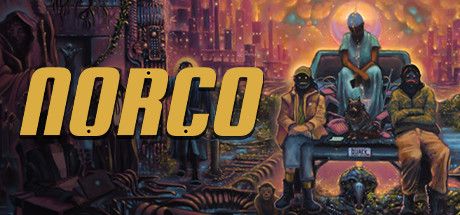
Publisher: Raw Fury Developer: Geography of Robots Year: 2022 Platform: Windows, Mac, Xbox One, Xbox Series, PS4, PS5
Rating: 6
Norco is a real place, a highly segregated (but mostly white) CDP that was renamed in 1911 after the New Orleans Refining Company was established. Part of “Cancer Alley,” Norco refines 10 million gallons of oil per day and regularly spits pollution everywhere and very notably during two catastrophic explosions in 1973 and 1998 and also during Hurricane Ida in 2021. It’s three square miles and is home to about 3,000 people.
Norco the game takes place in an alternate future, still dominated by the petroleum industry but somehow darker, bordering on apocalyptic. The U.S. government is barely there, parts of the country are in civil war, and organized crime is everywhere. Androids are also common as well as a relevant technological advancement of being able to upload memories onto computers. Norco well establishes a gritty atmosphere, a city where complex humans are doing their best to make their home a livable place. Unfortunately, the narrative occasionally takes a hit thanks to some occasional obtuse puzzle design and a story arc that becomes a little grandiose at the end.
Publisher: Campo Santo Developer: Campo Santo Year: 2016 Platform: Windows, Mac, Linux, PS4, XBox One, XBox Series, Switch
Rating: 5
A quite common theme with lower-budget indie developers when it comes to three-dimensional gaming is the general lack of NPC interaction. I get the reasons why but it often limits the scope of the narrative. Suspense is often a theme of these types of games as the player’s isolation is highlighted by finding cryptic notes and mysterious situations highlighted by spooky sounds and a haunting soundtrack. Gone Home subverted the player by pretending it was horror when it turned out to be anything but. Firewatch does deliver some earned suspense along the way, but similarly and disappointingly negates the player’s experience at the end.
After playing Blackwell Unbound I commented how doing a prequel was a strange choice, especially since the case involved just seemed like a regular day at the office. I wrote, “As alluded to earlier, the ending is a bit of a letdown, and it just feels like part of a larger episode with no great stakes, at least as it pertains to Rosangela.” Well, The Blackwell Convergence appropriately connects the stakes as it pertains to Rosangela. But while the story has improved cohesion, nearly every other aspect of this third installment in the Blackwell series felt like a step back.
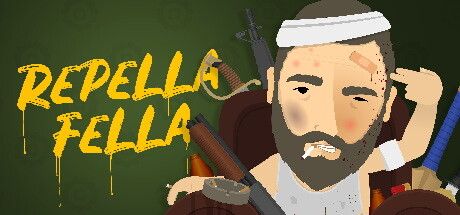
Publisher: 2 Left Thumbs Developer: Misadventurous Year: 2023 Platform: Windows, Mac, Linux
Rating: 9
Repella Fella is the funniest game I have ever played. No notes.
Okay, I’ll provide some notes, but first, take twelve seconds to watch this clip of the opening credits. If that didn’t at least make you smile, you would probably be miserable playing the actual game. Everyone else, you’re in for a treat.
Publisher: ustwo Developer: ustwo Year: 2020 Platform: Windows, Mac, iOS, tvOS, PS4, PS5, Xbox One, Xbox Series, Switch
Rating: 5
The second adventure game I’ve played with my daughter, Alba has a lot of the same feel-good charm of A Short Hike without having the same variety or freedom that made it an excellent adult game as well.
Publisher: Bob Bates Developer: Bob Bates Year: 2017 Platform: Windows, Mac, Linux, iPhone, iPad, Android
Rating: 6
Bob Bates is a legend in the world of text adventures. While his two games for Infocom (Arthur and Sherlock Holmes) are generally not considered among their best, he co-founded Legend Entertainment and had his hands in almost every game, including Eric the Unready, Gateway, The Blackstone Chronicles, and Quandaries. After being co-president of Zynga and working on all sorts of projects, he returned after 20 years to the world of interactive fiction with the delightful Thaumistry: In Charm’s Way. I was one of the kickstarters and even got a couple of lines into the game myself. Naturally, I was quite eager to play. And while it’s a very short game with little freedom, it’s still a joy for those who like wordplay and tongue-in-cheek humor.
My favorite episode of The Walking Dead is “The Grove,” which is a fairly common opinion. The climax was some of the most gut-wrenching TV I’ve ever witnessed; and while the moment itself is ridiculous on paper, the show earned the moment as they had been slowly building towards it for two seasons, making it seem like a natural progression in this terrifying universe. Anyway, this is basically how I felt at the end of playing this game. Only I cried for twenty more minutes.
In the very near future, Earth has gone to shit due to climate change and is only barely hanging on due to an incredible mining operation on the moon that delivers Helium-3 to Earth, providing much needed energy to the people. Helium-3 is a real isotope, is indeed on the moon, and has been speculated to be a possible energy source. The rest here is science fiction and is all explained in the opening narration. Unfortunately, the station and mining operation have gone dead, and for five years the Earth has been rapidly becoming uninhabitable. You, Claire Johanson, are being sent on a rogue solo expedition to the station to find out what went wrong and hopefully get that sweet, sweet Helium-3 pouring in again.
Publisher: Bruner House Developer: Dramatic Labs Year: 2023 Platform: Windows, PS4, Xbox Series, Xbox One
Rating: 6
Stardate 2023.232: It’s been a hot minute since Trekkies have been graced with a commercial adventure game. Twenty-seven years to be exact. In the meantime there have been endless action, strategy, RPG, and even pinball games based on the Star Trek franchise. Given that Trek is quite famously known for being light on action and heavy on diplomacy, it’s sad that adventure gamers have been left at spacedock for so long. But at long last the team at Dramatic Labs (made up of many former Telltale employees) have remedied this with the release of their first game, Star Trek: Resurgence. While there’s little in the way of puzzles and the interactivity can be painfully light at times, the good news is that the atmosphere and story are pure Trek and should entertain any fan of the franchise.
Taking place shortly after the events of Star Trek: Nemesis (and four years after the conclusion of Deep Space Nine), the game opens as the U.S.S. Resolute, a science vessel, is about to leave dock with their new first officer, a half-human, half-Kobliad named Jara Rydek. She was handpicked by Captain Solano, likely in part because she wasn’t a member of the crew that witnessed a mistake by their captain that cost many lives. For half of the game, you will guide Rydek through building rapport with the crew, evaluating and carrying out orders from the captain, and leading away missions.
The other character you will split time with is crewman Carter Diaz, an engineer from the lower decks who’s just hoping to do a good job and impress his Vulcan supervisor. Along with his colleague Edsilar (an unjoined Trill), his first task involves suiting up and making some repairs on the outside of the hull, which naturally doesn’t go as planned, forcing both he and Rydek to make critical decisions to save the ship.
The Resolute’s primary mission is to negotiate peace talks between the Alydians and the Hotari, species new to the Trek universe. The former is the more technologically powerful species, but the latter has the profitable mines and labor they’re dependent on and exploiting. Joining the crew is renowned negotiator Ambassador Spock, who will support Rydek and occasionally challenge Captain Solano. Predictably, peace talks quickly break down while Rydek and the crew uncover a terrifying horror that threatens the survival of not just the Federation, but the galaxy itself. Another intriguing alien race that had a one-off episode on The Next Generation will play a significant role. Given that Trek is notorious for alien-of-the-week episodes, it’s a welcome surprise to take a deeper dive into one of them.
As both Rydek and Diaz, the primary challenge will be navigating tough conversations. In some cases you will be making stressful command decisions, and in others you’ll be exercising your skills at diplomacy. Either way, your choices often affect how various crew members and characters feel about you. When this occurs, the game will immediately alert you with the result, illustrated with a picture of them showing approval, anger, or neutrality. You can then access the menu to read a fuller description of why the character reacted this way.
On a few occasions, this impacts how certain parts of the story play out (including the ultimate fates of some of the characters), though there is no way to prematurely end the game or drastically alter the story. Some actions will anger one character, yet please another. And frequently you are forced to decide whether or not to stay strong in your convictions or keep the peace. There are no wrong answers, and you can feel free to decide what makes sense to you. My approach while playing was, “What would Jean-Luc Picard do?” and I found the results to be pretty satisfying. My favorite part of conversations was employing empathy and understanding of other cultures to inform my decisions.
For those pining for action there are ample opportunities, during predetermined scenes, to use stealth or your phaser to bypass enemies. Phaser battles are limited in that you can’t freely move around. However, there is still plenty to do. You have to decide when to take cover, aim your weapon, and fire strategically at enemies who present a more imminent threat. The game is fairly forgiving in these areas, though I did fail several times. If you should die in the line of duty, you will be revived at the beginning of the scene to try again. And if a particular area is giving you fits, after failing the first time you will have an opportunity to temporarily switch to story mode. You will still take part in the scene, though you will be essentially invincible and can play at ease.
Play control is fairly intuitive via gamepad or mouse and keyboard. The former is a bit better for moving around in a 360-degree environment, though keyboard users should be just fine as you’re never given more than a room or two to explore at one time and precise movement is never necessary. Quick Time Events are also used sparingly in action scenes, often to dodge an attack or disarm your foe. Ample time is given for each event and serves mostly as a way to (successfully) increase adrenaline. Not only are there very few puzzles, those that exist are fairly dull and needlessly extend scenes in an already long adventure. They are essentially to-do lists; none are difficult and mostly just require using your tricorder to scan for biological or chemical irregularities. The most egregious example is when Rydek must traverse a room equipped with motion sensors that extend only in straight lines. Never mind the fact that the motion sensor on my home security system is a hundred times more effective, there is simply nothing interesting about ducking under and maneuvering between lasers.
The atmosphere is consistently engaging from beginning to end; it never doesn’t feel like you’re in the Star Trek universe. Franchise fans will feel at home with the ambient hum of the warp drive, the claustrophobic turboshafts, the colorful computer consoles, and the ominous thump of deployed photon torpedoes. There are also plenty of familiar yet relatively mundane activities you’ll be undertaking, such as using the transporter, analyzing readings with your tricorder, and piloting a shuttlecraft. These mostly require following simple directions, though the shuttlecraft flights require some basic maneuvering skill and can be failed if you’re not careful. Most of the time, character or plot development is happening concurrently, giving the tasks meaning while immersing you in the story. My only wish is that there was more freedom to explore the ship. At times it feels like you’re watching a television show, knowing that the director only has access to a few sets at a time.
Likewise hampering immersion are fairly modest character models that feel like they belong in a game from fifteen years ago. Facial movements are minimal; when characters spoke I sometimes found myself distracted by their lack of expression. They tend to walk stiffly as well. To top it off, the lip syncing is inconsistent. On the flip side, the cinematography is above average, with many detailed panoramic shots that bring home the scale of both the ship and the infinite void beyond.
You will visit other ships and alien planets along the way, including the Hotari mining colony, Alydian vessels, and an ice planet. While they are colorful and detailed, their scope is unnecessarily limited to familiar humanoid environments. The gravity is the same in every location. The tricorder recognizes pretty much everything. And the alien technology, while in a different language, is familiar enough to Diaz that he easily tackles it even under extreme duress.
The voice acting is a treat. Piotr Michael absolutely kills as Ambassador Spock. Had I not known that Leonard Nimoy is dead, I would have been none the wiser. Krizia Bajor also shines as Rydek, despite the writers giving her little room for joy or levity. Fans will also be delighted by a cameo from a beloved Trek veteran from The Next Generation. The music doesn’t quite reach the symphonic heights of a Jerry Goldsmith arrangement, but is nevertheless beautiful and very well-integrated into each scene, with only a few rare moments where it drowns out some dialogue.
The farther I progressed in the game, the less bothered I was by any of its faults. The nicely layered plot kept me riveted and the action heats up the closer you get to the finale. While some may argue there are too many back-to-back climaxes, they all feel genuine and rewarding. The final big scene is exceptionally scripted, with rapid changes between Rydek and Diaz as they desperately try to save the galaxy. But while I was wholly satisfied with the story’s ending, the denouement left me a bit cold. There’s virtually no resolution to the relationship choices you’ve made along the way, and several questions are left perplexingly unanswered, especially since there’s neither a cliffhanger nor a hint of a potential sequel. None of the alternate endings appear to fill in the blanks, offering just a few changes in character outcomes with different lines of dialogue.
While I have no strong desire to replay the game, I may have considered going back through various chapters to see how other command decisions played out. Alas, there is no chapter select available, and the only way to see a different permutation of the story is to log another ten or so hours to start again from the beginning, with no way to even speed through things you’ve already seen. You can log into the game’s website and use an in-game code to compare the decisions you made with the rest of the world’s players, though the statistics are not as comprehensive as with many similar games.
I hesitate to recommend Resurgence to non-Star Trek fans. So much of my enjoyment came from losing myself in a universe I carry a deep love and nostalgia for. While the complex story holds its own and would be a worthy entry into the official canon, the script itself is a bit low on pathos. A really good episode of Trek would leave me laughing or crying or feeling deeply philosophical about human nature. There are definite attempts to reach those heights here as well, but the story beats don’t always land. So unless you’re a huge fan of sci-fi and/or solving problems via diplomacy, you may find yourself less enthralled without prior familiarity with this universe. That said, the atmosphere and story-building are impressive by any measure, and for existing fans this should be a no-brainer. If you’ve been patiently and agonizingly waiting three decades for a Trek adventure game, Resurgence is sure to have you beaming.
Publisher: Frostwood Interactive; Dino Digital Developer: Frostwood Interactive Year: 2023 Platform: Windows, Mac, Linux
Rating: 4
Cognitive distortions are irrational thought patterns that can lead to self-doubt, anxiety, and depression. Cognitive behavioral therapy teaches people how to recognize these distortions, reframe them to something rational, and then change their behavior to match. Unwording, the third game from Frostwood Interactive (Rainswept, Forgotten Fields), is a journey of three days in the life of one man who’s currently stuck in a negative thought spiral. Rather than watching him work through this in therapy, you will get to help him by playing word games with the goal of reframing his destructive thoughts. While the premise is charming and the mini games are occasionally fun, this very short adventure lacks the depth and polish to fully raise it out of the doldrums.
The first day begins in bed with Tom struggling to brave the world as the player tackles the first word puzzle. The phrase “Wake Up” is emblazoned across four two-dimensional blocks, each block consisting of one to three letters. Tom clearly does not want to do this, however, so you’re asked to move the blocks around to come up with a phrase that matches his current cognitive distortion. Pressing the space bar produces a word cloud of Tom’s internal thought pattern to help guide you to the correct answer; in this case, phrases like “Go back to sleep” and “Quit” are floating around his head. You then must flip the blocks and utilize the letters on the other sides to find the correct phrase. While you don’t need to do anything to the word “Up” in this case, once you turn the blocks that make up the word “Wake,” the phrase “Give Up” will complete the puzzle and advance the story.
When Tom does finally get out of bed, he’s clearly none too happy about it so you must continue to drag him through his daily routine, solving similar puzzles that simply reinforce his negative thought patterns. You’ll avoid neighbors, coworkers, and anything resembling joy to just get him through the day.
On the second day, thanks to the help of an optimistic neighborhood canary that has pooped all over his smartphone, Tom begins the process of reconsidering his place in the world and how others fit into it. In a neat progression, the world changes from 2D to 2.5D and so do the word puzzles. These new puzzles, much like doing therapy, require a little extra work and perseverance. Rather than simply flip the blocks over, you now must rotate them in place until they correctly align with the needed phrase. By doing so, Tom will reframe his negative thoughts and be rewarded with a little more joy in his day.
On the third and final day, the world changes to 3D and the puzzles become harder still. Tom will be presented with text boxes and you must type in the correct word to advance the story. In some cases, like going through a door, the answer will be fairly obvious. Others require more lateral thinking. As a longtime fan of text adventures, I typically enjoy typing in my answers, though I ran into some unfortunate guess-the-verb issues in this section of the game.
This approach to mental health recovery is clearly reductive, but it’s a nice introduction to the topic and a fun excuse for some word puzzles. There is an easy mode and a normal mode (which only seems to affect the first section), with the former confirming each letter block as it’s correctly placed and providing a hint option that places blocks correctly for you upon request. Hints really shouldn’t be needed, however; I chose the normal mode and found little challenge with the block puzzles until some late game trial and error with the text parser.
Unwording strictly uses the keyboard and mouse and should not give players any difficulty. Moving Tom around is straightforward, and it’s generally easy to tell what and who he can interact with, especially since you typically visit all the same locations (e.g. the office, storefronts outside your apartment) in the same order each day. The characters and backgrounds are done in a simple cartoony look throughout that, while not unpleasant, is also not terribly interesting. There’s very little in the way of animation either, outside of Tom walking and the occasional hand gesture he makes to others. Most actions, such as grabbing something from the fridge, or sitting down to work, are presented with a fade to black and then the result. The game does have some graphical difficulties, as Tom’s arms and legs will frequently go through walls and other scenery. This is not a concern gameplay-wise as you can’t get stuck, but it does make the experience feel a bit sloppy.
There is no dialogue in the game and the only character interaction shown is via non-verbal communication. To compensate for this, as Tom’s perspective on life improves over the course of the three days, he smiles more often, his posture gets better, and the hues of his world incrementally grow brighter. Background music consists of gentle rhythms and dulcet tones, and there are basic sound effects that accompany certain actions such as opening a door or running the washing machine.
The game bills itself as an uplifting and powerful story, though there’s not nearly enough character development or story to deserve these adjectives. Tom is the definition of generic (as is everyone else here), and his mental health transformation is too abrupt to elicit pathos. About ninety minutes is all it takes to see everything there is to see in Unwording. Given the simplicity of the narrative and the minimal variety of puzzles, that’s about the right length. Those who are interested in the topic and are keen to get their hands on any game with word puzzles will likely find themselves enjoying a very short but pleasant diversion. Otherwise there’s little else to recommend to anyone seeking a full-fledged adventure game experience.





 Death By Troggles
You must be logged in to post a comment.