Tag Archives: Roberta Williams

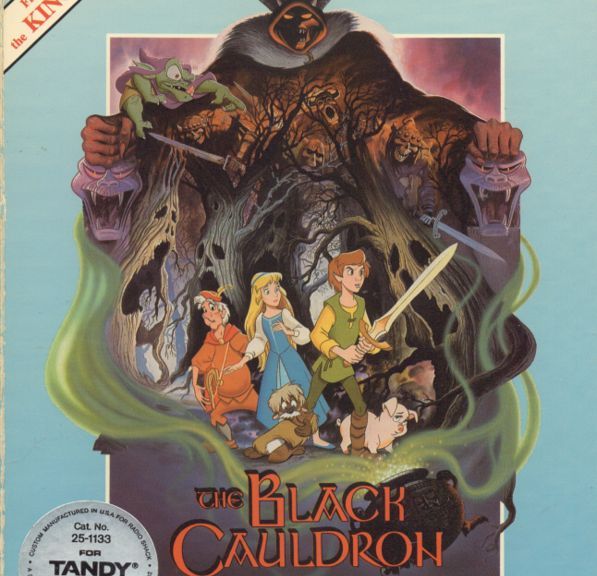
The Black Cauldron

Publisher: Sierra
Developer: Sierra
Year: 1986
Platform: DOS, Apple, Atari ST, Amiga

Rating: 3

On the heels of King’s Quest II, The Black Cauldron was one of the earlier Sierra titles using their Adventure Game Interpreter. And while it’s a much more richly realized game than the first two in the KQ series, this movie adaptation is oversimplified and suffers from many of the same pitfalls that make it a chore to play.

Continue reading The Black Cauldron

Phantasmagoria

Publisher: Sierra
Developer: Sierra
Year: 1995
Platform: DOS; Windows; Ma c; SEGA Saturn

Never before has Roberta Williams, or rather any game designer, integrated horror and humor to such monumental proportions. Of course, the humor derives itself from the George Lucas-type dialogue and poor acting, and much of the horror comes from the realization you had spent quite a bit of money to play this mess.

Continue reading Phantasmagoria

King’s Quest III: To Heir Is Human

Publisher: Sierra
Developer: Sierra
Year: 1986


Platform: DOS; Amiga

Sierra spent a little more time creating the third installment in the Daventry series and it shows. The increase in difficulty is quite welcome as well as a larger map and complex characters. To top it off, there is a plot. A plot that develops.

Continue reading King’s Quest III: To Heir Is Human

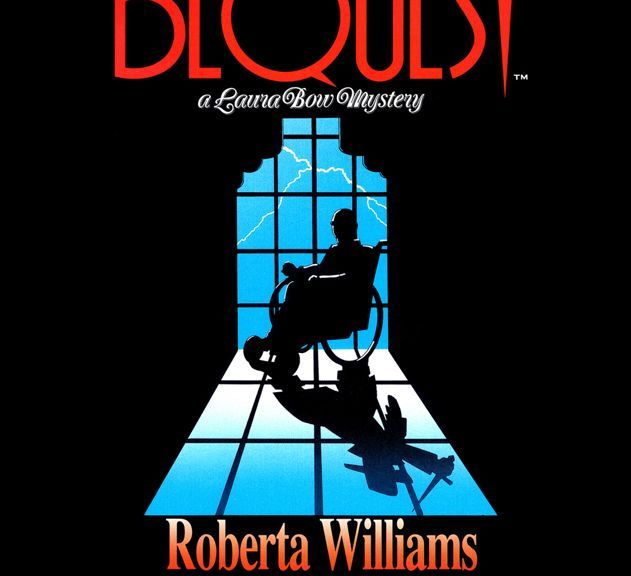
The Colonel’s Bequest

Publisher: Sierra
Developer: Sierra
Year: 1989
Platform: DOS; Amiga; Atari ST

Sadly, The Colonel’s Bequest is one of the best adventures Roberta Williams created. Returning to the roots she laid down in her first game, Mystery House, Roberta attempts to create a murder mystery that not only spooks but befuddles the player. It is befuddling, but not in the way Williams intended.

Continue reading The Colonel’s Bequest

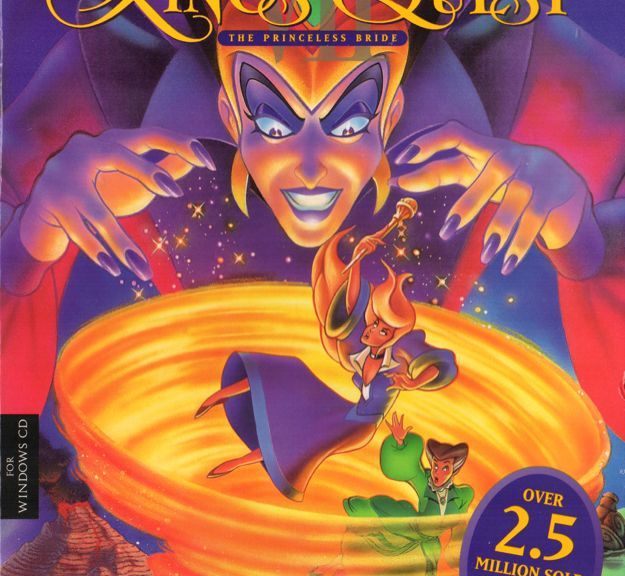
King’s Quest VII: The Princeless Bride

Publisher: Sierra
Developer: Sierra
Year: 1994
Platform: DOS, Windows, Mac

Rating: 1

Inigo Montoya: Do you hear that Fezzik? That is the sound of ultimate suffering.

Fezzik: From what?

Inigo Montoya: People playing “The Princeless Bride.”

Vizzini: Inconceivable!

While I adapted to the four-icon point’n’click style of adventure gaming, I longed for a change that was more intuitive while remaining challenging (much like the LucasArts catalogue). Well, once again Roberta Williams ushered in a new style of gaming with the single icon. The fucking thing lights up whenever you run the mouse over something important, removing virtually all the challenge and turning the game into an interactive movie. Since KQ7, some developers have been able to utilize a single icon and still make engrossing, challenging games. Not surprisingly, Roberta Williams failed spectacularly. Not surprisingly, the story is insipid.

Valanice is quite perturbed with her only daughter because Rosella has decided that marrying handsome hunks on the drop of a hat like her mother was so last plot line. Valanice taunts her daughter with stories of blind matronly love, while Rosella covers her ears and yells “Shut up! Shut up! Shut up!” But her mother does not comply, which drives Rosella to dive into an obviously dangerous whirlpool, most likely to commit suicide. Valanice, determined to bring back her daughter to the sophisticated world, dives in after her. Unfortunately for her, she gets dumped off in a desert, far away from the place Rosella winds up bemoaning, over and over and over, her new troll status.

Amazingly, the plot actually develops in this game.  Chapter by chapter, the player learns more objectives while maneuvering plot twists. It’s a shame that the material therein is a conglomeration of all the crap that’s ever been put into a computer game. The graphics consist of a poorly defined cartoon world with characters that are generally unpleasant to look at. Not only that, every sentient being is caricaturized to the point of skin-crawling pain, making the game devoid of the minimum amount of pathos necessary to give a shit. Puzzles range from incredibly easy to incredibly nauseating. There are even walking dead scenarios, which is ridiculous in a game that is otherwise insultingly easy. As for the sound, well, nothing memorable.

There are exactly three points during this game where I enjoyed myself:

1) The introduction, where Rosella tells her mother to bugger off.
2) The ending, and not just because the game was over.
3) The raven who spouts countless degrading insults at both Rosella and Valanice. I used some of them myself.

I was grateful the series was over after this game. Yes, there was a 3D action game that came a few years later utilizing the King’s Quest name, but the series death was already established.

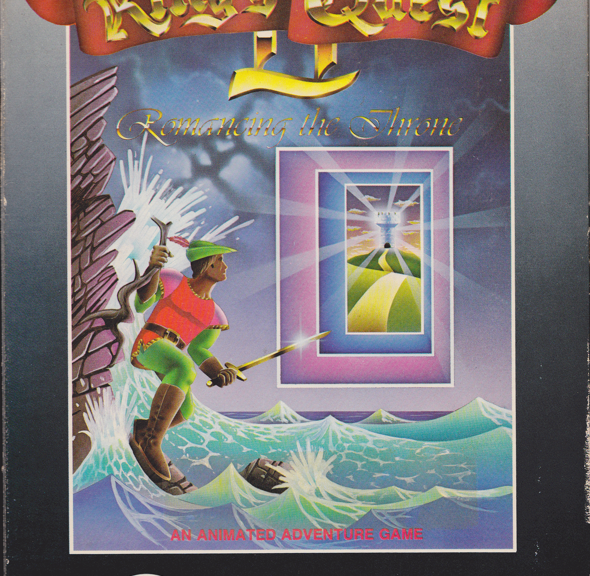
King’s Quest II: Romancing The Throne

Publisher: Sierra
Developer: Sierra
Year: 1985
Platform: DOS, Mac, Apple II, Amiga, Atari ST, PC Booter

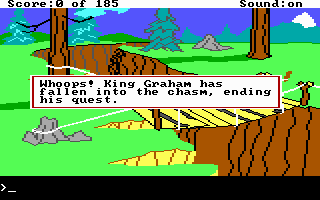
Second verse, same as the first. Only worse. King’s Quest II falls right into the “Hurry up and write a sequel by next Christmas” genre.

The only technical aspect improved upon from 1984’s King’s Quest is the brighter hues the time’s best 16 color RGB monitors could display. Otherwise, there is nothing particularly fascinating to gaze upon, except those highly accentuated items that no adventurer can resist taking, even if it is private property.

You are King Graham of Daventry, lonely, horny, and in need of a fair maiden to quench the fire in your loins. After many months of turning down every wench not suitable to your fine tastes, you yield to desperation and ask your trusty magic mirror to be your pimp. Thankfully, your mirror succeeds in finding you a delectable young morsel. Alas! She is locked inside of a castle by an obviously non-sentient being, likely using her only for selfish, unseemly acts of nature. While Graham begins fantasizing about his future quest, and pondering exactly how in God’s name he shall find this formidable castle, his body goes poof and rematerializes in a far away land. Now, you may ask, is this the land where the castle is erected? Of course not. Graham has been transported to a land where he must first hone his fine adventuring skills, finding three keys of various colors to unlock the doors necessary to reach the land where he can lay claim to the woman that will surely melt under the charisma bestowed within every member of the royalty of Daventry.

While the plot for Romancing the Throne is a little tighter than that of its predecessor, the ideas therein are rather humdrum. Most puzzles are of the lock & key variety, and are for the most part highly contrived. Several times, one puzzle cannot be completed until another one has, even though they bear no relation to one another. Like the first game, there are points to be won that are not necessary for the game’s completion; however, these extra points generally are rewarded for solving puzzles in a particular order (irrelevant to the game’s plot), or by disposing of enemies that may or may not present themselves depending on random events. And just like the first game in the series, there are more random enemies that make the PC speaker go berserk and test the integrity of your digestive system.

The one merit this game beholds is some sporadic humor. Look out for Batman and a plug for Space Quest. However, when the Easter eggs are more entertaining than the game itself, you have an idea of what you’re getting into. If you enjoyed King’s Quest: Quest for the Crown, you may enjoy the sequel. But Romancing The Throne has nothing to offer for most adventure gamers. Its saving grace is that it is probably the easiest of all the King’s Quest games, and can be won in less than a week by even the average adventurer.

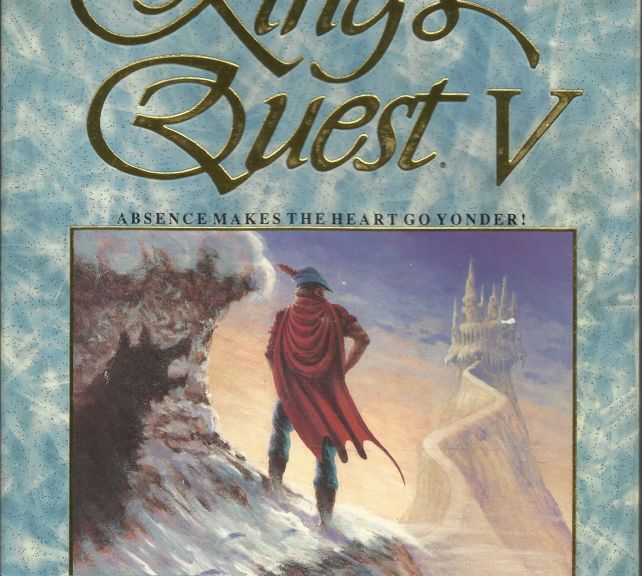
King’s Quest V: Absence Makes The Heart Go Yonder!

Publisher: Sierra
Developer:
Sierra
Year:
1990
Platform: 
DOS, Windows, Amiga, Mac, NES, FM Towns, PC-98

Possibly the first big-name adventure game to be on CD-ROM and completely eschew the need to use the keyboard, King’s Quest V spends way too much time focusing on its shiny new features, leaving the actual game to suffer immensely.

After a leisurely walk through Daventry, Graham returns home just in time to see the castle vanish before his eyes. A nearby owl–a talking one, natch–reinforces Graham’s despair by recounting the details of the tragedy. He then sends the king to go see the local benevolent wizard. A lengthy dialogue ensues where the Good wizard tells Graham that a Bad wizard (who is related to Mannanan from King’s Quest III), is out for revenge against the royal family. The Good wizard gives Graham the wand necessary to destroy the Bad wizard, and more or less leaves Graham to his own adventuring wits, which he will need to get anywhere near the Bad wizard. While the plot does help tie the series together a bit, it is in true Sierra fashion detailed in full before the player even touches the mouse. Seriously, there is virtually no plot development the entire game.

The point-and-click interface dumbs down play to merely finding the correct pixel or combining the right inventory items together. While this does relieve the player of parser ignorance, and the dreaded “You can’t do that” messages, many of the puzzles in KQ5 require inane logic, forcing the player to randomly click until the solution is found. Pixel-hunting creates even more “You are a pathetic imbecile” responses than ever, and solving puzzles by accident isn’t exactly satisfying.

The one thing this game does get right is the implementation of all the pretty features. The graphics are excellent, and were simply amazing in 1990 to those who were used to sixteen color games. The voice acting is mostly pleasant; however, whoever’s idea it was to create Cedric, Graham’s sidekick owl, should be given a medal by Satan, as I’m sure he uses Cedric to torture the damned.   Cedric follows Graham practically everywhere, is rarely helpful, and when he would be helpful, he is nowhere to be found. And if you want an idea as to what he sounds like, think of Jar-Jar Binks, only condescending.

But what really gives the game a black mark is the cruelest walking dead situation in history. While Leisure Suit Larry 2 had several cruel walking dead scenarios, they were aggravatingly funny in an Andy Kaufman sort of way. Not only is the situation here not funny, it is one working channel and there’s a marathon of King of Queens cruel. Either that, or an honest mistake that the shittiest beta-testers in history missed. There’s a spot in the game where a mouse is being chased by a cat. You must save this mouse by throwing a boot at said cat. Then, later in the game, the mouse will save you from an otherwise lethal predicament. But this event ONLY HAPPENS ONCE, and it happens so fast that if you turned away from the your computer for a few seconds, you would never know it happened! And if you don’t figure it out then, it isn’t even obvious later that you would need a mouse to save you. I know walking dead situations occur in nearly every adventure game before 1995 (heck, there’s even more in this game), but this one pissed me off more than any other. Having Cedric taunting me probably wasn’t helping.

Take all of the above annoyances and leave the player with a cliched and suddenly insultingly easy endgame, and you have a game you couldn’t pay me to play again.

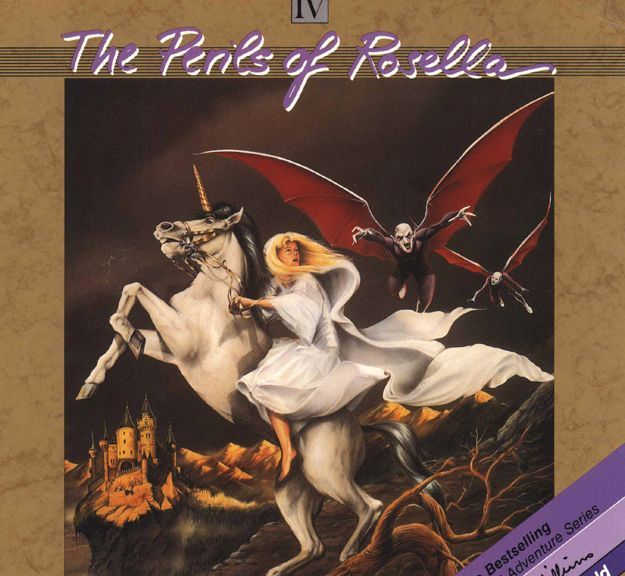
King’s Quest IV: The Perils of Rosella

Publisher: Sierra
Developer: Sierra
Year: 1988
Platform: DOS; Amiga; Apple II; Atari ST

Review: 1988 and 1989 were Sierra’s truly great years, and it all began with The Perils of Rosella. With the series’ fourth installment, Sierra revolutionized the gaming industry with professionally composed music, their new SCI game engine, the best parser they ever created, and an adventure worthy of the moniker.

King Graham is planning on passing his adventurer’s hat to the next of kin, but before Alexander and Rosella can fight over the rights to star in the next sequel, Graham lets everyone down and has a heart attack. While Graham is on his deathbed, Rosella runs out of the room in emotional anguish, only to have the magic mirror come to the rescue once more. Genessa, a good fairy from a faraway land, informs the hopeful Rosella that a magical fruit within her realm can save her father much like drinking water from the Holy Grail. Rosella says “Okay.” Genessa informs Rosella that because the producers needed to flesh out the game, she has been struck ill and does not have enough magic power remaining for a round trip; rather, there’s just enough left for a one stop shop. Rosella says, “Screw that!” Genessa informs Rosella that the evil fairy Lollotte has stolen her talisman, and if Rosella would be so kind enough to destroy the evil Lollotte and bring back her talisman, she just may continue to live, and would thus be able to send Rosella back home. Rosella says nothing. Genessa reminds Rosella of the incredible guilt she’d feel if she didn’t at least try. Rosella says, “Bloody hell!  I’m in!”

Okay, so maybe the introduction isn’t quite like that. I make light of it because Roberta Williams must let the player know the entire plot before the first chapter even begins, as she did in nearly every game she ever made.  At least it’s the only significant mistake she made here. In fact, the plot does veer slightly at various junctures. Rosella ends up needing to complete more quests than the one already outlined during the introduction. While the various plot lines are not connected very well, they do stand up on their own merits, and because the ride is fun you can forgive everything else. The characters (human and otherwise) you meet have good development considering you rarely interact with any of them for more than a couple minutes. The game has humor; I fondly remember reading all of the epitaphs in the cemetery. There are multiple endings, and creative ways you can die. To top it off, halfway through the game day turns into night, fleshing out more characters and allowing for more exploration, not to mention adding a few spooks.

Like the last game, time is a factor, as you must retrieve the talisman within 24 game hours. While that may seem like a short time, the game can be won much quicker than that if you know what to do. There’s a chance you may have to restart if you do enough aimless wandering, but if you make good use of the “save” and “restore” commands you shouldn’t have to worry too much. Some puzzles are difficult without being unfair. Mythology is used quite heavily but knowledge of the stories is neither required nor all that useful. There is one terrifyingly awful puzzle involving a whale’s tongue(!). Thankfully, it is not terribly difficult, although it’s a mite frustrating. At least Sierra was able to poke fun at this very puzzle in Leisure Suit Larry 3.

If you only play one game in the King’s Quest series, and you are not allergic to typing, make it The Perils of Rosella.

Contemporary RatingLow. The pointless time limit and some cheap falling deaths were annoying twenty years ago.

Cruelty RatingCruel. Not as cruel as other Sierra titles, but there is one way to lock yourself out of the good ending without realizing it. You might realize you did something wrong, but the game gives little indication.

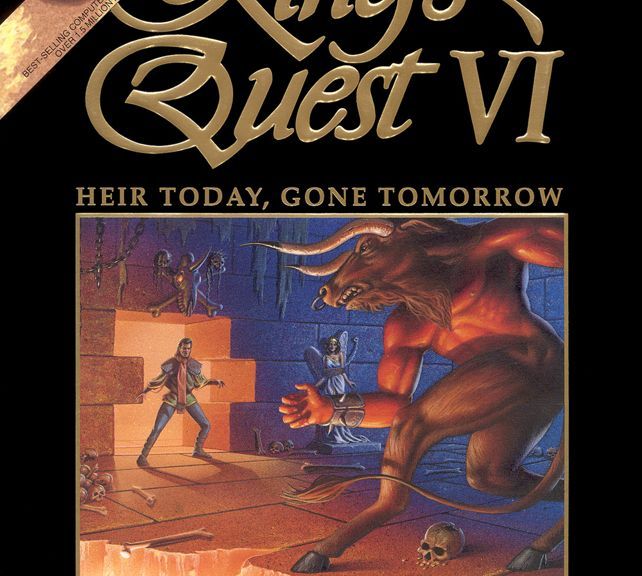
King’s Quest VI: Heir Today, Gone Tomorrow!

Publisher: Sierra
Developer: Sierra
Year: 1992
Platform: DOS, Windows, Amiga, Macintosh

Review: While a vast improvement over the previous installment, with a much longer, integrated plot and a much better use of mythology, the sixth installment still lacks in many basic areas that plague the King’s Quest series.  Thankfully, there’s enough that’s awesome here to make it worth playing.

Alexander, a very bored prince, is sulking in the throne room, something he learned quite well from his father. Roberta Williams digs into the plot device bag and pulls out the ol’ reliable Magic Mirror to get things started. And whadya know, Cassima, the lass King Graham helped save on his last adventure, appears in the mirror. She is trapped inside of a castle and expresses her longing for a man (a la Juliet).  While she never mentions him by name, Alexander assumes she is talking about himself. So, without asking his father’s permission or telling so much as his fairy godmother of his plans, Alexander takes off for the Land of the Green Isles, where Cassima is being held in solitude.

Wait a second. This sounds eerily familiar. Perhaps…yes, perhaps it’s because this is the exact same plot lifted from King’s Quest II: Romancing the Throne. Thankfully, Mrs. Williams must have realized her abysmal failure the first time around and decided to give it another shot.

The opening animation sequence is beautifully done. It also manages to be quite long without giving away the game’s plot in its entirety. The plot does move along during play, though barely, and during cut scenes like in King’s Quest IV: The Perils of Rosella. While not original, the King’s Quest series was never known for its plot. Rather, environment, mysticism, and puzzles (well, sometimes) helped sell the series. For the most part, they’re all here.

Yet I have a love/hate relationship with this game. I would have enjoyed it more with a typing interface. Then, some of the neat puzzles might have been hard. Unfortunately, many are very easy. Too many of the puzzles require “triggers” to activate them (breaking mimesis), and there is one very not obvious way to become walking dead for a very long time. If you don’t converse with a particular character at the beginning of the game, you will put the game in an unwinnable situation depending on which plot branch you take. Worse yet, you will not know you have done as such until the game is almost over. There is no excuse for such sloppy game design. Also, an extensive part of the game involving the Cliffs of Logic and the Catacombs is one huge copyright protection. The only way to solve the puzzles is to have the “Guidebook” that comes with the game. Instead of creating fun and intuitive puzzles, the designers simply became lazy.

On the bright side, most of the characters are developed well. The shopkeepers of the pawn shoppe and the library have captivating voices and wonderful personalities. In fact, everyone human that you meet is fun to interact with. However, many of the mythological and cartoon characters become rather annoying and have little pleasantness about them (except Hole in the Wall!). The main characters are so stereotypical that one wonders if Disney had a role in character development. Alexander will never do anything that is improper or not fit for a prince, unless of course he needs to do so to advance in his quest. And Cassima’s undying love for Alexander is groundless, but it does fit her undynamic personality. At least the corniness is good for a few chuckles.

The graphics are nothing spectacular and not much of an improvement over the last game in the series. Everything is very colorful, but much of it is too cartoonish. The sound effects are pretty good, however, and the end game song is a treat.

Most of the game is pleasant, and the advent of five unique islands to explore, a plot branch, and two endings with one giving you more points than the other (and a much longer, satisfying game) are great ideas and I applaud Sierra. Also, magic is used almost as extensively as it was in King’s Quest III: To Heir Is Human, an idea this series should have implemented more often.

Heir Today, Gone Tomorrow is a relatively easy adventure with poor plot development and some annoying puzzles.  So why do I like it so much? Perhaps it’s sentiment.  Perhaps because it’s predecessor was abominable.  Or perhaps it’s all of the charm.  And the things this game does well, it does really well.

Contemporary RatingMedium. Highly intuitive gameplay, but making an hour’s worth of puzzles a copyright protection is unforgivable.

Cruelty Rating:  Cruel. You can die frequently, and it’s not always obvious.  Only one walking dead situation, but it’s still very cruel.