Tag Archives: PC Adventure Games

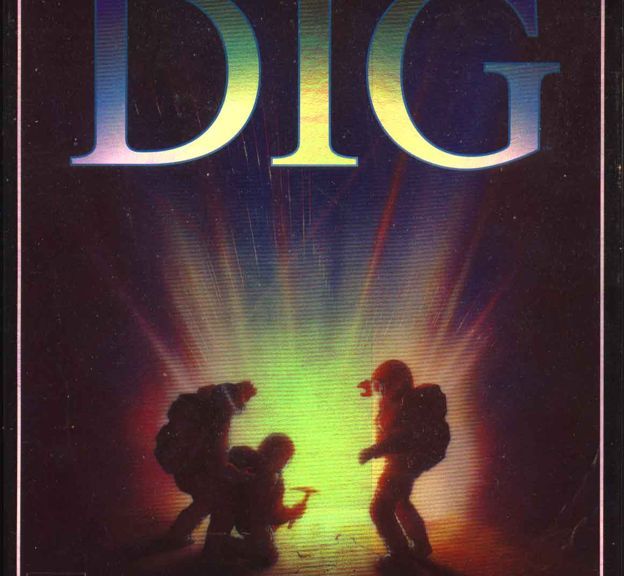
The Dig

Publisher: LucasArts
Developer: LucasArts
Year: 1995
Platform: DOS, Windows, Macintosh

Review: In 1989, Steven Spielberg pitched this story to his television series Amazing Stories, but learned the production costs would be too high, so he gave it to LucasArts (then LucasFilm Games). It went through several rewrites and had Orson Scott Card (from Monkey Island and Ender’s Game) and Brian Moriarty (who wrote Wishbringer and Trinity for Infocom as well as Loom for LucasArts), before settling on Sean Clark, who had created the successful Sam & Max Hit The Road. With this kind of development, there had been extraordinary expectations on the final result, and when it didn’t reach those expectations, it tanked.  The Dig is widely considered the worst game in LucasArts’ ca8talog.

I, however, am not in that camp. The story, while not exactly original, is well developed. An asteroid is heading for earth and commander Boston Lowe (played by you), reporter Maggie Robbins, and archaeologist Ludger Brink are in charge of detonating nuclear explosives on the surface to change the asteroid’s orbit, thus making it another moon (a little more realistic than the plot of Armageddon). That’s just the game’s introduction, as inside the asteroid your team discovers something so extraordinary that they wish they had just headed for home after completing their mission.

Without giving away more of the plot, the game has heavy doses of science-fiction and is a change of pace from LucasArts’ humorous tongue-in-cheek plots.  However, this should still be enjoyable for the average gamer, as very few of the puzzles are difficult or frustrating, allowing the story to take precedence. There are a few plot twists; while some are obvious, they are engaging nonetheless. And there is still plenty of humor, especially when Lowe begins talking to himself.  I laughed out loud on more than one occasion.

Where the game runs into trouble is character development. All three run cliché for all its worth, and many of their motivations are just plain silly. Worse yet, the dialogue is so awful that one wonders if George Lucas actually had a hand in the scripting himself.  The actors give it their best, including rookie Robert Patrick of Terminator 2 fame, but they can’t overcome the juvenile writing.

Still, I enjoyed the experience throughout, thanks in part to beautiful graphics and one of the best soundtracks in video game history. I was ready to rank this game at the upper echelon of my collection until the resolution, which may be one of the most disappointing in video game history. There have been worse endings, but none so unbelievably bland in comparison to the material that precedes it. Yet, I would recommend it to adventure game aficionados, as there is much to take from the game.

Contemporary Rating: High.  A few obtuse puzzles is all that that would inhibit the modern gamer, but by that time, if you’re into the game, they wouldn’t matter.

Cruelty Rating:  Merciful.  The game won’t let you do dumb things.

Dark Fall: The Journal

Publisher: The Adventure Company
Developer: XXv Productions
Year: 2003
Platform: Windows

Review: Produced seemingly out of nowhere, Dark Fall is the labour of love from Jonathan Boakes, a British game designer who finally struck it big with this offering. And the returns were well deserved. Despite having limited resources to create it, Boakes stretched the limits of his game engine to create a highly atmospheric mystery.

After receiving a desperate call from your brother, you take a train into Dorset, England. He has been working on plans to redevelop an abandoned hotel and train station, and just as was suspected happened here seventy years ago, he along with some local ghost hunters have gone missing. Unraveling the mystery is your obvious goal, but enjoying the atmosphere is most of the fun. There’s something to be said about a game that can be won in about seven minutes if you know what to do, but can take hours upon hours of note-taking and puzzle deduction to arrive to the conclusion.

The hotel and train station are exquisitely detailed with a plethora of historical pictures, posters, and hand-written notes to really plunge the player into the 1940s. Everywhere you turn there is an added touch to really make the hotel come to life. Though there is not one character you interact with throughout the game, you feel like you truly get to know about a dozen people simply by seeing their rooms and evidence of their existence. And as movement and the limited inventory puzzles are quite intuitive, the atmosphere can be enjoyed without too much frustration.

Of course, the game is highly touted for being scary, which is also its major draw. Personally, I found the isolation, graphics and simple sound effects quite effective at producing chills, especially when played with the lights out. However, nearly all of this effect was excised when I discovered that there is no way to die. I realize that striking an effective balance between a risk-free environment and the instant-death room games of yore is tough, but for a game to truly be considered horror there has to be something to fear. If there is no way to make a mistake, then nuances which may originally be considered frightening are reduced to mere intrigue.

I would still recommend this game to those who like exploration and investigation. A few puzzles are a bit esoteric and recall the true horrors of Myst, but most are fairly intuitive and logical. And with many optional touches, such as using an Ouija board and solving some old cryptograms, Dark Fall has a lot to offer puzzle enthusiasts. Just don’t expect to lose any sleep over it.

Contemporary RatingHigh. Impressively intuitive from an independent designer.

Cruelty Rating:  Merciful.  No risk to be had in this horror game.

The Curse of Monkey Island

Publisher: LucasArts
Developer: LucasArts
Year: 1997
Platform: Windows

Review: With Ron Gilbert gone, the Monkey Island series veers slightly in tone and design, but manages to maintain an excellent example of adventure gaming. The pixelated backgrounds have been replaced by hand-drawn cartoon graphics, and Guybrush Threepwood’s personality has gone from “fish out of water” to “dumb and clumsy.” He’s also been given a voice to match. And all the changes work because the game matches the changes.

After saving Elaine from death at the hands of once-again revived Captain LeChuck, Guybrush proposes to his love, accidentally giving her a cursed ring, turning her to stone. The plot gives way to the puzzles as Guybrush tackles one after another. But unlike in Monkey Island II: LeChuck’s Revenge, it works here. For one, the plot does pop up more frequently, but more importantly, the puzzles aren’t so freaking obtuse. They’re goofy and irreverent, sure, but for the most part don’t take giant leaps of logic to figure out. That isn’t to say the game is a cakewalk. Several of the puzzles are difficult but certainly fair.

I also found myself laughing quite a bit, especially at Murray, the talking skull. Even though I didn’t prefer the series’ personality shift (including the Hollywood ending), The Curse of Monkey Island remains entertaining throughout. Fans of the series shouldn’t be too disappointed.

Contemporary RatingHigh. Flawlessly designed, never really frustrating.

Cruelty Rating:  Merciful.  It’s a LucasArts game!

Nord and Bert Couldn’t Make Head or Tail Of It

Publisher: Infocom
Developer: Infocom
Year: 1987
Platform: DOS, Macintosh, Commodore 64, Apple II, Amiga, Atari ST

Have you ever wanted to get a nice juicy steak, but all you had was a stake?  Have you ever wanted to literally kill two birds with one stone?  Or have you come across a pretty girl and it made you long for a gritty pearl?  Then you should definitely help out Nord and Bert, because they truly can’t make hails or teds of it.  Wait, um…

This adventure has you playing with homonyms, spoonerisms, idioms, and other plays on our language and culture in order to help save the town of Punster from total chaos.  There’s a story, but it’s there to serve the puzzles.  Just dig in and get your lexicon dirty.

The game designers smartly realized that most gamers would not be intimately familiar with every phrase, idiom, and slang the game is riddled with; thus an in-game hint system is a welcome sight. Despite the occasional frustration that ignorance creates while playing, the game can be funny and very satisfying when you do advance on your own intellect. Nord & Bert is a must-play for those who love word puzzles. Hardcore adventurers may want to look elsewhere.

Contemporary RatingHigh. If you figure out the answer to a puzzle, the parser is not going to get in the way.

Cruelty Rating:  Tough.  While you can get rid of an item you need and the game won’t tell you you’re stuck, you’ll figure it out pretty quickly.  Also, the game is short enough that even if you screw up it’s not really frustrating.

The Pandora Directive

Publisher: Access Software
Developer: Access Software
Year: 1996
Platform: DOS, Windows, Macintosh

Review: The fourth installment in the lauded Tex Murphy series, The Pandora Directive takes a huge step forward in nearly every facet. While using the same engine and basic controls of Under A Killing Moon, most of the problems have been rectified to create a truly enjoyable experience. This time, Tex is once again broke and desperate for any case. He gets one when an old friend of scientist Thomas Malloy drops by the diner and asks Tex to locate him. What follows is an epic cat and mouse chase through California and South America, not only to find Dr. Malloy, but the secrets he carries.

While there remains several contrivances throughout the game, the plot is tighter and simply more interesting than that of the last game. There are fewer puzzles that involve goose-chases, which helps maintain interest. But the best addition to the plot is a dynamic scoring system that changes the story as you proceed. There are three main paths throughout the game depending on how you treat the people you cross. You can take the high road, treating your friends and enemies with dignity and respect, take the middle road by taking some shortcuts, or take the low road by being arrogant and despicable. The story can veer based on the choices you select when talking with people or actions you make when you have the opportunity to take advantage of someone. Each path has some puzzles and videos of its own, making replay an actual treat instead of a mindless chore. All in all, there are six possible endings, and a few of them can only be seen if Tex has taken a certain path.

Also improved significantly is the acting. Chris Jones remains adequate, if unmemorable, as the Bogart-like protagonist who narrates his own adventure. Barry Corbin (Northern Exposure) is over the top as a bad guy, but he’s still entertaining. Tanya Roberts (That 70’s Show), Razzie nominee recipient, is decent as a sexy adversary. And Kevin McCarthy (Death Of A Salesman) is excellent as Malloy’s friend. Heck, Suzanne Barnes even improves as Chelsea, Tex’s love interest. Nobody grates on the nerves which goes a long way to making the game enjoyable.

In fact, your enjoyment of the game will largely depend on your patience with the first-person maneuvering through pre-rendered scenes (and blue-screened actors). Like the last game, it can be clunky at first, but eventually becomes second nature. And there are plenty of shortcuts one can use to keep from walking the same streets over and over. The stealth missions are more frequent and more intense, making good use of the game’s engine. Frustratingly, many objects hide in very hard to see places as you kneel and turn your head to find them. At least Jones, recognizing that a game dependent on atmosphere shouldn’t slow down for long, included an on-line hint system to help you through the tough puzzles (at the cost of points). Furthermore, if you want to skip half the puzzles and just enjoy the plot, you can play without them.

If you liked Under A Killing Moon, you will undoubtedly love The Pandora Directive. You don’t need to have played the former first to understand what’s going on, but you may enjoy the plot even more if you do.

Contemporary RatingLow. Early 3-D rendering and clunky controls would irritate today’s gamers, not to mention the pixel-hunting.

Cruelty Rating:  Polite.  There are many ways to bite the bullet, but dangerous situations are apparent.  I found no way to get stuck.

Maniac Mansion: Day of the Tentacle

Publisher: LucasArts
Developer: LucasArts
Year: 1993
Platform: DOS, Amiga, Atari ST, Apple II, Macintosh

ReviewMovie sequels often don’t do as well as the original. The ideas generally aren’t as fresh and those involved can afford to rest on their laurels, their audience almost guaranteed. This is not true with computer games.  In fact, the opposite is almost true. From Leisure Suit Larry to Police Quest to Half-Life, designers and programmers often work even harder on the sequels, using updated technology while listening to user concerns about the first game in building a better product. The greatest example of this is the sequel to Maniac Mansion.  It didn’t hurt that they brought Tim Schafer in on the project.

All the primary characters return for this installment, including Dr. Fred Edison, his wife Edna, Weird Ed, and Dead Cousin Ted. However, the plot is driven by Purple Tentacle, who drinks some sludge from the river, transforming himself into an evil, power-hungry dictator. The good doctor, realizing that he is unstoppable in the present, attempts to send Bernard and his two friends back in time to turn off the sludge machine before Purple Tentacle drinks from it.  Naturally, the time machine fails, sending Hoagie to the past, Laverne to the future, and Bernard right back in the present.  From here you must try to do things in all three time periods to stop purple tentacle and his tentacle minions, all while getting your friends back to the present day. 

While there really is no room for plot development, there are cut scenes that show how Purple Tentacle takes over the world in the future, and they are pretty comical. However, the gist of the game is puzzles, and there is a whole truckload. While many of them are wacky, they generally makes sense and only requires leaps of logic in a few minor cases. What makes them more interesting than your everyday adventure is that you control all three characters, and must help each other with solving puzzles. Despite the fact you are across three time zones, there is a mechanism which allows you to exchange items with one another. Some puzzles are solved by playing with temporal mechanics, thus requiring multiple-step solutions as you witness a task in one time period affecting another. Additionally, some items are used more than once, providing more challenge than normal. 

My only real complaint is all the walking back and forth you have to do as you fetch items from your friends, especially late in the game. It never becomes ridiculous, but it annoyed me enough to drop the game in my rankings a bit. But there are obvious reasons that Day of the Tentacle is often makes top ten lists; it’s production is nearly flawless, and it’s pretty funny, to boot. I would have preferred more substance, and a sharper wit, but those are just subjective observations that will vary from player to player. Whatever your taste, it would be hard not to give this one a recommendation.  What I do know is if you liked Maniac Mansion, you will love this game. I hated Maniac Mansion, and I still love this game.

Contemporary RatingHigh. One of the oldest games that remains highly intuitive today.

Cruelty Rating:  Merciful.  No way to die or screw up.  Only reason to save is if you quit or you’re worried about the power going out.

King’s Quest VI: Heir Today, Gone Tomorrow!

Publisher: Sierra
Developer: Sierra
Year: 1992
Platform: DOS, Windows, Amiga, Macintosh

Review: While a vast improvement over the previous installment, with a much longer, integrated plot and a much better use of mythology, the sixth installment still lacks in many basic areas that plague the King’s Quest series.  Thankfully, there’s enough that’s awesome here to make it worth playing.

Alexander, a very bored prince, is sulking in the throne room, something he learned quite well from his father. Roberta Williams digs into the plot device bag and pulls out the ol’ reliable Magic Mirror to get things started. And whadya know, Cassima, the lass King Graham helped save on his last adventure, appears in the mirror. She is trapped inside of a castle and expresses her longing for a man (a la Juliet).  While she never mentions him by name, Alexander assumes she is talking about himself. So, without asking his father’s permission or telling so much as his fairy godmother of his plans, Alexander takes off for the Land of the Green Isles, where Cassima is being held in solitude.

Wait a second. This sounds eerily familiar. Perhaps…yes, perhaps it’s because this is the exact same plot lifted from King’s Quest II: Romancing the Throne. Thankfully, Mrs. Williams must have realized her abysmal failure the first time around and decided to give it another shot.

The opening animation sequence is beautifully done. It also manages to be quite long without giving away the game’s plot in its entirety. The plot does move along during play, though barely, and during cut scenes like in King’s Quest IV: The Perils of Rosella. While not original, the King’s Quest series was never known for its plot. Rather, environment, mysticism, and puzzles (well, sometimes) helped sell the series. For the most part, they’re all here.

Yet I have a love/hate relationship with this game. I would have enjoyed it more with a typing interface. Then, some of the neat puzzles might have been hard. Unfortunately, many are very easy. Too many of the puzzles require “triggers” to activate them (breaking mimesis), and there is one very not obvious way to become walking dead for a very long time. If you don’t converse with a particular character at the beginning of the game, you will put the game in an unwinnable situation depending on which plot branch you take. Worse yet, you will not know you have done as such until the game is almost over. There is no excuse for such sloppy game design. Also, an extensive part of the game involving the Cliffs of Logic and the Catacombs is one huge copyright protection. The only way to solve the puzzles is to have the “Guidebook” that comes with the game. Instead of creating fun and intuitive puzzles, the designers simply became lazy.

On the bright side, most of the characters are developed well. The shopkeepers of the pawn shoppe and the library have captivating voices and wonderful personalities. In fact, everyone human that you meet is fun to interact with. However, many of the mythological and cartoon characters become rather annoying and have little pleasantness about them (except Hole in the Wall!). The main characters are so stereotypical that one wonders if Disney had a role in character development. Alexander will never do anything that is improper or not fit for a prince, unless of course he needs to do so to advance in his quest. And Cassima’s undying love for Alexander is groundless, but it does fit her undynamic personality. At least the corniness is good for a few chuckles.

The graphics are nothing spectacular and not much of an improvement over the last game in the series. Everything is very colorful, but much of it is too cartoonish. The sound effects are pretty good, however, and the end game song is a treat.

Most of the game is pleasant, and the advent of five unique islands to explore, a plot branch, and two endings with one giving you more points than the other (and a much longer, satisfying game) are great ideas and I applaud Sierra. Also, magic is used almost as extensively as it was in King’s Quest III: To Heir Is Human, an idea this series should have implemented more often.

Heir Today, Gone Tomorrow is a relatively easy adventure with poor plot development and some annoying puzzles.  So why do I like it so much? Perhaps it’s sentiment.  Perhaps because it’s predecessor was abominable.  Or perhaps it’s all of the charm.  And the things this game does well, it does really well.

Contemporary RatingMedium. Highly intuitive gameplay, but making an hour’s worth of puzzles a copyright protection is unforgivable.

Cruelty Rating:  Cruel. You can die frequently, and it’s not always obvious.  Only one walking dead situation, but it’s still very cruel.

Phantasmagoria: A Puzzle of Flesh

Publisher: Sierra
Developer: Sierra
Year: 1996
Platform: DOS, Windows

Review: About the only thing that the second installment of this “series” has in common with the original is full motion video.. Otherwise, near everything else, including the writer, director, actors, and genre have changed.

Exit Roberta Williams, enter Lorelei Shannon. Both were involved directly in the making of King’s Quest 7, one of the worst adventure games of all time. I have forgiven Lorelei after doing this project.

Unlike the first game, this is not horror. Shannon’s script has some tense moments, and there’s plenty of gore, but Puzzle of Flesh is more of a sci-fi thriller. And the tense moments that exist become so predictable that they could hardly cause a fright. What this script does have that its predecessor does not is an original plot and character development. During the game the player gets a good feel for nearly a dozen characters.

Curtis Craig, played by Paul Morgan Stetler, is the protagonist, an attractive single introvert who works in a cubicle for a pharmaceutical company as an editor. He’s at the low end of the totem-pole but appears content with his simple life. He’s dating one of his co-workers, but his true love is his pet rat Blob. No one really knows much about him; in fact, Curtis doesn’t know that much about himself either. Of course, some really bizarre, seemingly supernatural things begin happening to Curtis and those around him and he spends the entire game trying to figure out who, or what, is behind these events. Flashbacks are used extensively, giving Craig and the player information, little by little, about what might be going on.

Stetler is fantastic. He rarely overacts, and his non-verbal reactions are often right on target. His gay friend Trevor, played by Paul Mitri, is also very good. He makes a good contrast to Stetler’s character, and his acting appears very natural when he’s being funny (and junior high-like when he’s asked to do drama). Monique Parent, Cinemax soft-porn star, has a similar role here and does well enough for that role. Most of the supporting actors are sufficient, especially Michael Taylor Donovan as Stetler’s supervisor.

The real standout is Ragna Sigrun, who spends most of the game trying to seduce Stetler. Her range is evident throughout, and like Stetler, I found myself unwillingly attracted to her immediately.

The game’s main faults lie within the nature of the beast of FMV games. Continuity is very difficult to achieve, as the switch from still screens to video sequences tends to break atmosphere. Also, characters oftentimes seem to react inappropriately in situations because the player decided to do things in a slightly different order than the author had intended. Ultimately, though, there is very little freedom, as the days do not progress unless the character triggers certain events. Mimesis is broken quite often.

And the plot does have several holes. However, they are minor enough that they will probably not be annoying if you find the script material interesting. I did, so I turned my brain off at times to enjoy the ride. My main gripe is with the end sequence, as it is overlong and requires the player to figure out a puzzle, seemingly for puzzle’s sake. All remnants of pace and tension are wiped out, and as the game ended, I was glad. The last thing I want in a game is to be glad it’s over.  However, I did appreciate the multiple endings.

This game is not for kids. It may not even be suitable for teenagers. Even with the censors on, the heavy adult themes present may be too much for some to handle. A significant portion of the game revolves around S&M, gender identity issues, and child abuse.  Throw on top of that murder, several sex scenes, and lots of blood, and you got something the whole family can enjoy!

Like the first game, it is very short and pretty easy. It took me two days, but I enjoyed myself most of the time. A game like this should probably be short, as the emphasis is on the interactive movie experience and not puzzles. Just put yourself in a dark room and escape from reality for a few hours, much like a good movie.

3230304-phantasmagoria-a-puzzle-of-flesh-windows-replying-to-emails-is-a

Contemporary RatingMedium. A little too much tedium at times, the story not advancing until you click everything that can be clicked.

Cruelty Rating:  Polite. A few points where you can die, but you’ll be saving regularly anyway.

Sam & Max Hit the Road

Publisher: LucasArts
Developer: LucasArts
Year: 1993
Platform: DOS, Windows, Macintosh

Review: A couple of the more popular heroes in the history of adventure games, Sam & Max, freelance police, spawned many rabid fans and eventually their own morning cartoon (that won an award, no less). Sam is a well-dressed, sarcastic canine that was pulled straight out of 40’s noir. Max is crude, narcissistic, and a self-proclaimed violent lagomorph. And they’re both dedicated to solving their client’s plights, as long as there is substantial monetary gain to be made.

The premise is yet another bulls-eye for LucasArts, and is apparent from the opening sequence, where Sam and Max rescue a damsel in distress from a mad scientist, by the simplest method available, a thorough butt-kicking. Shortly after, they make the following discovery:

Max: He’s not a real guy, Sam! Can I keep his head for a souvenir? Why do you suppose its ticking?
Sam: That’s no head, Max! It’s one damned ugly time bomb! Let’s leave this criminal cesspool pronto!
Max: Good idea, Sam. Maybe we can ditch the head somewhere while the credits are running. Mind if I drive?
Sam: Not if you don’t mind me clawing at the dash and shrieking like a cheerleader.

The exchange would be funny enough in an episode of Police Squad, but is classic coming from these furry creatures. Further, after the credits sequence finishes:

Sam: Well, that was a pleasantly understated credits sequence.
Max: I enjoyed the cheesy retro ambiance.
Sam: What the hell are you talking about, Max?

This self-awareness remains throughout the adventure, with Sam and Max making comments to the player and to the game designers. In fact, how you feel about the game will rely heavily on your taste in humor, as you will be barraged with one joke after another, some subtle, some crass, and some intentionally lame.

As for the game itself, the plot is quite bizarre. Your case directs you to find a missing “Bigfoot” and a giraffe-necked girl that were kidnapped from a carnival by country-western star Conroy Bumpus. You’ll visit several quirky tourist traps, some based on real places, like the World’s Largest Ball of Twine in Minnesota, with exaggerated effect. The characters you meet are mostly human caricatures intended to dig at pop culture, country music, and Western civilization in general. The interface itself is point-and-click and very intuitive. The graphics are sharply detailed, and the soundtrack is adequate. There are no dead ends, timed puzzles, or other such annoyances for the beginning gamer. And the voice actors for Sam and Max are excellent, with the supporting case up to the task, including a Bigfoot who has seen too many James Stewart flicks.

9526361-sam-max-hit-the-road-dos-outside-of-the-office-anything-can-happ

The puzzles are inventory-based, and few are of the lock and key variety. While you play the game as Sam, Max tags along causing trouble over the screen, but you can use him as an inventory item to solve any number of puzzles!  They usually involve gratuitously disgusting or violent acts, but not always. While nearly all of the puzzles are unique, they unfortunately require leaps of logic from the player on more than one occasion. They aren’t terrible, but slowed down the pace of the game considerably for me, which is the last thing I want in a comedy.

As typical for LucasArts, there are several amusing mini-games to play(including an entertaining variation of Battleship), Lucas films are spoofed (with a hilarious puzzle from Raiders Of The Lost Ark), and a few Easter eggs are present. I enjoyed many parts of Sam and Max, but was not satisfied on the whole. The characters seem more suited for a PG-13 or an R-rated audience, but their humour is necessarily toned down for the PG audience it was also aimed at. And while I laughed out loud a good half-dozen times, I feel as though their potential was never realized.

Thankfully, Sam & Max’s adventures didn’t end here.  They have three whole new adventures thanks to Telltale Games.  If I finished those, I am sure all three would hit the top fifty.  But despite enjoying them immensely, I sadly haven’t found the time to finish any of them.

9526325-sam-max-hit-the-road-dos-max-can-be-very-eloquent-sometimes-and-

Contemporary RatingHigh. While some of the puzzles are unfairly difficult, a quick trip to an on-line walk-through should eliminate most of the frustration.

Cruelty Rating:  Merciful. Like with most LucasArts games, you can’t even die, let alone get stuck.

The Beast Within: A Gabriel Knight Mystery

Publisher: Sierra
Developer: Sierra
Year: 1995
Platform: DOS, Windows, Macintosh

Review: Sierra took a risk by taking a successful game (Gabriel Knight: Sins of the Fathers) and completely changing the interface for its sequel. The second game in the Gabriel Knight series is strictly full-motion video, with real actors attempting to bring the story to life. Compared to other FMV games, The Beast Within is a rip-roaring success; but the nature of the beast unnecessarily hurts the series.

This time, the game takes place entirely in Germany. The local town is need of Gabriel’s “powers” to help rid themselves of what they believe are werewolves. As he is once again experiencing writer’s block (after his successful book based on the last game!), Gabriel reluctantly agrees. What follows is a six-chapter series that slowly dishes out an engaging plot, only a little more predictably than before. This time around, the player alternates between playing Gabriel and Grace (his employee from the first game), as they both must research the problem and risk their lives to fulfill their destinies.

The game is fairly easy, with a faithful dose of hotspot clicking to advance the plot. However, there are still many inventory puzzles, and quite a few are entertaining to solve, including one that involves splicing tape recordings. What really holds the game back is the same problem with its predecessor, multiplied threefold. At more than one occasion, Grace must nail every hotspot in a handful of rooms, merely for information gathering, with no indication that it is necessary.

The other disappointment, frankly, is the acting, especially that of the two main characters. In Sins Of The Fathers, Gabriel was a hunk and a cocky sonofabitch, with layers of depth and sensitivity buried underneath the tough exterior. Here, he is pretty much a wuss, and not at all attractive. Grace is not any better, overreacting to nearly every situation while being passive-aggressive with everyone she meets (again, unlike the previous game, where Grace is cool, with a cutting wit). Thankfully, the supporting cast puts in top-notch performances, especially Peter LucasWolf Muser, and Fredrich Solms.

While the writing at times leaves a bit to be desired (including humor, which is almost non-existent), the story and characters are enough to draw the player in through to the end, which like the previous game, is well-developed and thoroughly intense. The only major beef I had with the plot was that even though I discovered who the antagonist was well before game’s end, I couldn’t do anything about it because Gabriel didn’t know (and he should have). Instead of simply implementing mutliple endings and/or plot branches, I was squeezed through a painfully linear endgame.  Thankfully, the final puzzle is pretty damn good, leading to a satisfying ending.

Overall, this game was a success, widely considered the adventure game of the year. It is a worthy play, but probably only to fans of the series.

Contemporary Rating: Medium. Very easy to play, but the insane amount of pixel-hunting at times would drive modern gamers batty.

Cruelty Rating:  Polite. There are a couple of situations where you can die and must save before hand just in case, but the situations are very obvious.